




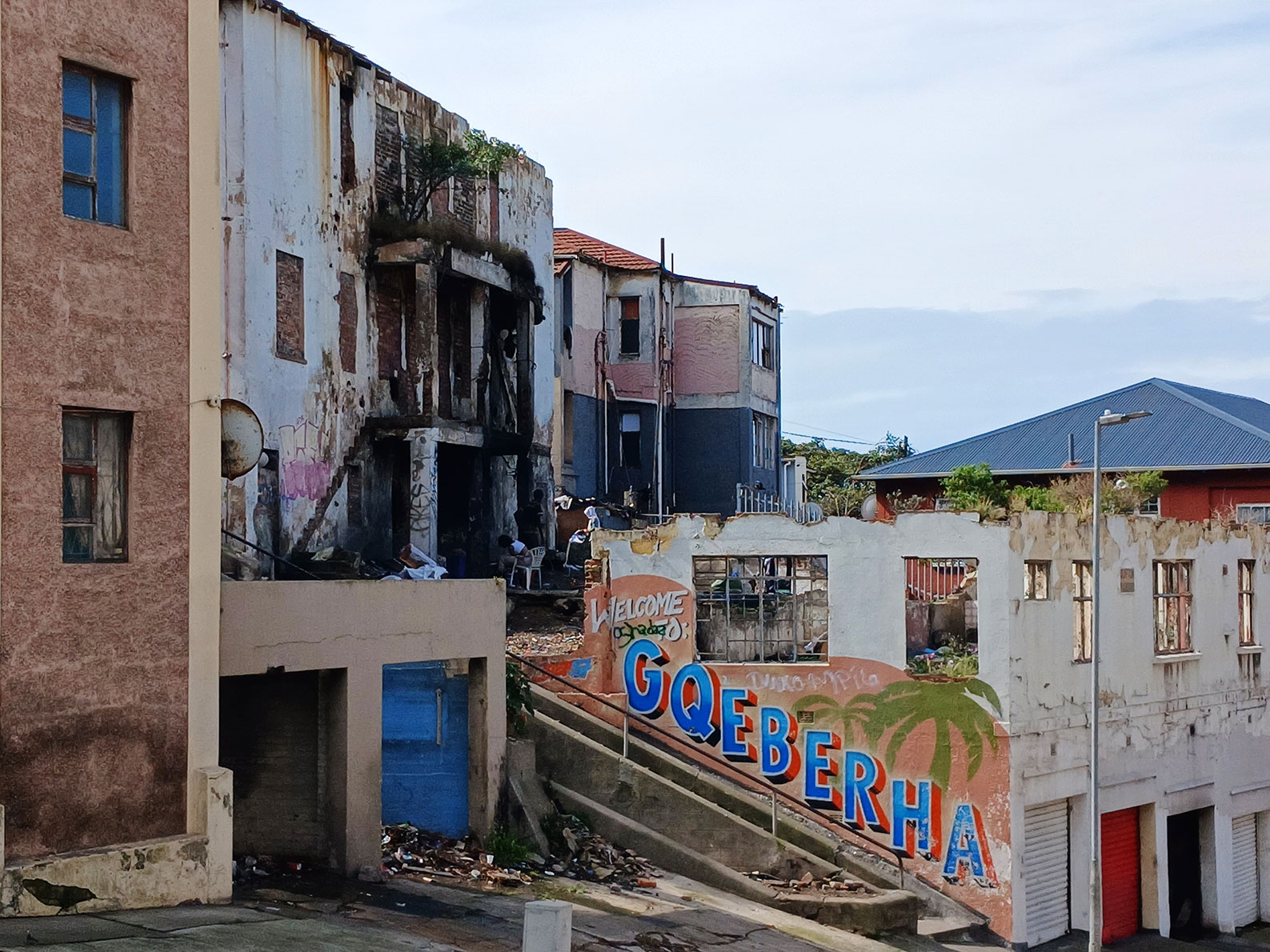
 Abandoned buildings in Nelson Mandela Bay, where residents face steep rate increases when the metro’s revised budget is passed. (Photo: Riaan Marais)
The Nelson Mandela Bay metro’s initial budget, presented to the National Treasury on 18 May, was unfunded and sent back for the metro to cut costs, including international travel and the Assistance to the Poor programme.
With dwindling collection rates, sky-high electricity and water losses and pressure to increase the price of basic services, the budget report makes for grim reading.
The council will debate the revised budget on Thursday, June 4. Once approved, the new tariffs for water, electricity, and other services will take effect on 1 July. Current projections are that residents will face steep rate increases.
Out of time
The budget was delayed because the Treasury rejected the initial draft as unfunded. Under the Municipal Finance Management Act (MFMA), budgets must be approved 30 days before the new financial year begins and must rely strictly on realistic revenue projections, cash reserves, or capital project loans. Because the original draft failed to meet these funding requirements, it could not be recommended to the council for approval.
/file/attachments/orphans/ED_512819_542327.jpg "Nelson Mandela Bay Mayor Babalwa Lobishe (Photo: Lulama Zenzile / Gallo Images / Die Burger)")
According to the budget report, the Treasury held a meeting “to assess the funding status of the noted budget (i.e. 2026/27 to 2028/29). When National Treasury applied their systematic tool in gauging the funding position of the budget, it became apparent that the budget was unfunded and therefore could not be placed before the council to recommend its approval.
“National Treasury repeatedly advised the municipal delegation that our Assistance to the Poor (ATTP) subsidisation scheme remains the highest in the country in terms of the kilowatts of electricity and kilolitres of water that we subsidise our indigent households with.
“They urged that this matter be re-looked and reversed as the municipality is experiencing financial strain. One of the most critical areas that has caused this dilemma is the status of the average collection rate.”
The Treasury also recommended that the council limit its international travel expenditure and revise its overtime policy.
The budget that has now been presented to the council is funded, but was presented out of time.
Municipal response
Metro spokesperson Sithembiso Soyaya said the municipality was “committed” to complying fully with legal requirements and Treasury processes.
“It is important to clarify that the municipal council considered and noted the proposed 2026/27 Medium-Term Revenue and Expenditure Framework Budget and Integrated Development Plan at a special council meeting held on 29 May 2026, in line with the legislative requirements governing the municipal budget process.”
He said that while the deadline was 31 May, the MFMA provides mechanisms for municipalities to address situations where a budget has not yet been approved by the council before the start of the financial year, which is 1 July.
“The municipality is actively following the legislative processes prescribed by the MFMA and is engaging the relevant oversight authorities in accordance with the Act. The provisions requiring immediate reporting to the MEC and potential provincial intervention only become operative should a municipality fail to approve its budget by the commencement of the new financial year,” said Soyaya.
/file/attachments/orphans/Image3_822522.jpg "A picket organised by the Nelson Mandela Bay Civil Society Coalition on 28 May demanded better service delivery and good governance. (Photo: Deon Ferreira)</p>
<p>")
Rates increases
These are the proposed increases in the budget that will be debated this week:
- An average property rate increase of 5.5%, effective from 1 July;
- An electricity price increase of 10.95%, pending approval from the national energy regulator (Nersa); and
- An increase of 6.5% across the board for water, refuse collection and sanitation rates.
According to the budget report, the water rate increase is driven by rising employee-related costs, more expensive bulk water purchases, external debt servicing for infrastructure projects, and the need to cover bad water debt. The report emphasises that, in line with Treasury guidelines, municipal rates must fully cover service costs. This includes maintaining and renewing water purification plants and networks, as well as expanding water reticulation systems.
/file/attachments/orphans/Motherwell_818843.jpg "A street in Motherwell, Nelson Mandela Bay, is flooded by a leaking sewage manhole, a problem that went unaddressed for months. (Photo: Supplied / Thanduxolo Doda)")
Regarding the metro’s failing wastewater treatment works, the budget report states: “[T]he collected rates should be sufficient to cover the full costs associated with the maintenance and renewal of treatment plants, sanitation networks, and the expansion of sanitation infrastructure.”
Explaining the metro’s application to Nersa for a major electricity price hike, Dr Mvuleni Bukula of the Department of Electricity and Energy explained that bulk purchases from Eskom consume roughly 66% of total electricity costs. Technical and non-technical electricity losses account for another 11%.
“In addition, a regulated surplus of approximately 9% has been included to ensure financial sustainability and to support reinvestment in infrastructure,” noted Bukula.
A supporting cost-of-supply study revealed that the metro’s total revenue requirement for the 2026/2027 financial year is R9.26-billion — a R1.1-billion increase from the previous year.
/file/attachments/2989/Photo-3-1_7360531_315037.jpg "An electricity transmission in the metro that collapsed In January. (Photo: Facebook / Nelson Mandela Bay Municipality)")
The report noted that the metro’s budget for purchasing bulk electricity exceeds service revenue by R1.5-billion per financial year. To cover this deficit, the service is currently subsidised through increased property rates.
To eliminate this R1.5-billion budget drain, the city is proposing the following turnaround strategies:
- Auditing prepaid meters: Investigating properties showing zero electricity purchases over the past three months;
- Infrastructure repair: Fixing faulty equipment responsible for technical losses; and
- Universal metering: Ensuring all electricity consumers have functional meters installed.
Debt
By the end of April, outstanding debt owed to the municipality had climbed to R23.42-billion, marking a R4.8-billion increase since the close of the previous financial year.
Just over half of this total, R11.85-billion, is for water. According to the budget report, this was “driven by the punitive water tariff structure that was implemented to deal with severe drought conditions”.
The remaining debt includes R5.03-billion in accrued interest, R2.26-billion in unpaid property rates, R1.83-billion in outstanding sanitation charges, R1.02-billion in electricity arrears, and R874.8-million in refuse fees.
Residential households are the primary debtors, owing R20.35-billion (86.9% of the total), followed by commercial entities at R2.63- billion (11.2%) and government departments at R272.5-million.
Community impact
Community leader Zukile Madikane said ratepayers were expected to pay more for regressing service delivery every year, with no clear plan to turn the situation around.
“Such a small amount has been set aside for infrastructure maintenance. When they’re supposed to budget about 8% for maintenance, the city set aside only 2% of its entire budget for maintenance, as we saw in the adjustment budget for the current financial year.”
Madikane noted that residents would find water rate hikes difficult to accept, especially when many already face multi-day service disruptions.
“As we speak, there are many communities that are struggling because there has not been water for days. The dams are full, but the taps run dry.”
/file/dailymaverick/wp-content/uploads/2025/06/IMG-20250417-WA0027.jpg "Zukile Madikane (centre), who runs Ikhakha le Afrika, a group dedicated to road safety, has decried the proposed increases. (Photo: Supplied)")
He said the sewerage infrastructure had collapsed, with pump stations across the city so dysfunctional that raw sewage flowed into the sea and onto beaches.
“We can’t have a situation like in Knysna where the municipality was fined R10-million for failing to maintain sewerage infrastructure.
“As such, we are considering mobilising resources to litigate the municipality on its failure to provide adequate services,” said Madikane.
The director of the Richmond Hill Special Rates Area, Ed Richardson, said the municipality had to introduce the hikes because it had failed to run the trading services (water, electricity, and sanitation units).
He noted that the electricity tariff increase was driven by the fact that the energy directorate — once a primary profit centre for the metro — was now running at a loss.
“The municipality needs to take action and stop the unauthorised use of electricity. I sit in the Humewood community police forum, and they do regular raids on the same businesses, which have bypassed electricity meters.
“They would get a fine, and two weeks later go back to stealing again. The city does not shut these businesses down or prosecute them. They are not actually policing them. Then there’s the problem of new informal settlements where there are illegal connections everywhere. The municipality is not doing enough to address these problems.”
Richardson said the city was losing a significant portion of its water. “I worked out that even if households could stop using water entirely, the metro would still be over its quota. So the whole thing about consumers using so much water is nonsense.”
He added that there was no logic behind the property rate increase.
“I don’t know how they’re going to defend it, because my property value is actually going down. There are all these increases when salaries are not going up. The collection rate of the city has been declining, and it’s going to drop even further because people simply cannot afford to pay these increases.”
Mayibuye Civic Movement leader Tukela Zumani said the municipality can’t continue to make the residents pay for its inefficiencies.
He said all the trading services departments are business units that should at least be able to cover their own expenses.
/file/attachments/orphans/WhatsApp-Image-2026-01-18-at-1330_737822.jpg "A water leak in Nelson Mandela Bay that was reported in November last year was only fixed on 6 January. (Photo: Facebook)")
“However, each year the electricity, water and sanitation units run at a loss. Instead of correcting whatever it is that is wrong internally, the city is forcing the residents to pay for its failures.”
Cost of living
Zumani said the cost of living was becoming ridiculously high.
“It’s appalling that the municipality is adding to this burden already faced by ordinary citizens who are struggling to make ends meet.”
Kevin Udemans, the owner of a laundry in Newton Park, said any increase in municipal tariffs would probably force the business to pass costs on to customers through higher prices.
“Water, electricity, rent and labour are our biggest costs, so we need to adjust our prices,” he said.
“Over the past three or four years, we have had to keep up with rising costs and make sure we increase prices every year because it affects our running costs and profitability.”
Udemans said residents and businesses were not receiving value for money from the municipality, pointing to the persistent electricity and water outages across parts of the metro.
‘We will be forced to close’
The treasurer of Yokhuselo Haven, Antonette Hamman, said a proposed increase in municipal tariffs would place further financial strain on the organisation.
“Any drastic increase in municipal tariffs is going to kill us. We will be forced to close our doors because we won’t be able to keep up with the expenses. It will really be bad,” said Hamman.
/file/attachments/orphans/Photo1_723164.jpg "Yokhuselo Haven board member Antonette Hamman with office manager and house mother Rochelle Norris. (Photo: Kyran Blaauw)")
The haven, which provides refuge for some of Gqeberha’s most vulnerable women and children, has previously raised concerns about its financial woes, pleading for assistance with municipal expenses.
Hamman warned that, should the haven close, 10 women and 12 children affected by domestic violence and gender-based violence would be left without support.
She said the municipality should avoid a blanket approach to steep increases in tariffs and instead consider the realities faced by organisations such as Yokhuselo Haven and the contribution they make to society.
“I think they should visit our organisation, which provides essential services. They should come and see what we do and then make an informed decision,” she said.
A resident from Gelvandale in Gqeberha’s northern areas, Michael Plaatjies, said proposed tariff increases would be unfair to residents already grappling with poor service delivery.
Plaatjies said persistent water leaks, blocked manholes and recurring power outages had become part of daily life in the Northern Areas, warning that further increases would be “devastating” for struggling communities.
“If I had to [rate] the municipality’s service delivery in the northern areas, I would unfortunately have to give them one out of 10. If you drive down Gail Road, you will see how the trash keeps heaping up, and the municipality makes no effort to remove it,” he said.
“So one then wonders how you can expect people to pay more for services like refuse removal, but your streets are looking the way they do. Just think about the consequences this will have for pensioners and people who rely on social grants. They will simply not be able to afford it.” DM
Comments
Scroll down to load comments...