




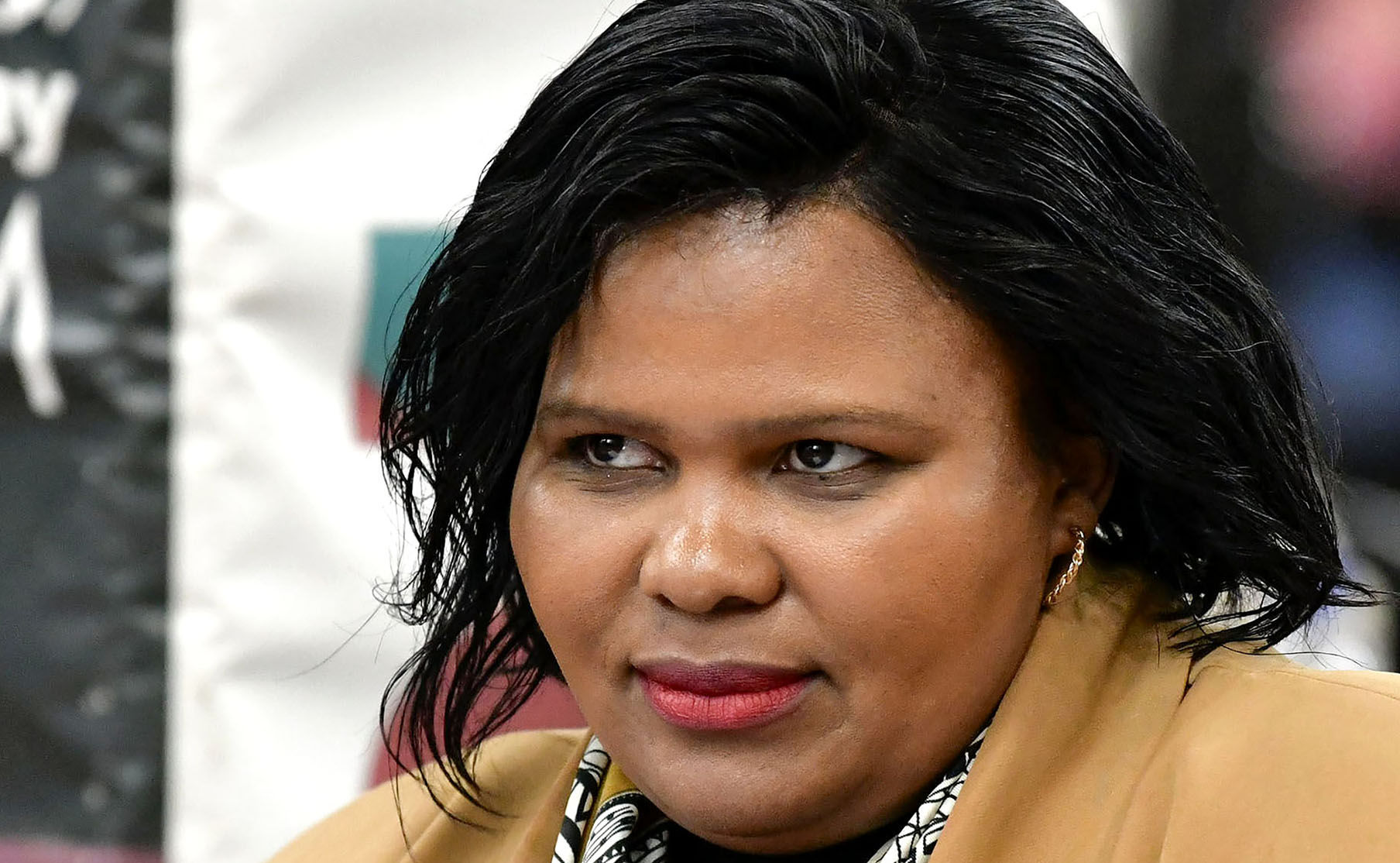
 Nelson Mandela Bay executive mayor Babalwa Lobishe. (Photo: Lulama Zenzile / Gallo Images / Die Burger)
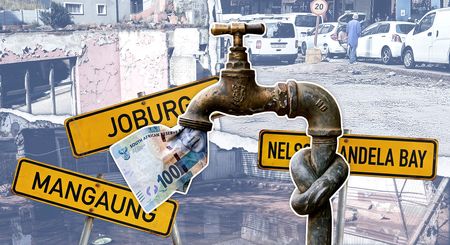
On Tuesday morning, the National Treasury announced that Nelson Mandela Bay is one of 69 municipalities whose equitable share payments will be blocked “to instil fiscal discipline and ensure that public money is properly managed”.
This about R500-million payment is one of three equitable share payments made by the Treasury through the year.
While the metro’s money may be blocked, the announcement unlocked a flurry of allegations against the fragile ANC-led coalition government that it was protecting corrupt officials.
The metro is in the grips of extensive service-delivery failures, with 2,000 electricity outages recorded between May 2025 and April 2026 and daily, extended water outages hitting large parts of the city.
According to the announcement, the affected metros will have to submit proper plans to deal with Unauthorised, Irregular, Fruitless and Wasteful Expenditure (UIFWE) – NMB has the highest figure in the country – and a detailed strategy to hold municipal officials and office-bearers accountable where required by law.
“The decision follows persistent and serious non-compliance with the Municipal Finance Management Act (MFMA) and its supporting regulations, despite support provided by the National Treasury through guidance, engagement and formal or informal communication,” the statement read.
Progress visit loading
The decision comes on the eve of a visit to the metro by Deputy Minister of Cooperative Governance and Traditional Affairs Dr Namane Dickson Masemola, which the municipality said in a notice would occur under the theme “Every Municipality Must Work”. Masemola will also be briefed on the status of the current intervention by the national government in the metro.
/file/attachments/orphans/WhatsAppImage2026-06-10at163105_679594.jpeg "From left, Eastern Cape MEC for Cooperative Governance and Traditional Affairs Zolile Williams, Nelson Mandela Bay Executive Mayor Babalwa Lobishe and Deputy Minister of Cooperative Governance and Traditional Affairs Dickson Masemola, with Nelson Mandela Bay Deputy Mayor Gary van Niekerk in the background, in Gqeberha on 10 June 2026. (Photo: Department of Cooperative Governance and Traditional Affairs)")
Metro communications director Sithembiso Soyaya said the contents of the correspondence were under review. “We shall respond at the appropriate time,” he said. No further response was received.
Other municipalities that face the same fate as the metro are: Buffalo City in KuGompo (formerly known as East London), the Makana Local Municipality, the Sundays River Valley municipality, Inxuba Yethemba municipality in Cradock and the Port St Johns municipality.
Corrective rather than punitive
While in the past, the municipalities often initiated negotiations with the Treasury after a threat to withhold funds, the fiscus’ statement said the time for explanations was over:
“The municipalities have been given sufficient notice in writing and urged to take measures to change their financial management positions ahead of the withholding of funds. They were also given a platform to send, in writing, reasons why their funds should not be withheld.”
But the Treasury said that its intention was “corrective rather than punitive”.
According to the statement, the National Treasury had confidence that the withholding of funds would be “for a short-term period” and did not foresee any effect on service delivery.
The statement continued that the Treasury had tried its best to support municipalities, but despite these interventions “many municipalities are still failing to comply with the provisions of the Municipal Finance Management Act”.
“Transfers will resume once the affected municipalities meet the required conditions and submit proper proof of the conditions being met,” the statement concluded.
Conditions to release funds
These conditions include the establishment of working disciplinary boards and a proper plan to deal with UIFWE.
The Treasury has stipulated that one condition is that a minimum of a 25% reduction in UIFWE must be met by 30 September and that proof of the recovery of the money, the outcomes of investigations and support documents for proposed write-offs must be provided.
For the metro, this would mean a whopping reduction of R7.5-billion, done the right way.
Zero accountability
Lance Grootboom from the ACDP said the current ANC-led coalition government in the metro should be “strongly condemned” for collapsing the municipality’s finances.
He said at the heart of the Treasury’s decision was the refusal by the political leadership of the city to hold the administration accountable for billions in wasted, unauthorised and irregular spending.
/file/attachments/orphans/LanceGrootboom_133737_382791.jpg "ACDP councillor Lance Grootboom. (Photo: Deon Ferreira)")
“Nelson Mandela Bay now has the worst record for irregular spending in the entire country. The ACDP has requested updates on the UIFWE register over and over again, but the CFO and the administration have completely failed to provide an accurate, updated register. The ACDP has been highly vocal, demanding that these financial matters be brought to MPAC (the Municipal Public Accounts Committee) for proper investigation. Instead, the administration continues to hide these files, and the ANC-led coalition lets them get away with it.
“This complete failure is out in the open. The city’s own ‘UIFWE Reduction Strategy’ promised to clean up and write off 10% of the historical debt by 30 June 2026. They failed miserably. The strategy also proudly stated there would be ‘Zero new UIFWE from 1 July 2026’. But looking at the current mess, it is obvious that this is another broken promise that will not happen.”
‘Total cover-up’
Grootboom accuses the metro of a “total cover-up” that exposes deep financial rot:
- The administration is deliberately hiding more than R1.1-billion in investigation files from MPAC, keeping them stuck at the Disciplinary Board so the council cannot take action;
- It “accidentally” left a massive R1.44-billion approved write-off completely out of the city’s official audited financial books;
- It refuses to name the specific officials who were supposed to stop new irregular spending from 1 July; and
- It has failed to update the UIFWE register and bring reports to MPAC.
“The National Treasury has pulled the plug because they see exactly what the ACDP has been fighting against: oversight committees are ignored, the UIFWE register is hidden and nobody is being punished.
“Nelson Mandela Bay is already facing a terrible revenue collection rate and broken infrastructure. Now, our poor communities will suffer even more because millions of rands meant for basic service delivery are blocked. If this ANC-led coalition does not stop protecting this administration, our city will continue to lose money and services will collapse completely,” Grootboom said.
/file/attachments/orphans/33_481940.jpg "The Feather Market Centre has several water leaks that have damaged the interior of the building, causing a bad stench from the wet carpet after it rained. (Photo: Deon Ferreira)")
/file/attachments/orphans/Image2_823213.jpg "Nelson Mandela Bay environmentalist Dr Gary Koekemoer forms part of a picket in front of the Nelson Mandela Bay Stadium in Gqeberha, displaying a poster calling for a permanent city manager. (Photo: Deon Ferreira)")
“Nelson Mandela Bay is currently lying in ruins, and these ruins are growing every single day under this government. It is time to rebuild our city and hand the wheel to competent, ethical leaders who will finally put the residents of Nelson Mandela Bay first,” Grootboom said.
“This intervention did not happen overnight. It is the inevitable consequence of years of poor political leadership, weak governance, financial mismanagement and the continued failure of municipal administrations to comply with the Municipal Finance Management Act.
“The affected municipalities were repeatedly warned, assisted, and afforded opportunities to rectify their financial affairs. Instead of taking decisive corrective action, many chose to ignore their legal obligations, allowing financial instability and poor governance to become entrenched,” Grootboom said.
‘I blame the officials’
When MPAC chairperson Luxolo Namette was asked if the committee should take partial blame for failing to deal with UIFWE, resulting in Treasury’s latest action, he said: “No, MPAC cannot be blamed.”
“Whenever there’s a committee, the political side is always ready; it’s the officials who fail to bring the reports so we can deal with matters from the different directorates. If they don’t come to the party, what can we do?” he asked.
/file/attachments/orphans/LuxoloNamette_935105.jpg "The Nelson Mandela Bay metro Municipal Public Accounts Committee chair Luxolo Namette. (Photo: Andisa Bonani)")
Namette said the MPAC had exhausted all channels to get officials to bring the reports so it could deal with consequence management and the UIFWE, including writing to mayor Babalwa Lobishe, acting city manager Lonwabo Ngoqo and council speaker Eugene Johnson.
“Only the speaker responded and said she will take the matter up with the mayor and I haven’t heard from either of them since I wrote to them early this month.”
Namette said he was preparing an item for council as mandated by MPAC to report on the administrative hurdles they had faced in dealing with the UIFWE, for a resolution to be taken on how to move forward.
‘I blame the mayor
Deputy executive mayor Gary van Niekerk said Lobishe was “so distracted with all the things going on around her” that the metro and its residents now risked paying the price.
Van Niekerk said residents would ultimately pay the price if the funding was withheld, adding that he would do “whatever needs to be done” from his office to help avert the crisis.
“I’ll do whatever needs to be done from my side, from my office, to assist, just to make sure that that doesn’t happen,” he said, adding that he would work closely with chief financial officer Jackson Ngcelwane.
/file/attachments/orphans/WhatsAppImage2026-04-07at154652_103246.jpeg "Nelson Mandela Bay mayor Babalwa Lobishe (left), and several senior leaders, appeared in Cape Town before Parliament’s cooperative governance and traditional affairs committee on 24 March 2026. (Photo: Phando Jikelo / RSA Parliament)")
Van Niekerk last week blamed Lobishe for the metro’s “inaction and governance failures” and distanced himself from them.
But Van Niekerk suggested Treasury’s intervention was symptomatic of broader leadership failures at the top of the metro.
“The problem you have with the mayor is that she’s so distracted with all the things going on around her. And that is exactly why I wanted to support her so much,” he said. “But I feel like I do not want to assist any more because my assistance is seen as interference and that I make her look bad. And that’s not the case.”
/file/attachments/orphans/ED_547817_607090.jpg "Nelson Mandela Bay deputy executive mayor Gary van Niekerk. (Photo: Gallo Image s/ Die Burger / Lulama Zenzile)")
The latest criticism follows another public clash between the pair last week, when Van Niekerk accused Lobishe of blocking an implementation-ready turnaround plan targeting 100 priority roads and aimed at improving service delivery.
Worried, but not shocked
“I am deeply concerned and very worried about this decision,” MPAC member and DA councillor Brendon Pegram said, “but I want to say that I am definitely not shocked.”
“Once again this comes down to the ongoing failures in the financial management of this municipality. We have been warning the ANC-led coalition for months that their mismanagement of finances, their hesitancy towards consequence management and ignoring principles of good governance will eventually force National Treasury to step in.
“The team from National Treasury was here, and they raised their concerns. They were brutal in their responses as to the way forward. Despite the support and chances to fix the issues, the municipality has once again failed to comply with the MFMA. This administration has basically managed to break every record in a bad way.
/file/attachments/orphans/WhatsAppImage2026-03-05at140956_394505_945876.jpeg "Nelson Mandela Bay DA councillor Brendon Pegram.<br>(Photo: Andisa Bonani)")
(Photo: Andisa Bonani)
“I am worried about what this means to the residents. Service delivery is already non-existent. This is not what residents deserve. Financial instability like this is criminal.”
Senior politicians and officials in court
Contravention of the MFMA is not a new term in Nelson Mandela Bay, and several current and former city officials have active cases before court relating to alleged mismanagement of municipal funds.
Deputy mayor Gary van Niekerk returns to court later this month in the hopes that his case can be expedited and his trial can get under way before the 4 November local government elections.
Besides allegedly contravening the MFMA, he is also charged with cyberfraud. The State claims he racked up a legal bill of more than R550,000 in 2022.
Last month, NMB director of legal services Nobuntu Gantana returned to court alongside former housing boss Mvuleni Mapu, where the pair also face charges related to the MFMA, as well as fraud and defeating the ends of justice.
The charges date back to 2019, during a period where both accused served as acting city manager, and terminated the services of Gqeberha law firm Gray Moodliar.
At the time, Mpongwana also allegedly misled the National Treasury.
Meanwhile, Mapu faces more charges related to the MFMA, as well as fraud, alongside former city manager Noxolo Nqwazi.
These charges relate to irregularities in the awarding of a R24-million tender to build toilets in some of the poorer communities of Nelson Mandela Bay in an effort to “de-densify” the areas at the height of the Covid-19 pandemic.
‘Residents deserve better’
“The Freedom Front Plus Eastern Cape has consistently warned that municipalities cannot continue to operate without accountability,” said councillor Bill Harington.
“Political leaders and senior officials who fail to exercise oversight, tolerate irregular expenditure, or neglect consequence management must accept responsibility for the deterioration of local government. Public office carries legal and fiduciary responsibilities, and these cannot simply be ignored without consequences,” he said.
Harington said the intervention was both justified and necessary.
Of equal concern was the widespread failure by many municipalities to investigate unauthorised, irregular, fruitless and wasteful expenditure, to recover financial losses where appropriate, and to ensure that their Municipal Public Accounts Committees performed their statutory oversight functions.
/file/attachments/orphans/Photo-2_365230.jpg "A man searches through waste at an illegal dumping site in Gqeberha’s northern areas on 11 June 2026. Residents say irregular refuse collection has contributed to the growing accumulation of waste in some neighbourhoods. (Photo: Deon Ferreira)")
“Where there is no accountability, poor governance inevitably flourishes, corruption finds fertile ground and service delivery deteriorates,” Harington said.
“Residents who faithfully pay their rates and taxes deserve better. They deserve municipalities that prioritise service delivery over political patronage, competence over cadre deployment and accountability over excuses. Every rand lost through irregular or wasteful expenditure is money stolen from communities that desperately need functioning roads, reliable water, proper sanitation, electricity and safe public infrastructure.”
Investment and employment at risk
CEO of the Nelson Mandela Bay Business Chamber Denise van Huyssteen said it was disappointing to once again note that the National Treasury was withholding equitable share transfer funding to the Nelson Mandela Bay Municipality.
“This non-performance of expenditure has become a recurring pattern that continues to result in lack of service delivery and maintenance of critical electricity, water, sanitation and roads infrastructure.
“Furthermore, this urban decay and continued regression is visible in many parts of the metro, which does not bode well for investor confidence. A lack of [an] enabling environment makes it extremely difficult for businesses to operate and to maintain investment and employment in the metro,” she said. DM
By Tuesday afternoon, Daily Maverick had not received a comment from NMB mayor Babalwa Lobishe.
Comments
Scroll down to load comments...