




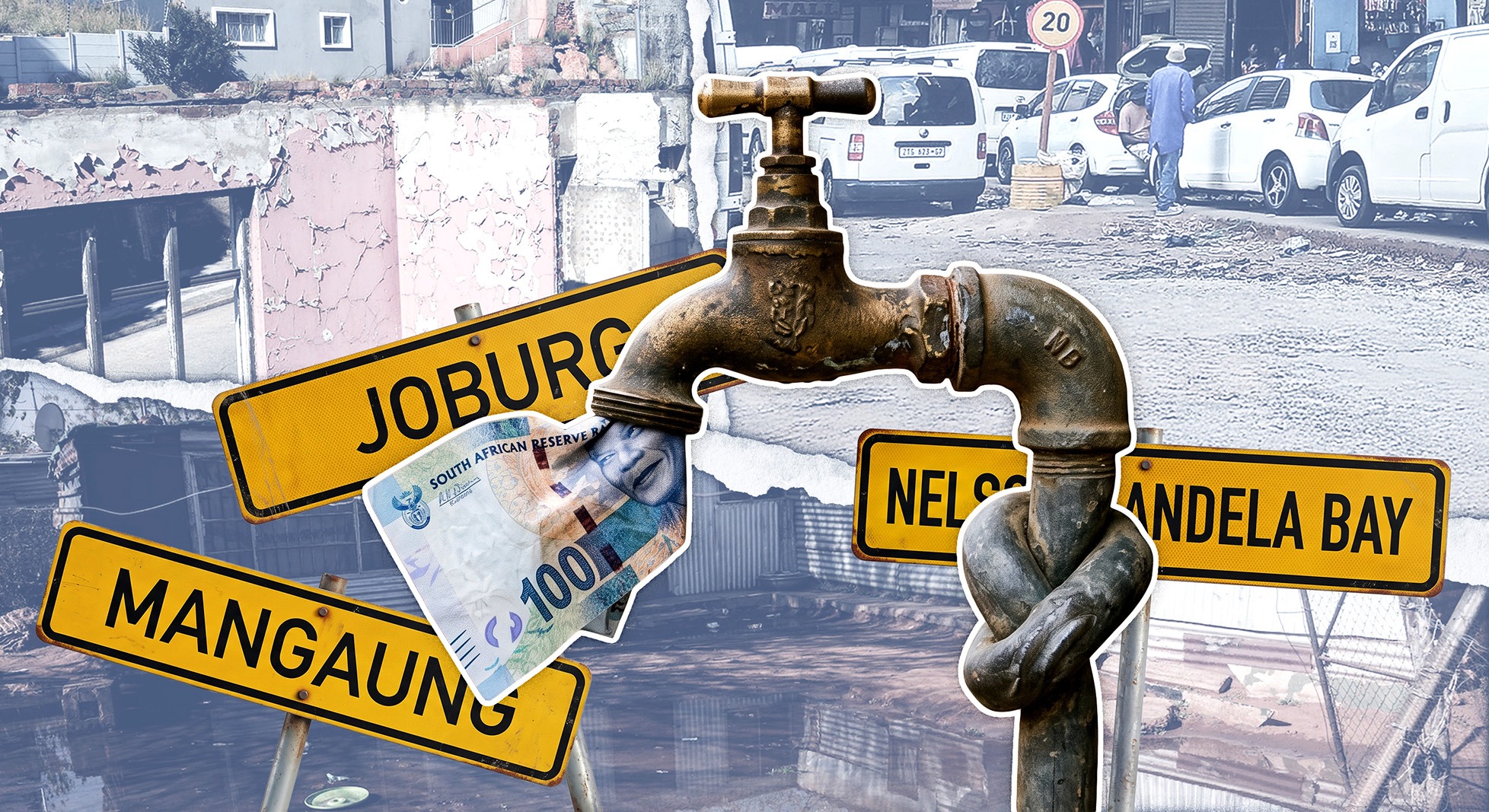
 Illustrative image: sources generated with Google Gemini Flash Image 2.5: Clifton Mansions, Gqeberha Central. (Photo: Deon Ferreira) | Flooding from a burst water pipe in Thembelihle. (Photo: Ihsaan Haffejee) | The Joburg Mall in the Johannesburg CBD. (Photo: Bheki Simelane)
National Treasury has finally reached for the one tool that tends to make municipalities sit up straight: the money tap.
On Tuesday, 7 July, Treasury said it was in the process of temporarily withholding the July 2026 local government equitable share transfers to 69 selected municipalities across the country.
The list includes big names such as the City of Johannesburg, Buffalo City, Nelson Mandela Bay, Mangaung and Matjhabeng, as well as district and local municipalities from every province in a national roll call of municipal dysfunction.
Treasury says the withholding of funds is aimed at instilling fiscal discipline, ensuring that public money is properly managed, and forcing municipalities to deal with unauthorised, irregular, fruitless and wasteful expenditure, known in government shorthand as UIFWE. It also wants municipal officials and office bearers to be held accountable where the law requires it.
The department insists the move is corrective rather than punitive. Because the withholding is meant to be short term, Treasury says it does not expect an impact on service delivery.
That may be true on paper but on the ground, residents in many of these municipalities already live with the daily effects of poor financial management: dry taps, broken roads, unreliable refuse collection, billing chaos, Eskom debt, water board debt and municipal councils that seem to discover “consequence management” only after Treasury issues a reprimand.
The legal basis for the move is section 216(2) of the Constitution, read with section 38 of the Municipal Finance Management Act (MFMA). Treasury says the affected municipalities were given written notice and an opportunity to explain why their funds should not be withheld.
The department says the decision follows “persistent and serious non-compliance” with the MFMA and its regulations, despite guidance, direct engagements, training and formal or informal communication with the affected municipalities.
The problem is familiar and will come as no surprise to many South Africans. Councils adopt budgets that are not properly funded while officials fail to pay statutory commitments when they fall due. Municipalities rack up irregular expenditure and then fail to investigate it. Municipal public accounts committees, which are meant to drive accountability, do not do the work required of them. Disciplinary boards exist in name or not at all.
Treasury says some municipalities have failed to process UIFWE as required under section 32 of the MFMA. This section requires a municipal council to recover such expenditure from the person liable, unless a council committee investigates the matter and certifies it as irrecoverable before it is written off.
In plain English: councils are supposed to investigate poor or bad spending, decide who is responsible, recover the money where possible, and take corrective action.
Instead, Treasury says many municipalities have not processed UIFWE cases through their public accounts committees. That means the very committees tasked with oversight are not functioning effectively.
Auditor-General findings
Treasury cites the latest Auditor-General of South Africa’s 2024/25 consolidated report on local government audit outcomes, which largely confirms its own findings.
Since 2021/22, municipalities have incurred R24.12-billion in fruitless and wasteful expenditure.
Over the same period, municipalities and their entities incurred R145.21-billion in irregular expenditure, with R40.14-billion incurred in 2024/25 alone.
They also disclosed R118.13-billion in unauthorised expenditure since 2021/22.
Budget credibility is also sliding.
In 2024/25, 116 municipalities, or 45%, adopted unfunded budgets. That was up from 113 municipalities (44%) in the previous year’s adjusted budget.
By the end of the 2024/25 financial year, municipalities owed R3.4-billion in interest to Eskom and R1.21-billion in interest to water boards. Late payments also hit statutory bodies and third parties. Treasury says 48 municipalities had third-party deductions overdue for more than one month.
When municipalities fail to pay Eskom and water boards, they weaken the very entities that keep the lights on and taps running. When they fail to pay SARS, the Auditor-General, the Financial Sector Conduct Authority or pension funds, they drag other public institutions into the pothole with them.
Creditor amounts and the biggest offenders
The Free State has the highest number of affected municipalities at 16, followed by North West with 12 and the Northern Cape with 11. KwaZulu-Natal has seven, the Eastern Cape and Gauteng have six each, Limpopo has five, while Mpumalanga and the Western Cape each have three.
Of the 69 affected municipalities, 39 are flagged for failure to address UIFWE and implement consequence management. Twelve are listed for adopting unfunded 2025/26 adjustment budgets. Thirteen are flagged for amounts owed to the Auditor-General, 16 for pension fund-related amounts, 13 for SARS, 18 for Eskom and 13 for water boards.
The creditor amounts listed in the spreadsheet add up to about R27.4-billion across the Auditor-General, pension funds, SARS, Eskom and water boards. The biggest chunk sits with water boards, at about R15.7-billion, followed by Eskom at about R9.75-billion. Pension fund-related amounts come to about R1.43-billion, SARS about R412-million and the Auditor-General about R143-million.
The largest single listed amount is Matjhabeng’s R9.5-billion owed to water boards. The City of Johannesburg is flagged for an Eskom amount of about R3.73-billion and water board exposure of about R1.23-billion. Merafong City is listed with about R1.53-billion owed to water boards, while Rand West City is listed with about R950.5-million.
Inxuba Yethemba in the Eastern Cape is also flagged across several categories, including an unfunded adjustment budget, about R16-million owed to the Auditor-General, about R2.08-million to SARS and about R910.5-million to Eskom.
Conditions that municipalities have to meet
Treasury has attached conditions that municipalities must meet before the withheld transfers are released.
The first is a UIFWE reduction test. Municipalities must achieve at least a 25% reduction in the total UIFWE balance as at 30 June 2026, based on their unaudited draft 2025/26 financial statements submitted to the Auditor-General. The reduction is measured during the first quarter of the 2026/27 municipal financial year, from July to September 2026.
They must also provide evidence, including consolidated UIFWE registers, MPAC recommendations, council resolutions, proof of recovery, investigation outcomes and documents supporting any write-offs.
The second test is consequence management. Municipalities must show that disciplinary boards were lawfully appointed and are functional. They must show that qualifying financial misconduct matters were referred to these boards, recorded and acted on. Where matters require disciplinary action, civil recovery or criminal proceedings, municipalities must provide proof.
The third test concerns bulk suppliers and third parties. Municipalities must submit signed payment agreements with creditors such as Eskom, water boards, SARS, the Auditor-General and pension funds. Treasury says once it receives signed agreements, it will release an amount equivalent to the invoice, guided by the payment agreement. The remaining balances will only be released once there is proof that previously released money was used as intended.
There is also a warning on unfunded budgets. Mayors of municipalities that allowed unfunded 2025/26 adjustment budgets must write to the minister of finance committing that, from 2026/27, they will never again allow their municipalities to table and adopt unfunded budgets.
It is unusually blunt language for intergovernmental fiscal plumbing, but the real test will be whether Treasury sticks to its own line. Local government has become very good at surviving warnings and even better at treating audit findings as background noise.
For residents, the risk is that the same councils that failed to manage money properly will now use withheld transfers as another excuse for collapsing services.
For Treasury, the risk is that if it backs down too quickly, the message to municipalities will be that non-compliance still has no real price. DM
Comments
Scroll down to load comments...