




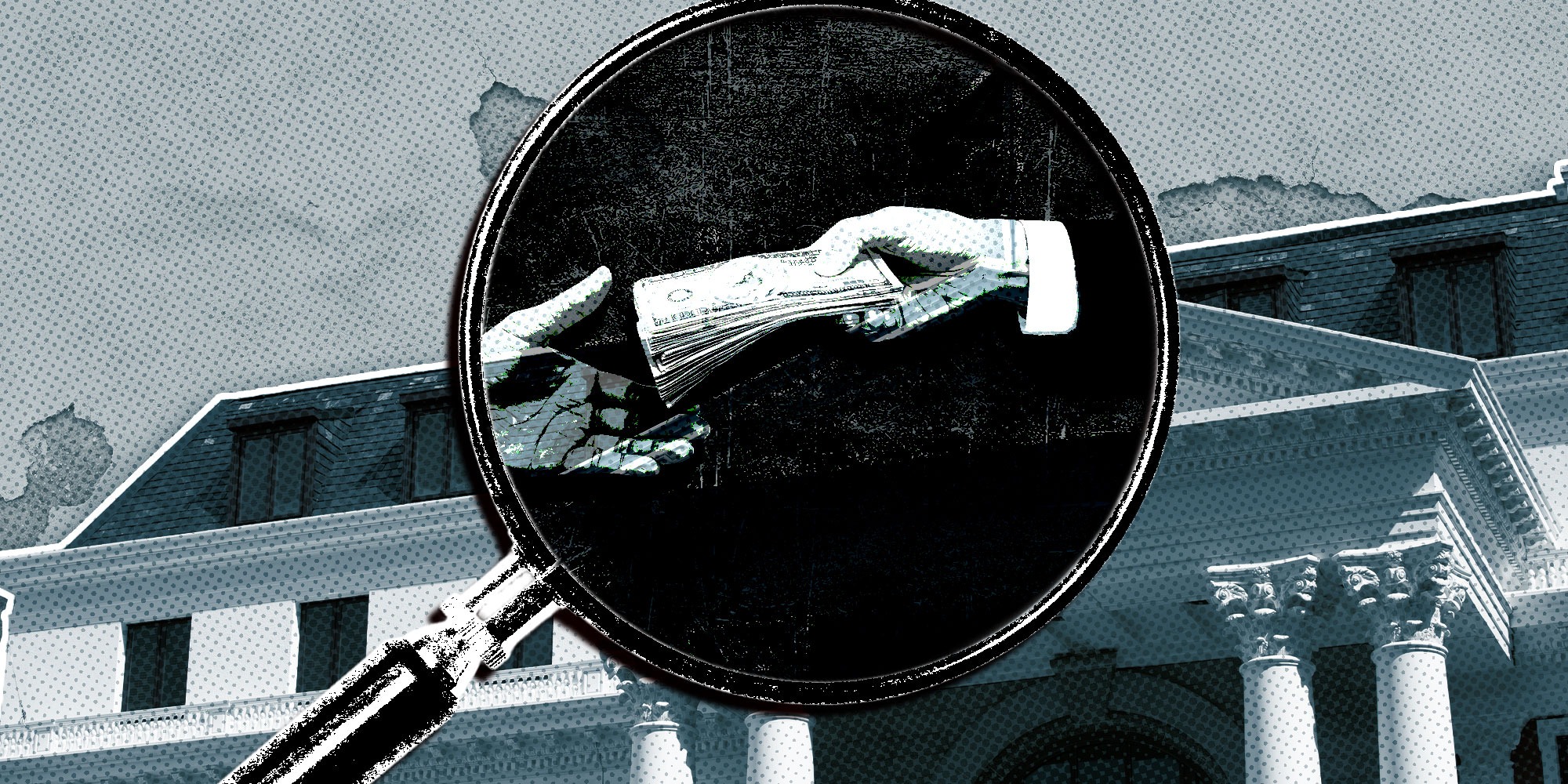
 Illustrative image: Parliament. (Photo: Daily Maverick) | Magnifying glass and money changing hands. (Photos: Magnific) | (By Daniella Lee Ming Yesca)
The last few weeks have seen serious questions being asked about whether a private lobbying company, Tony Leon’s Resolve Communications, has been able to influence Democratic Alliance (DA) politicians. This issue, sparked by former DA leader John Steenhuisen’s astonishing claims to News24 will have repercussions for the DA for some time.
At the same time, Eskom chair Mteto Nyathi has claimed, first on X and then on The Money Show that “too many among South Africa’s elite – black and white – appear to believe the rules that govern the rest of us do not apply to them”.
He essentially claimed that organised business, in the form of Business Leadership SA (BLSA) and Business Unity SA, had sought political help in trying to force Eskom to give up the ownership of the National Transmission Company of South Africa.
This led to an angry denial from BLSA CEO Busisiwe Mavuso, who said: “We have not approached him for favours, nor have we separately gone and approached the President.”
/file/attachments/orphans/BusisiweMavuso1_999770.jpg "Business Leadership South Africa CEO Busisiwe Mavuso. (Photo: Deon Ferreira)")
She also says the real issue is that Eskom is refusing to implement policy that has been explicitly outlined by President Cyril Ramaphosa. He promised during his State of the Nation Address that Eskom would implement proper competition in our electricity market.
This in turn has led the CEO of the Black Business Council, Kganki Matabane, writing in the Sunday Times, to question the role organised business now plays in our economy. As has been pointed out many times, business groups now play an almost outsized role in the state, providing expertise, capital and sometimes salaries.
The result of this must be that business is having a bigger impact on our government policy than at almost any time in the past.
This might well lead to suspicions that this is why the government has given up so much control at Eskom, Transnet and other sectors.
Digital TV, sausages and vapes
Certainly, this is one of the biggest changes over the last decade. While it has generally been accepted (possibly because the state is so weak, there is literally no other option), it has happened without much transparency.
That is not to say the partnership between the government and business is hidden; it is incredibly public. But the nitty-gritty, how decisions are really made – that obviously does not happen in public.
It is a sad fact of most democracies that this is usually the case. It is often very hard to determine who has influenced policy and how.
There have been some incredible examples over the years of the government and parties adopting certain policies that later proved to be only in the interests of certain parties.

Perhaps the most public of these actually occurred at the ANC’s 2015 national general council. There, the party’s communications commission resolved to adopt a policy that would see encrypted digital terrestrial television being rolled out.
The next day, the communications minister at the time, Faith Muthambi (who also played a key role in protecting and empowering Hlaudi Motsoeneng and allowing him to seriously damage the SABC) issued a statement saying this was not true.
/file/dailymaverick/wp-content/uploads/Merten-Analysis-The-case-against-Muthambi.jpg "Former communications minister Faith Muthambi.(Photo: Elmond Jiyane / GCIS)")
That led to Luthuli House issuing a statement (through the gone-too-soon Jackson Mthembu) rebuking her.
To go further back, the ANC, under then president Jacob Zuma, adopted the National Development Plan at its Mangaung Conference in 2012.
Virtually none of it was ever implemented in government, which shows how adopting policies in principle can mean nothing in practice.
It is in this space, between what is publicly adopted and what actually happens, where figures mentioned in the Resolve Communications and Eskom spats practise their dark arts – sometimes with spectacularly bizarre results.
In 2022, the Department of Agriculture, in a display of less than infinite wisdom, banned the use of words such as “burgers” and “sausages” from being used in the packaging of goods that did not contain meat.
Absent public riots by meat-eaters claiming to have been defrauded of their God-given right to exclusivity over the terms, it was hard to understand why this policy had been adopted. It was an insult to any shopper anywhere.
But it was also very revealing. It showed how one group of people, meat producers, had been able to lobby the department.
Last month, Parliament’s Portfolio Committee on Health adopted a new Tobacco Bill.
Crucially it makes a distinction between “combustible products” (cigarettes, pipes, etc.) and “non-combustible products” (vaping).

While the committee says it heard from 1,113 people and received 52 submissions, there can be no doubt there was intense lobbying behind the scenes.
Considering that this change will make it easier for tobacco companies (which curiously do not display people smoking their products on the front pages of their websites) to sell their products, one can presume they spared no expense in this.
Even the incredibly long delay in agreeing to this bill (which has not yet been voted on by Parliament) might well be the result of lobbying by somebody who was well-resourced and well-motivated.
For those concerned about this process, have no fear. It was chaired by Faith Muthambi, she of the perfect track record.
Lobbying and the national coalition
It may be that one of the beneficial consequences of the fracturing of our politics is that this kind of lobbying becomes harder and perhaps less obscured.
In the past, when the ANC was so dominant, there might have been a relatively small number of people who needed to be lobbied for a policy to be adopted. Now, with a larger number of parties on parliamentary committees, it may mean a much larger, more diverse group of people will need to be lobbied.
But the scope for lobbying of individual departments and ministers may be widened.
This is because a minister from a relatively small party may be much more accessible and susceptible to lobbying. They may not have the confidence or the backing of a bigger party to tell a company or lobby group to back off. And they may feel they only have a relatively short time in government anyway, perhaps making them more agreeable to any kind of underhanded deal.
This might well mean there will be more examples of the nonsensical ban on the use of words like “burger” for vegetarian products.
Lobbying will always be with us.
And so it should be. It is a sad fact of democracy that in determining policy not every voice can be treated equally.
Consumers would want everything for free, and producers need to make a profit to survive and reinvest in the future. As a result the government needs to manage the playing field.
And sometimes business people can have very real concerns that are difficult to express in public. Sometimes, as with the current business-government partnership, they may be playing a hugely constructive role in the government to the benefit of millions of people. And making a profit at the same time.
The real lesson is probably that while you could probably never have total transparency, our current system is not transparent enough.
This will lead to more cases such as Resolve Communications and the current Eskom spat coming to light in the future. DM
Comments
Scroll down to load comments...