




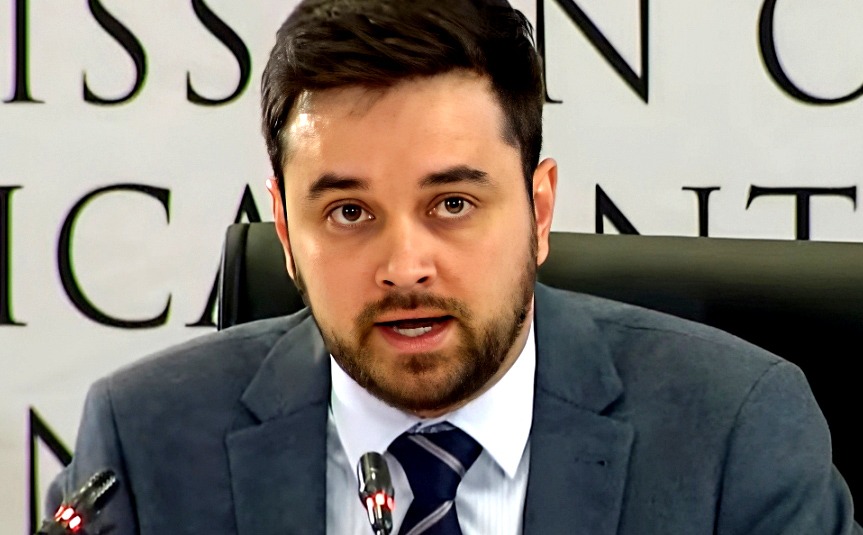
 Dr Albertus Schoeman, a task team leader at the World Bank, tells the Madlanga Commission of Inquiry that collusion and conflict of interest are at the heart of the issues the commission is investigating. (Photo: Screenshot / Madlanga Commission Media Channel)
Appearing before the Madlanga Commission on Inquiry on Thursday, 9 July, World Bank anti-corruption specialist Dr Albertus Schoeman presented evidence in the form of a report on the financial disclosure and integrity management systems governing senior officials in the criminal justice system, arguing that critical weaknesses have left the state vulnerable to corrupt infiltration.
The report identifies South Africa’s financial disclosure regime as the cornerstone of the public sector integrity framework, but argues that it is undermined by significant gaps in disclosure requirements, weak institutional capacity to verify declarations and inadequate enforcement against officials who fail to disclose their interests or submit false information.
Schoeman is an extended-term consultant and task team leader for the World Bank’s anti-corruption programme in Southern Africa. He holds a PhD in politics from the University of Sussex and has previously worked with Transparency International, the University of Sussex and the Institute for Security Studies on governance and anti-corruption.
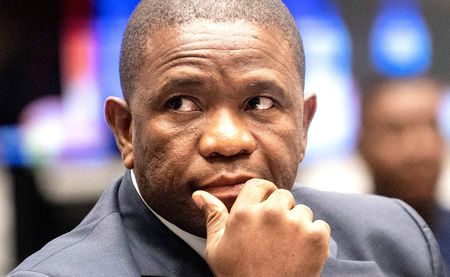
He told the commission that collusion and conflicts of interest lay at the heart of the allegations it had heard, arguing that the evidence pointed to a pattern of public officials placing personal relationships with organised crime figures ahead of their constitutional duties.
He questioned whether existing oversight mechanisms were functioning as intended. Between the financial years 2021/2022 and 2023/24, no SAPS officials were referred for lifestyle investigation. In 2024/2025, only five of 823 senior management members underwent lifestyle investigations, with all five being cleared.
Cops have low trust in SAPS
Schoeman also highlighted deteriorating confidence within the police service itself. A SAPS organisational climate survey for 2022/23 found that only 24.4% of officials believed police members conduct themselves professionally, while just 31.6% agreed that officers did not abuse their powers.
“The prevailing view among officers is that the SAPS’ organisational culture is one of low integrity,” Schoeman said.
Schoeman questioned whether the institutions responsible for safeguarding integrity had the necessary powers to do so. He noted that the Special Investigating Unit could not independently conduct lifestyle audits and that the current legal framework placed responsibility for integrity management, including lifestyle audits, on accounting officers and the relevant executive authorities.
He reiterated that the commission hearings had revealed a recurring pattern of officials placing private interests above their public responsibilities. Those conflicts allegedly manifested in the obstruction of criminal investigations, the leaking of confidential information to criminal networks and the manipulation of procurement processes to steer contracts towards associates.
“Each [was] underpinned by an expectation of reciprocal benefit, whether in the form of gifts, payments or gratifications channelled through family members and private business interests,” he said.

According to Schoeman, the ability of senior officials to maintain allegedly corrupt relationships with organised crime figures over an extended period without institutional detection or meaningful consequences exposed profound weaknesses in South Africa’s public sector integrity framework.
His assessment echoed the central allegations that have emerged throughout the Madlanga Commission’s hearings: that criminal networks were able to cultivate long-term relationships with senior law enforcement officials while the state’s oversight mechanisms failed to detect or disrupt them.
Among the matters that emerged was that of the R228-million SAPS health services contract awarded in June 2024 to Vusimusi “Cat” Matlala’s company Medicare24 Tshwane. The contract was terminated in May 2025.
It also reinforced the warning contained in KwaZulu-Natal police commissioner Lieutenant General Nhlanhla Mkhwanazi’s explosive June 2025 media briefing, in which he alleged that organised crime had penetrated parts of the country’s criminal justice system through corrupt relationships with senior officials.
Disclosure loopholes leave corruption hidden
Schoeman argued that the financial disclosure form lay at the heart of South Africa’s public sector integrity framework because the information it captured determined what investigators could scrutinise.
His report identifies several weaknesses that create opportunities to conceal illicit gains. Among them are the exclusion of family members from disclosure obligations, the absence of beneficial ownership requirements, limited information about how and when assets were acquired, and the omission of certain categories of assets.
“Collectively, these shortcomings provide only a partial picture of an official’s financial interests and make it difficult to detect unexplained changes in wealth or identify hidden conflicts of interest,” Schoeman said.
He described the exclusion of spouses and close relatives from disclosure requirements as one of the system’s biggest weaknesses, warning that officials can simply register property, company shares or other assets in the names of family members to keep them hidden.
“This is a major vulnerability and leaves open one of the most direct and commonly used channels for hiding interests,” he told the commission.

Beyond family members, Schoeman said the regime also failed to capture beneficial ownership, requiring officials to disclose only assets registered in their own names while allowing companies, trusts and property controlled through nominees or intermediaries to remain hidden.
Without requiring officials to disclose who ultimately controlled an asset, the system left a significant blind spot for investigators attempting to trace illicit wealth, he argued.
He also criticised the limited detail required for assets that were disclosed. The current system recorded what an official owned, but not when an asset was acquired, how it was obtained or from whom. Without that information, authorities could not determine whether an official’s wealth was consistent with legitimate income or identify unexplained increases in assets over time.
Schoeman said the disclosure regime also excluded high-value movable assets, cryptocurrencies, bank accounts, cash holdings and money loaned to third parties, leaving significant opportunities to conceal illicit proceeds.
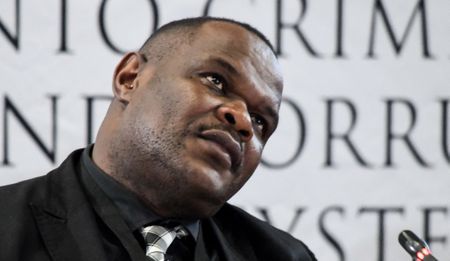
A classic example is that of suspended Sergeant Fannie Nkosi of Gauteng’s Organised Crime Unit who faces multiple charges after police found firearms, cash hidden under a mattress and six “undetected” case dockets at his home, marking the second high-profile raid on his house since October 2025.
Weak sanctions blunt corruption fight
Bringing this point home, Schoeman argued that the weaknesses in South Africa’s financial disclosure regime went beyond what officials were required to declare. Even where conflicts of interest, unexplained wealth or false disclosures were identified, he said, the system lacked meaningful consequences.
“However, even if any discrepancies, conflicts or unexplained wealth were to be detected, the policy framework for issuing sanctions against officials lacks teeth,” he said.
He warned that consequence management was decentralised, leaving disciplinary decisions to individual departments and creating opportunities for inconsistent enforcement, institutional capture and interference by colleagues or officials linked to corrupt networks. With oversight spread across 42 national departments and 97 provincial departments, accountability depended largely on the discretion of individual heads of department.
The sanctions themselves are also weak. Officials who fail to comply with disclosure requirements face penalties ranging from verbal or written warnings to suspension without pay or disciplinary action.
“Only a single dismissal has thus far been reported in the public service over the past two years,” Schoeman told the commission.
Rebuilding the integrity system
Schoeman argued that South Africa’s financial disclosure regime could not be repaired through piecemeal reforms. Instead, he described the integrity framework as a chain in which disclosure, verification, oversight and sanctions depended on one another. When one link failed, the entire system was weakened.
According to his report, every link in that chain is compromised. Disclosure forms provide only a partial picture of an official’s finances, verification is fragmented across multiple institutions with limited independence and specialist capacity, and sanctions are inconsistent and too weak to deter serious misconduct.
Schoeman also called for a fundamental overhaul of the institutional framework, arguing that South Africa’s fragmented approach contrasted with countries such as Botswana, where members of parliament, the executive, the judiciary and the public service were subject to a unified disclosure system overseen by a central authority.
Such an approach, he argued, promoted consistency, built specialist investigative capacity and provided greater independence in verifying declarations and enforcing sanctions.
The shortcomings exposed by the commission, he said, pointed to one conclusion: South Africa needed a dedicated corruption prevention agency. Whether that built on the National Anti-Corruption Advisory Council’s proposal or expanded the mandate of the Special Investigating Unit was open to debate, but the current fragmented system was no longer fit for purpose. DM
Comments
Scroll down to load comments...