




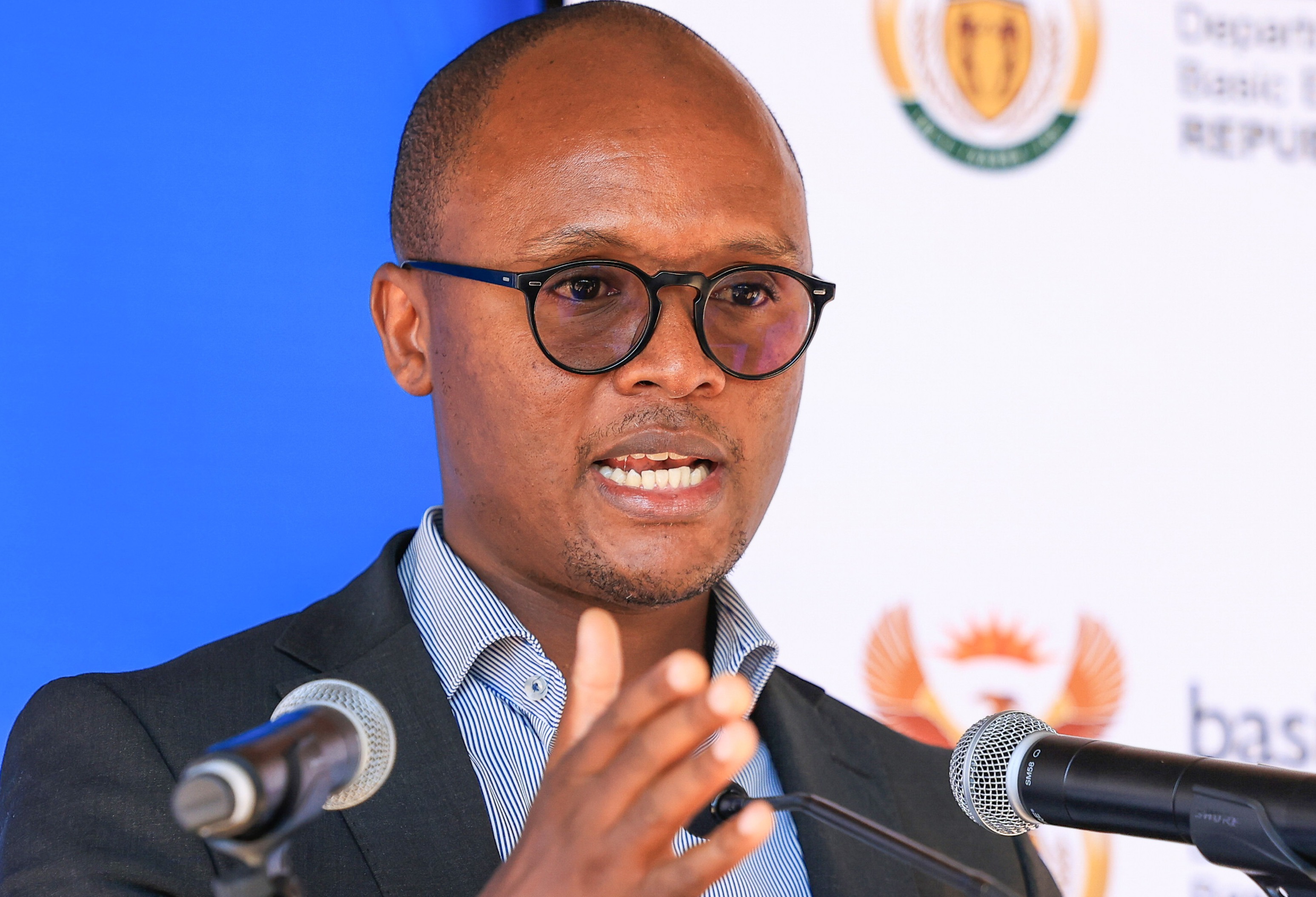
 Minister of Communications and Digital Technologies Solly Malatsi. (Photo: Gallo Images / Luba Lesolle)
Over the next 30 business days, starting today, the State Information Technology Agency (Sita) board has two tasks: submit a board-approved recovery plan directly to Minister Solly Malatsi, and compile a verified procurement backlog database.
That database must be benchmarked against the investigation data to ensure that Sita’s progress is tracked transparently and cannot be exaggerated.
Within 60 business days, the board must submit a formal plan containing specific controls to strengthen board administration, records management, supply chain management delegations, contract compliance and executive accountability.

And further, Sita must provide quarterly health reports to Malatsi, tracking its supply chain management turnaround times, contract-register automation, implementation of Auditor-General audit findings and consequence management.
Anyone who has been through a structured performance management process at work will recognise that timeline and realise how difficult it would be for the agency to achieve a positive outcome.
Kicking the hornet’s nest
On Monday, 6 July 2026, the Minister of Communications and Digital Technologies, Solly Malatsi, alongside Public Service Commission (PSC) chairperson Prof Somadoda Fikeni, formally released a comprehensive, independent investigation report detailing systemic governance, procurement and administrative failures at Sita, covering the period from 2020 to 2025.
“This report is difficult reading, but it is necessary reading,” Malatsi said at the media conference announcing the outcome. “Sita is the state’s central ICT engine.”
“When Sita fails, departments wait longer for the systems they need, budgets are placed under pressure and citizens ultimately experience the consequences through poorer public services.”
The catalyst for this independent investigation was a formal oversight visit to Sita’s Centurion headquarters on Wednesday, 11 December 2024, by Malatsi and the Parliamentary committee on communications and digital technologies.
The visit was prompted by an alarming deterioration in the agency’s service delivery, growing governance challenges and a severe backlog in its financial reporting … as well as the agency’s inability to submit its 2023/2024 annual report on time.
Malatsi formally requested that the PSC launch an independent probe into the agency’s public administration and procurement activities immediately after the visit.
To its credit, the board issued a statement on 13 December 2024, welcoming the investigation and acknowledging that Sita’s history was marred by “long-standing systemic issues”, including a truly flabbergasting leadership turnover of 23 CEOs over a 25-year history – with five serving in just a three-year window.
In the spider’s web
The report has a few standout headlines, but rather than finding individual criminal guilt, the main takeaway is how a continuous leadership vacuum undermined supply chain management compliance, leading to severe project delays, poor board records and high corruption risks.
Daily Maverick has been running a simultaneous investigation since November 2025 – focusing on the the past decade of Sita performance – and can concur that Sita’s corporate performance directly mirrors its leadership stability.
During stable periods, such as the tenure of Dr SJ Mohapi, Sita recorded an annual performance plan (APP) target achievement rate of 76% in FY2016/17.
But as it entered a prolonged acting executive era after 2020 (including Luvuyo Keyise as executive caretaker from January 2020), performance fluctuated and ultimately collapsed.
Performance hit 58% in FY2021/22, plummeted to 44.44% in FY2022/23 (when the permanent MD resigned after only eight months) , and hit a low of 42.86% in FY2024/25.
The PSC found that this executive rollercoaster eroded supply chain controls, leading to a total of R2.07-billion in irregular expenditure over four audited years.
These findings match disclosures in the annual reports of R1.03-billion confirmed in FY2018/19 , R285.5-million in FY21/22 , R452-million in FY22/23 , and R514.171-million in FY24/25.
A snapshot of the horror: FY2020/2021
In the 2020-2021 financial year, Sita racked up irregular expenditure to the tune of R109.79-million (first flagged in 2018/2019 at R24.4-million and then R261.95-million cumulatively) under a 10-year contract for cloud and hyper-converged infrastructure to help streamline government IT by consolidating servers and storage into a single, efficient box. The Auditor-General flagged that technical evaluation requirements were relaxed to favour a specific supplier.
Sita took no disciplinary action against the responsible officials because they had left the agency.
In the same annual report, the agency also disclosed irregular expenditure of R305-million in a situation where procurement rules were violated to award a network infrastructure contract to a specific supplier. Again, no disciplinary action.
But most concerning is Sita’s chronic procurement delays that have crippled state functions. To illustrate, in 2016, Sita was tasked as an urgent priority to resolve an extreme backlog of more than 129,000 national vocational candidates who had been waiting for their qualifications since 2007. It required five years of intensive joint Sita-Department of Higher Education and Training interventions to finally clear this backlog to 99.85% completed by FY21/22.
Similarly, ageing infrastructure – a symptom of money not making it to the intended target – led to chronic, widespread network downtimes at Department of Home Affairs offices across South Africa, forcing the department to launch a joint War on Queues task team with Sita to stabilise basic IT line performance.
An eye for an eye
When you consider that Sita’s customers are the government departments that need to deliver services, report details stating that by 2026, 529 procurement matters remained open, with the oldest sitting in adjudication and contracting for an average of more than 400 days – with a total of 203 orders taking more than a year from work order to final outcome – are quite infuriating.
Sita’s customer satisfaction scores plummeted alongside supply chain management efficiency. In FY24/25, overall customer satisfaction score was only 48%. And when broken down, customers rated the agency’s efficiency at 22%, transparency at 36%, and outcome-driven delivery at 38%.
This was what drove Malatsi to include a bypass mechanism for government departments to skip the IT procurement chokepoint.
And remember, this is not Sita’s first visit to the accountability naughty step. During FY17/18, the agency launched a deep forensic cleanup of its supply chain management unit. This resulted in the termination and immediate resignation of a significant portion of that unit’s workforce.
The cleanup uncovered a massive procurement anomaly: Sita had established multiple sole supplier contracts without any formal process.
These contracts directly originated from potentially irregular relationships between South African Police Service officers, Sita staff and an external service provider. These findings (chief among them a R52-million order for forensic lights) were referred directly to the Independent Police Investigative Directorate, the Hawks, National Treasury and Parliament’s Standing Committee on Public Accounts.

The performance management process is only the beginning. The Department of Communications and Digital Technologies, alongside the Department of Public Service and Administration, National Treasury and the Presidency, is leading a formal review of Sita’s legislative mandate and business model to ensure it is fit for purpose in a modern digital state.
There are no prizes for guessing what the most likely outcome will be. DM
Comments
Scroll down to load comments...