




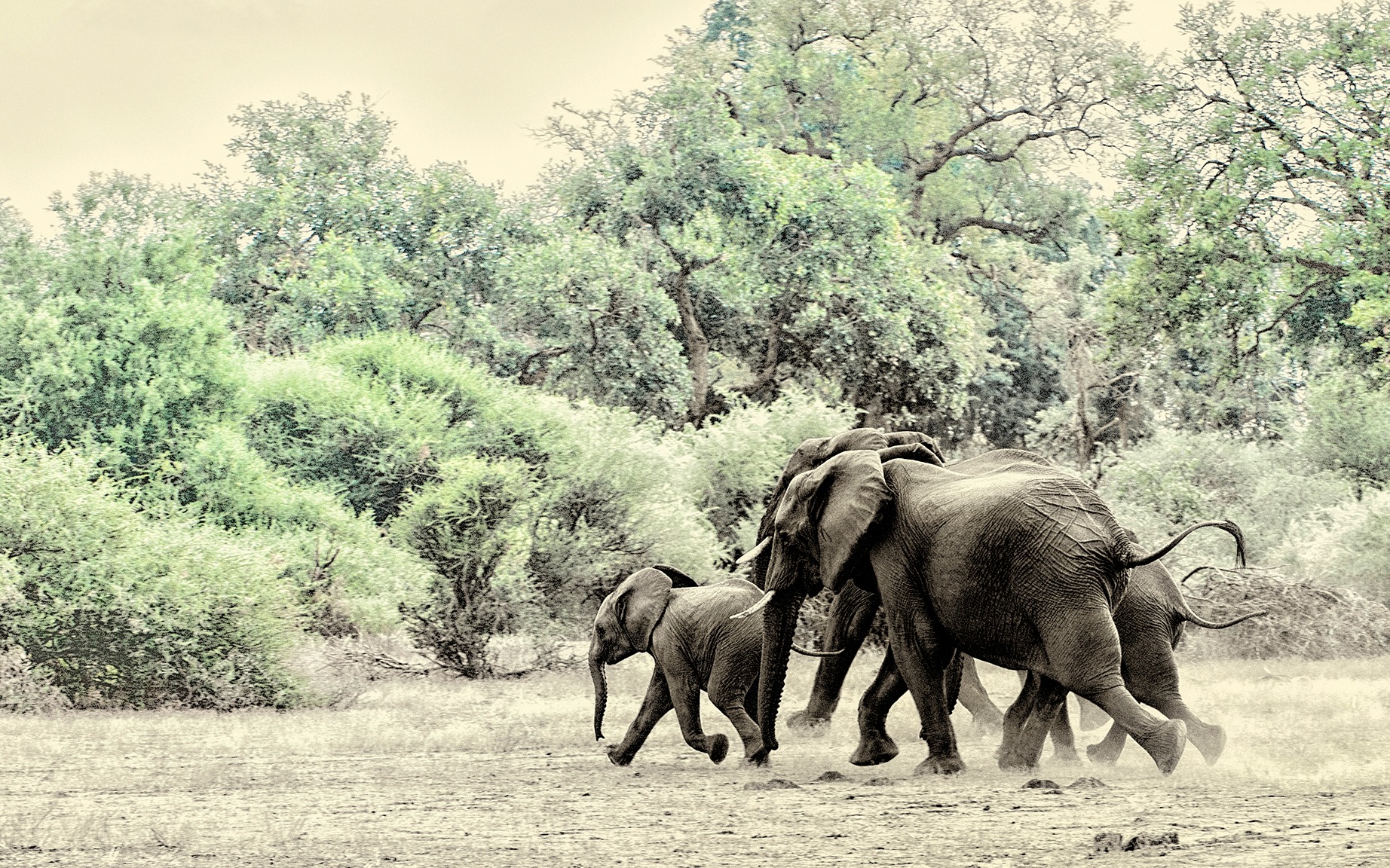
 Ezemvelo KZN Wildlife claims that culling elephants is inevitable. (Photo: Don Pinnock)
It was billed as a briefing to Parliament’s Environment Portfolio Committee on elephant management in KwaZulu-Natal. Its slide presentation was slick and convincing at face value.
The bomb dropped at question time.
Ezemvelo’s scientific manager Ian Rushworth said 1,220 elephants needed to be removed, and those that could not be relocated would have to be culled.
/file/attachments/orphans/Elephantcovering_442152.jpg "(Graphic: ChatGPT)")
He noted that it was highly unlikely that reserves and countries in Africa would accept them, so the implication was clear.
“What we have to start talking about is lethal control,” he said. “Ultimately we’ve got to start talking about culling.”
Rushworth did not present this as a remote possibility. He stated that the debate should shift from whether elephants should be killed to how it should be done.
“The real question,” he told MPs, was how to ensure that culling was “as humane and ethical as possible” and with “the least impact on elephants and the other elephants that remain”.
He added that the EKZN provincial authority had already approved culling but did not mention whether there was a culling plan in place.
The presentation claimed reduced elephant numbers would lower risk to people, reduce future removals, provide forage and shade buffers in droughts, reduce contraception costs and safeguard biodiversity.
Rushworth suggested that culling could support “a whole industry” of meat, hides and even ivory carving, adding that elephant meat could be part of a long-term food-security buffer.
“It has always struck me, he said, “that China has people that carve ivory, but Africa, where all the elephants are, there’s no ivory carving industry. It could be a massive industry.”
His statement ignored the facts that international trade in ivory has been banned under CITES since 1989 and China closed its ivory market in 2017.
Another way of saying ‘culling’
Ezemvelo’s slide presentation before question time avoided the word culling. It presented an “Elephant Management Approach”, saying KwaZulu-Natal has five state-run reserves with elephants, 17 private properties, and a population projected to rise from about 2,800 to 4,300 in 10 years.
The presentation then listed the constraints: translocation options were “limited”, large properties were scarce, 11 of 17 private properties were already “above capacity”, neighbouring countries were too full or too far away, norms and standards were “restrictive” and contraception could reduce growth but “can’t be to zero”.
Rushworth presented the non-lethal options as difficult, costly, too slow or insufficient. By the time he spoke, culling appeared not as one option among many, but as inevitable.
He said the Elephant Norms and Standards (ENS) were too restrictive on culling and there were unreasonable delays at the Department of Environment (DFFE) when applied for. This “restricts our ability to make decisions and to move rapidly to solve problems”. (A senior official from DFFE later refuted this claim, stating that there were no delays in approvals from DFFE.)
According to those elephant norms:
- culling may be undertaken only in terms of a culling plan prepared by the responsible person, with the assistance of an ecologist who is a recognised elephant management specialist;
- the actual or projected elephant numbers at a specific location are incompatible with the agreed land use objectives spelt out in the management plan;
- that a reduction in population numbers is therefore necessary; and
- evidence that all other population management options, referred to in paragraph 15, have been rejected by the ecologist.
The slide presentation was cautious, noting that lethal management should occur only after “all other alternatives have been considered”. Though alternatives were described as difficult, the evidence placed before Parliament did not show they had been exhausted, as required by the ENS.
However, Rushworth displayed a clear bias towards culling, disparaging immunocontraception. It ignored the fact that Humane World for Animals has a long-running and successful record of working with Ezemvelo on immunocontraception as well as other non-lethal elephant-management interventions, including at Tembe, Hluhluwe-iMfolozi, Ithala and with the Mawana/Loziba herd.
The question of too many
Under questioning, Rushworth conceded that the population projection was “a very simple projection, not based on detailed models for each protected area”, and intended to “illustrate” growth. He backtracked, saying it was more to illustrate the principle than to be “scientifically rigorous”.
A simplified projection may justify concern, planning and scrutiny. But, as MP Andrew de Blocq noted, it cannot justify killing elephants.
/file/attachments/orphans/Elephantcomparisons_795795.jpg "(Graphic: ChatGPT)")
This hasn’t deterred EKZN from pushing to use “overpopulation” to justify culling 1,220 elephants. The presentation’s logic depended heavily on the claim that numbers are already too high and will soon become worse. It asserted that all reserves were above capacity except iSimangaliso.
MPs asked what measurable evidence was being used to determine “the right elephant carrying capacity for each reserve”. They did not receive an answer.
/file/attachments/orphans/elephantnumbers_739124.jpg "Planned removals from KZN parks. (Source: KZN Wildlife)")
The assumption of a “magical number” of elephants per area was recently criticised by a number of leading elephant experts, led by Kruger Park’s Dr Sam Ferreira.
“South Africa’s elephant management continues to rest on the assumption that ecological impacts can be reduced to a simple static number, a reserve’s so-called carrying capacity”, they write.
“The risks of the above framing are twofold. First, carrying capacity is not a fixed concept. It changes with rainfall, seasonal cycles, and animal behaviour. Second, peer-reviewed scientific evidence does not support a simple link between elephant numbers and ecological impact.”
It adds that elephant impacts are highly site-specific, and that numbers alone are poor predictors of ecological impact.
Rebuttal by EMS Foundation
A rebuttal of the Parliamentary presentation by the EMS Foundation the following day argued that Parliament was not given the underlying material needed to test claims of overpopulation: “No detailed demographic modelling was presented. No statistical methodology was disclosed. No sensitivity analyses were produced. No confidence intervals were explained. No independent peer review was provided.”
It argued that KZN Wildlife lacks a lawful basis for culling because it has failed to exhaust mandatory non-lethal alternatives, lacks approved Elephant Management Plans, and has not obtained the required ministerial approval.
A fact that emerged during the debate was that in all the KZN Wildlife reserves, elephant management plans with elephants expired in 2022. A slide presented to Parliament says in all cases the plans were either “in progress” or “en route to the Minister”. This raises the question about the legal basis for any action regarding elephants, including relocation or management.
No explanation was offered for the failure to maintain these plans – by the very organisation tasked with overseeing them.
Immunocontraception
KZN Wildlife’s slides claimed contraception was ongoing but “not without its challenges” and quoted an unreviewed dissertation by Emma Fagan to suggest pZP should only be used in populations of 200 to 250 elephants.
But at question time, MPs challenged that directly, saying contraception is successfully used across about 50 reserves in South Africa (SA) with over 1,800 elephants under contraception.
“The idea that immunocontraception only works for populations smaller than 200 animals is an entirely new claim to me,” said MP Andrew de Blocq. “I looked at the Fagan reference, and it refers to an MSc thesis that hasn’t been peer reviewed.”
“I haven’t seen publication yet coming out of that,” Rushworth acknowledged, “so it’s currently not peer reviewed.” But conceded that contraception can be “extremely effective” in small populations and “in theory” could be effective in large ones, but then argued that helicopter hours, budgets and coverage make it hard in practice.
A slide on contraception in Tembe reserve showed the opposite. Contraception there clearly showed the population basically flatlined after contraception.
/file/attachments/orphans/elephantpopulation_752120.jpg "The impact of immune-contraception in Tembe reserve. (Source: KZN Wildlife)")
Humane World had previously informed the Parliamentary committee that they continue to provide immunocontraception at no cost to EKZN. They also provide extensive free helicopter support to herd back straying elephants. They were, however, not invited to present on the details of their relationship with EKZN going back to 2013. DM
Don’s take
Meat for votes?
Culling requires a rigorous process which has clearly not been followed, and feeding elephant meat to communities would set a dangerous precedent, creating ongoing expectations.
If an agency promotes wildlife utilisation while arguing for lethal wildlife management, the public is entitled to ask whether it is ecological necessity or economic opportunity driving the decision.
The sudden and unexplained haste in rushing ahead with elephant culling is suspiciously close to the forthcoming local government elections, making the connection of meat for votes possible.
Ezemvelo has now placed serious issues before Parliament: fenced reserves, human-elephant conflict, infrastructure failures, biodiversity pressure and climate risk. But unsubstantiated concern is not proof.
On the transcript and documents available, the case for culling rests on simplified projections, contested contraception claims, unscientific and outdated carrying-capacity assumptions and alternatives not yet shown to be exhausted.
The unanswered question is not whether elephants need managing. It is whether Ezemvelo has proved that killing them is legal or even necessary. DM


Comments
Scroll down to load comments...