




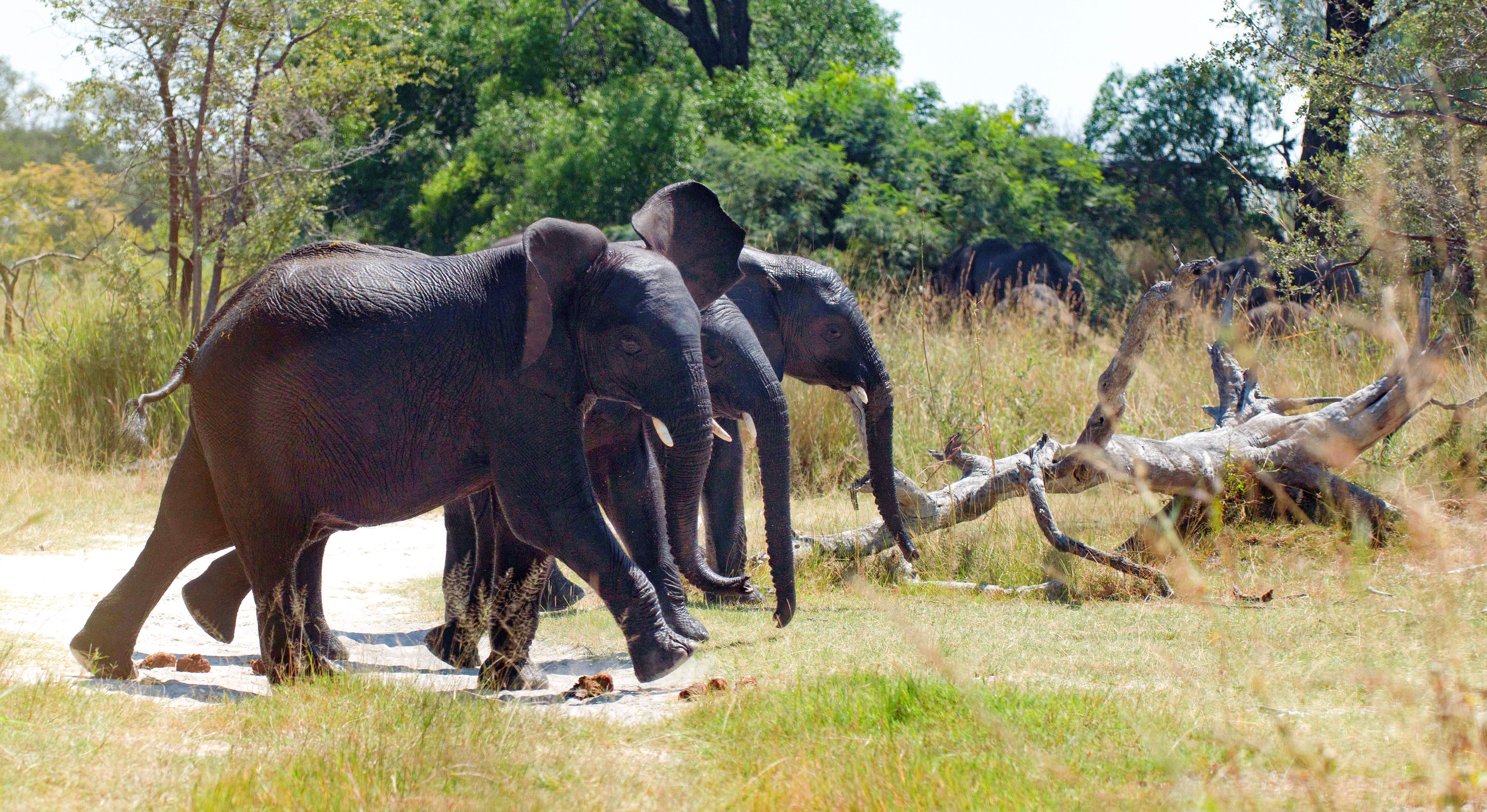
 Elephant impacts on trees in the Kruger Park may depend less on total numbers than on repeated use of particular places. (Photo: Don Pinnock)
For decades, one of the most contested questions in the Kruger National Park has been whether elephants are destroying the trees.
The issue has shaped the park’s most controversial management decision — the culling programme that ran from 1967 to 1994, in which 14,557 elephants were killed, and numbers were held near 8,000.
/file/attachments/orphans/ElliesTrees2_255306.jpg "The Kruger Park is not experiencing a general collapse in woody cover. (Photo: Don Pinnock)")
After culling ended, Kruger’s elephant population rose steadily, exceeding 31,000 by 2020, according to a new study published in Ecological Applications.
But the study suggests that the relationship between elephants and vegetation is not nearly as simple as the old argument implies. Kruger, it finds, is not experiencing a general collapse in woody cover. In fact, satellite-derived data show the opposite: from 2007 to 2022, woody vegetation increased across the park as a whole.
One of the more surprising findings is that the researchers did not find a strong relationship between dry-season elephant density and woody-cover change. Areas with more elephants did not automatically show greater tree loss.
The authors suggest several reasons. Elephant counts used in the study were based on dry-season aerial surveys, while some vegetation impacts may be driven by wet-season movements. Bulls and breeding herds may affect trees differently.
Impacts may also depend less on total numbers than on repeated use of particular places, especially where water, fertile soils and palatable vegetation attract elephants.
This has important implications for management. The study cautions against assuming a simple “direct, park-wide correlation” between elephant numbers and ecological impact. Instead, it argues for monitoring vegetation change directly and responding to specific high-impact areas.
That approach fits Kruger’s broader shift away from managing elephants by a fixed population target. Since the mid-1990s, the park has reduced artificial water provision in an attempt to create more varied patterns of elephant use across the landscape.
The study, titled Long-term vegetation changes in elephant-related areas of concern in Kruger National Park, South Africa, was led by Corli Coetsee of SANParks Scientific Services, with colleagues from SANParks, Nelson Mandela University, Pixel Detective Consulting, Colorado State University, KU Leuven, the University of Bayreuth and the Cape Peninsula University of Technology.
Impacts ‘localised’
Its central finding is that elephant impacts are highly localised. The authors write that, contrary to widespread concerns, their remote-sensing data did not show a “general decline in woody cover” across Kruger – “woody cover” included any shrub, bush or tree taller than about two metres. However, they found that some areas flagged by park staff showed losses in both woody cover and large-tree height, especially along perennial rivers and on fertile soils.
A landscape can become woodier overall while still losing large trees. Shrubs and coppicing stems may increase, raising total woody cover, even as older trees disappear from riverbanks, floodplains and fertile areas.
Ecologically, the loss of large trees still matters: they provide shade, nesting sites, fruit, structure and habitat complexity.
To identify where elephant-related vegetation change might be occurring, the researchers did not begin with satellites alone. They first consulted Kruger personnel, including all 22 section rangers, four regional rangers and additional staff such as pilots, conservation managers and scientists. In total, 32 people were consulted.
Park staff were asked where they believed elephants were causing areas of concern and what mechanisms might be involved. These areas were drawn on maps and later digitised. The study then compared those mapped areas with remotely sensed changes in woody cover and vegetation height.
After filtering out concerns not directly related to vegetation change, the researchers identified 31 vegetation-related areas of concern.
These fell broadly into four categories: areas where elephants and fire may interact; areas along perennial rivers; areas away from major rivers, but close to seasonal water and fertile soils; and areas where rare plants or unusual vegetation types could be vulnerable to elephant impact.
The study then used a method known as Gedi-fusion remote sensing to measure change. Gedi, the Global Ecosystem Dynamics Investigation, is a spaceborne Lidar system mounted on the International Space Station. It uses laser pulses to measure vegetation structure.
By combining Gedi data with Landsat, radar and other datasets, the researchers estimated woody cover and canopy height across Kruger at 30m resolution.
The result was a more complex picture than either side of the elephant debate might expect.
Cover increased
On average, woody cover in Kruger generally increased between 2007 and 2022. This fits a broader pattern of woody thickening seen in savannas globally.
But within the park, changes were patchy. Some areas showed substantial increases in woody vegetation. Others, particularly along rivers and in fertile seasonal-water areas, showed losses.
The study found that only about 2% of pixels across Kruger showed decreases in woody cover. Of those declining pixels, 31% occurred inside the areas that park personnel had identified as elephant-related areas of concern.
To separate elephant effects from fire, the researchers also examined areas where woody cover declined, but no fire occurred during the study period. These fire-free loss areas covered 2.15% of the park, or about 40,000 hectares. Of those fire-free loss areas, 44% overlapped with areas flagged by park staff as elephant-related concerns.
The authors argue that this overlap suggests elephants were likely a major driver of woody vegetation loss in those places, including by limiting recruitment of new trees. However, they also note that some of these fire-free areas occur close to perennial rivers, where floods may have contributed to tree loss.
Rivers hardest hit
/file/attachments/orphans/ElliesTrees3_710015.jpg "There have been losses in both woody cover and large-tree height along perennial rivers. (Photo: Don Pinnock)")
Rivers emerge as one of the study’s key landscapes of concern. Along perennial rivers, tree loss can be shaped by repeated disturbance. Floods may remove adult trees, while elephants and other herbivores can prevent young trees from replacing them. The result is not only the loss of existing trees, but a failure of recovery.
The Limpopo and Luvuvhu river systems are important examples. The study notes that previous work has shown how floods, lower groundwater recharge and elephant damage can contribute to the contraction or disappearance of riparian tree groves.
In some cases, trees that established after floods later declined, most probably because of elephant impacts. It’s also in these places that historical disturbance of elephants by people may have been important in allowing riparian woodlands to establish and persist.
Fire is another important factor. In fertile basaltic areas, heavier grass fuel loads can produce more intense fires. If elephants have already stripped bark or damaged stems, trees may be more vulnerable. The study describes elephant impacts on woody vegetation as “spatially heterogeneous”, often mediated by fire, flood, drought and other herbivores.
Adaptive strategies
The new study does not call for a return to broad population control. Rather, it supports “targeted and adaptive management strategies” in vulnerable places: riverine woodlands, fertile seasonal-water areas, rare plant habitats and sites where fire and elephant damage combine.
Its value lies partly in the way it combines two kinds of evidence: local knowledge from rangers and staff, and advanced remote sensing from space. The researchers argue that this combination can help identify high-use zones and guide future interventions.
The result is a more nuanced account of Kruger’s elephant question. Elephants are neither simply destroying the park nor harmlessly moving through it. Across Kruger, the trend is that woody cover is increasing. But in particular places, under particular conditions, elephant pressure appears to be contributing to the loss of trees and the failure of woodland recovery.
The debate, then, is not whether elephants are good or bad for Kruger. The study suggests that the more useful question is where their effects become ecologically significant – and how quickly managers can detect and respond to those changes. DM
SANParks elephant management approach
Elephant management in itself is a complex issue, with available scientific evidence being subject to varying interpretations and huge diversity of stakeholder values and expectations.
SANParks bases its management approach on evidence and information in the context of ongoing learning. We acknowledge that:
There is no such thing as an “ideal number” or elephant carrying capacity for a specific national park;
The impact of elephants depends on where they live, how much space they have and how they use the landscapes;
Elephants play a key role in savannah ecosystems because of the intensity with which they use particular areas; and
SANParks, therefore, manages elephant impacts, not numbers, requiring an integrated landscape level approach. DM


Comments
Scroll down to load comments...