



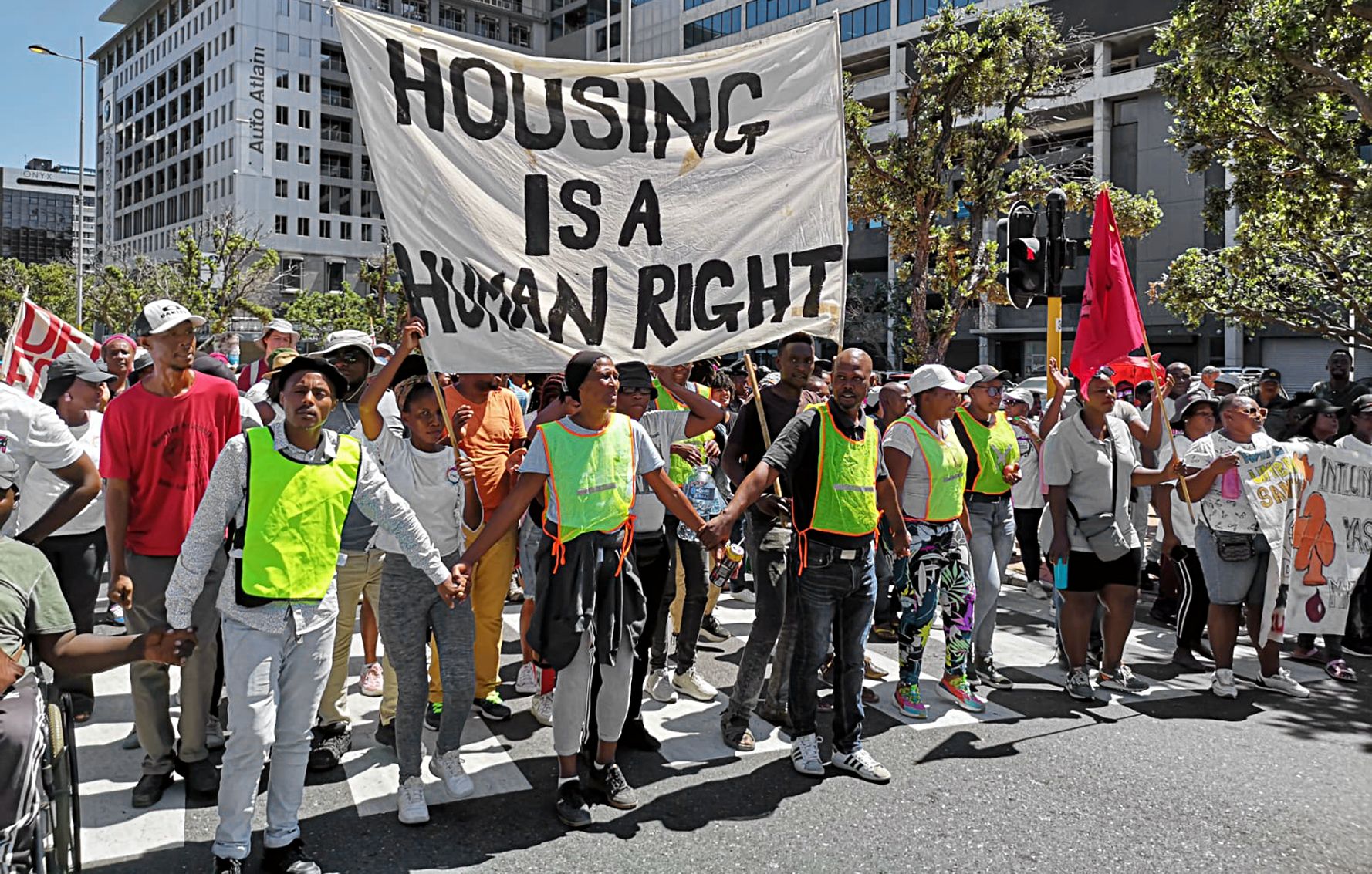
 Members of several housing rights movements, including Ndifuna Ukwazi, Intlungu yaseMatyotyombeni and Indibano Yabahlali, march from Hanover Street to Cape Town Civic Centre on Wednesday, 8 February 2022. (Photo: Tamsin Metelerkamp)
In October 2025, Cape Town mayor Geordin Hill-Lewis told Daily Maverick that he considered the term “spatial apartheid” a “kind of propaganda language that is no longer rooted in reality”. When a minor PR crisis ensued, he explained that the DA was not responsible for “perpetuating” the phenomenon. On Thursday, 2 July, in a historic judgment, nine judges of the Constitutional Court ruled unanimously that Hill-Lewis’s party was indeed responsible for its prolongation.
Handed down two days after a nationwide crisis that threatened to sink the country into a maelstrom of xenophobic and ethnic violence, the judgment represents the culmination of a decade-long battle waged on behalf of Cape Town’s marginalised and dispossessed.
As Justice Nonkosi Mhlantla, with the full support of the remaining eight judges on the Bench, noted in the second sentence of the opening paragraph:
“The submissions in these matters have highlighted the crucial distinction between merely distributing resources and ensuring that those resources are distributed in a manner that actively dismantles historical inequalities shaped by race and class along geographical lines.”
The judges were unanimous, in other words, that in enacting section 25 and section 26 of the Constitution, the Western Cape provincial government and the City of Cape Town had always been obligated to pay attention to location — and, specifically, that this obligation entailed the provision of affordable housing not just in the Cape Town CBD but in the upmarket, historically white suburb of Sea Point.
For a tight-knit group of activists and human rights lawyers, the ruling is a profound victory in their bitter and enduring conflict with Cape Town’s development agenda. Back in January 2016, when the Western Cape government — acting on the orders of the then premier, Helen Zille — announced the sale of the mothballed Tafelberg Remedial School to the Phyllis Jowell Jewish Day School for R135-million, the site of the struggle became these empty buildings on Sea Point’s Main Road.
/file/dailymaverick/wp-content/uploads/2025/09/Z63_7453-copy.jpg "The old Tafelberg School in Sea Point on 9 September 2025. (Photo: David Harrison)")
To many Capetonians, the address was an obvious cypher for the city’s blatant imbalances. Why, the question was asked, did the DA government choose to sell the old Tafelberg school at a profit when the people that serviced Sea Point’s economy — the waiters, cleaners, nurses and childminders — were forced to commute for hours every day from the Cape Flats? Why not repurpose the empty buildings for affordable housing?
As it turned out, it was a question tailor-made for a court challenge, one that cut to the heart of South Africa’s post-apartheid promises.
In the original application brought before the Western Cape Division of the High Court in May 2017, the first applicant — and the deponent of the founding affidavit — was Thozama Angela Adonisi, a nurse at the Christiaan Barnard Memorial Hospital and the resident of a basement dwelling in a Sea Point block of flats.
Adonisi, as the court papers made clear, was at the time a member of the leadership committee of Reclaim the City, a voluntary social movement made up of working-class residents that had recently launched its campaign for affordable housing in “well-located areas”.
The movement, backed up by the trustees of housing activist group Ndifuna Ukwazi, successfully persuaded the court — in a judgment handed down on 31 August 2020 — that the sale of the old Tafelberg school was in breach of the Constitution. But less than three weeks later, on 18 September 2020, although Premier Alan Winde had stated in the same media release that he was “absolutely committed to achieving spatial redress” in the province, he explained why he was appealing against the judgment anyway.
/file/dailymaverick/wp-content/uploads/2025/02/Tafelberg-March-by-RTC-on-8-Feb-2025-1-by-Zachariah-Mashele-Ndifuna-Ukwazi.jpg "Activists from Reclaim the City march on 8 February 2024 in support of releasing the Tafelberg site in Sea Point for social housing development. (Photo: Supplied / Ndifuna Ukwazi)")
Fast-forward to 2024, which would witness two significant events in the unfolding saga. In April of that year, the Supreme Court of Appeal would find in favour of the provincial government. In June, at the Sheffield DocFest in the United Kingdom, the documentary film Mother City would make its international premiere, with Ndifuna Ukwazi and the Tafelberg case as its central pillar.
‘No place for old locals’
As articulated by the film’s co-creators, the acclaimed journalists Pearlie Joubert and Miki Redelinghuys, the spatial apartheid that had long characterised Cape Town was by this point inciting a minor insurrection. This new heat, the product of a development policy that foregrounded tourism and economic growth, was all there in Mother City’s strapline: “A daring urban revolution in a city breathtakingly beautiful and brutal.”
In September 2025, Daily Maverick would include all of these details in a feature entitled “Sea Point’s broken promises — no place for old locals,” where we would point out that it wasn’t only working-class Capetonians being kept out of the city’s central districts; it was now the middle-income earners too.
The feature would lead to an in-depth interview with Mayor Geordin Hill-Lewis, who in October 2025 would defend his vision for the city’s future.
It was our third question that caused all the trouble.
“As you no doubt know,” we said, “Mother City follows the fight for affordable housing in Cape Town’s ‘well-located’ areas, with social activists demanding that the people who service the tourist economy — from restaurant workers to hotel staff to cleaners — finally be granted housing close to their places of work. In essence, it is a film about spatial apartheid; about the fact that the City of Cape Town seems uninterested in addressing the phenomenon. What are your comments?”
Hill-Lewis, after dismissing Mother City as a “propaganda film” that “tries to provide a tacit endorsement for illegal land occupation,” went on to explain that he had “done more in the last three years to release land for social housing in well-located parts of the city than in the 10 years prior to that combined”. There were at that stage “about 12,000 [affordable housing] units at various stages of development,” he informed us.
Then he said this: “I’m not sure whether those adjectives are [Pearlie Joubert’s] or yours — when you say things like ‘spatial apartheid’ and ‘deliberate exclusion’ — but I think that’s just kind of propaganda language that is no longer rooted in reality.”
/file/dailymaverick/wp-content/uploads/2024/06/Mother-City-Nkosikhona-Swartbooi.jpeg "Leading affordable housing activist Nkosikhona Swartbooi speaks at a Reclaim the City Rally. (Photo: Supplied)")
More than a month later, after the comments had sparked a minor but ongoing PR crisis, Hill-Lewis would insist through his personal assistant that he was “commenting on the narrative put forward by the activists and not dismissing the fact that the legacy of spatial apartheid exists.” In February of 2026, in a widely viewed on-stage interview with Dan Corder, he repeated the explanation.
“The question put to me [by Daily Maverick],” he responded to an audience member during the Q&A, “implied that we are perpetuating spatial apartheid. That notion, the notion that we have some active policy position to perpetuate spatial apartheid, I said is propaganda nonsense, and I stand by that. It would be completely insane to suggest that there is no such thing as the legacy of spatial apartheid.”
On 2 July, by every possible reading, nine judges of the Constitutional Court ruled unanimously that the Hill-Lewis-led City of Cape Town, aided and abetted by the Western Cape provincial government, had indeed been perpetuating the legacy of spatial apartheid.
A story of division
“A city’s architecture tells the story of its soul,” the second paragraph of the judgment began. “In Cape Town, as in most, if not all, South African cities, that story remains one of division — where the echoes of apartheid’s spatial planning continue to reverberate through its streets and suburbs. Every morning, thousands of Cape Town’s workers board buses, taxis and trains in the pre-dawn darkness, travelling for hours from the city’s periphery to its centre. Their daily journey is not just a commute — it is a living testament to the enduring legacy of spatial injustice that this case glaringly exposes before this Court.”
As a corrective, after noting that the provincial government and the City of Cape Town had “failed to comply with their obligations” to implement and complete social housing programmes in the CBD and Sea Point, the Constitutional Court ordered both entities to report back within three months on their housing pipelines and budgets.
By Daily Maverick’s understanding, this injunction was a direct result of the refusal of Winde’s provincial government to accept the high court ruling of August 2020. DM
Comments
Scroll down to load comments...