



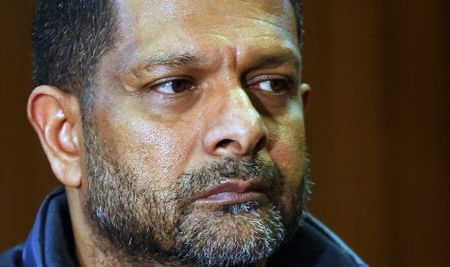
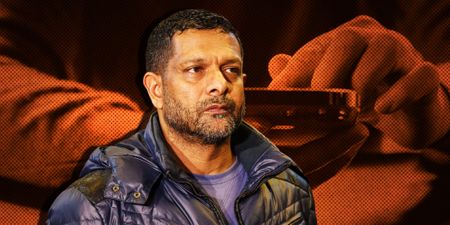
 Illustrative Image: Senior Crime Intelligence Officer, Feroz Khan. (Photo: RT Wright / Gallo Images) | Feroz Khan attemtped murder. (Photo: Madlangacommission / SAPS / Facebook) | (By Daniella Lee Ming Yesca)
 While Feroz Khan lay sedated, “non verbal” and in “critical condition” in a hospital ward in Johannesburg his legal team faced a severe pushback from commissioners for public statements attempting to implicate the inquiry in the general’s shooting.
The matter was so serious, said commission chairperson, retired judge Mbuyiseli Madlanga, that it needed to be aired in an open forum to protect the integrity of the commission itself.
Speculation and false statements
On Wednesday, after Khan’s legal team, advocate Zubair Khan and attorney Mohammed Valley, withdrew an application to file a supplementary affidavit to Khan’s original ex-parte attempt to force “in camera” proceedings, Madlanga spoke up sternly.
“Up to today, we have never had to follow, interact with, pronounce on or engage with issues that are out there in the media,” he began.
He addressed Khan and Valley directly, stating that commission spokesperson Jeremy Michaels had “noted with concern” statements Khan had made in an interview with Newzroom Afrika’s Ziyanda Ngcobo and other media houses after Sunday’s shooting, implicating the commission in a “leak” of documents.
Madlanga asked Khan what time General Khan had served his papers on the commission on Sunday night. To which evidence leader advocate Adila Hassim replied that this had occurred at 11.04pm exactly.
“And what time was the general supposed to have been shot?” asked Madlanga, to which Khan responded “about 11.30pm”.
Hassim noted that eNCA had arrived on the scene of the shooting at about 11.18pm and had been informed the shooting had occurred just after 11pm.
She said Valley and Khan had spoken to the media afterwards, stating that the general had “feared for his life and had been travelling in unmarked vehicles and had no police protection”.
They had also been quoted as saying “unfortunately, the prophecy that blood will spill in the roads has now come true”.
In the interview Khan had mentioned the assassination of Witness D, Marius van der Merwe, said Hassim, adding: “And then you mention the fact that the application was served and that there must have been a leak within the commission.
“Everything looked at in context, you are suggesting General Khan might have been shot as a result of that leak. Why else mention this?” she asked Khan.
Khan responded that he had in fact been reading a statement on behalf of the family and that Valley had been present at the time. He said he had also obtained “his impression” of events from the family. Khan admitted that this was speculation.
Crowded hospital foyer
Khan had also suggested that because the general might have implicated other high-ranking officials this “leak” had occurred, and a further claim was that the commission had “directed” officials to check up on Khan’s condition in hospital. These were “totally false”, added judge Madlanga.
After consultation with Varney, Khan responded that at the time the hospital foyer had been “crowded” with various police “units” all eager to get to the patient, and that someone had told someone that someone from the Madlanga Commission had wanted access.
Madlanga shot back that how a “reasonable person” understood the claim that Khan had been shot after submitting his application, and that there must have been a leak, was what mattered.
“Go back to the context to when General Khan is shot,” said Madlanga, continuing. “When you look at it holistically, he serves the commission, he gets shot after service of the documents, there are leaks within the commission. When you look at the totality, it does reasonably suggest you were saying as a result of the leak from the commission. That is how it would have been understood. Listeners would understand this. You say this in the context of General Khan being shot.”
“Absolutely not,” replied Khan. He said he had made these statements “unknowingly and before the media” and that this had not been what he had intended to communicate.
To which Madlanga responded: “May I say this is then. If you are ever to make media briefings again, be careful what you say to impute the integrity of this commission”.
The show goes on
Meanwhile, Hassan said the team was ready to proceed with Khan’s evidence on Friday, whether he was present or not, and that the commission would decide which sensitive matters might be held “in camera”.
Khan’s earlier attempt to backtrack on the application he made when he approached the court for an “in camera” hearing without informing the commission backfired on him when evidence pertaining to Khan’s connection to alleged tobacco smugglers, underworld figures and politicians was made public in court documents.
A game-changing affidavit by Madlanga Commission investigator Tshepo Nyatlo was contained in the bundle relating to Khan’s attempt to interdict the SA Police Service (SAPS) and the Madlanga Commission from accessing electronic devices seized during a raid on his Houghton home in May.
Khan will have to explain Annexure C and his relationship with a list of people of interest including EFF leader Julius Malema, alleged tobacco lord Mo Sayed, alleged assassin Matipandile Sotheni, Carnilinx owner Adriano Mazzotti, businessman “Ze” Khumalo, alleged gold smuggler Tariq Downes and others.
Valley told the commission on Wednesday that Khan had received 300,000 WhatsApps and 11,000 pages of financial documents from the commission on the Saturday before he consulted his legal team on Sunday. He was shot while driving home afterwards. They needed time to go through these, they said. DM
Comments
Scroll down to load comments...