




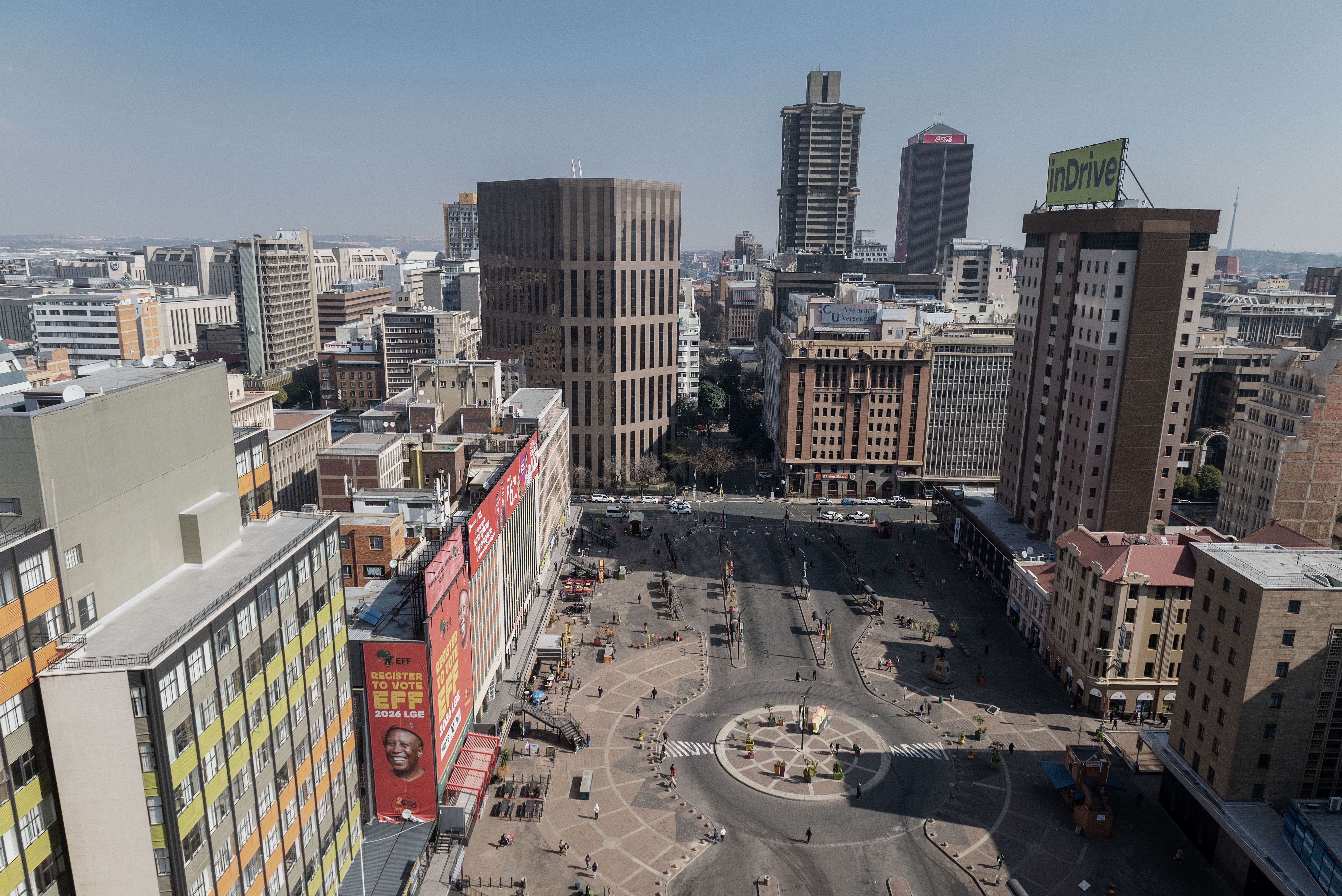
 Gandhi Square, in the heart of Johannesburg CBD, is one of the city’s most notable landmarks. It is managed by Olitzki Property Holdings. Owned by Gerald Olitzki, they have transformed underutilised buildings and neglected public spaces and contributed to the revitalisation of Johannesburg’s inner city. (Photo: Leon Sadiki)
Joburg is popping – it’s the counter-narrative to the meta-narrative of decline. As a city reporter, I witness the dangers of the single story in real time almost every day, and my guide today is Gerald Olitzki, the founder of Olitzki Property Holdings (OPH).
The author Chimamanda Ngozi Adichie taught the world to avoid the single story. (If you haven’t watched it, her TED Talk is a must.) It’s spot-on for the city.
Joburg has big issues. Sure. But there is another story. To wit: the city is the sexy backdrop to the Netflix hit The Polygamist. The never-say-die people keep the city going and are not sufficiently audited and narrated as social capital. At 74, Olitzki has been insisting on a different story for his city for decades.
He is showing me the walkable city – or how you can walk from Carlton Centre in the east to the magistrates’ court on the western edge along a thriving, clean and rather cool east-to-west spinal column. OPH, along with other businesses, has a city lease to keep the spine clean and secure.
/file/attachments/orphans/OPH6_341617.jpg "Gerald Olitzki, founder of Olitzki Property Holdings, has played a pivotal role in reshaping Joburg’s inner city. Through a vision rooted in urban renewal, OPH has transformed underutilised buildings and neglected public spaces into vibrant, safe, and functional environments that support businesses, residents and visitors alike. (Photo: Leon Sadiki)")
On a Friday morning, it’s buzzing with people on foot. The cafés we pass are full. The ample beauty salons are doing a clipping trade in nails and hair. Visible security staff keep it safe; cleaning is ongoing. Olitzki is annoyed by a single piece of paper we find.
OPH owns many of the buildings along the route, and their rental occupancy is above 90%. It’s not talk but a well-known story. Daily Maverick witnessed it during the walk and met the tenants.
While the national economic story is one of stalled growth and high unemployment, there is a different economy at play here. It looks to be thriving, a fortune at the bottom of the pyramid. The fortune of the bottom of the pyramid is the theory of economists CK Prahalad and Stuart L Hart. Its thesis is that there is good business to be done in consumer markets that corporates often overlook as they chase the middle and top of the pyramid. The most famous examples are the money-send fintech M-Pesa and Bangladesh’s Grameen Bank, which gives empowering microloans to women entrepreneurs and farmers.
We’re looking at a 2,000 m² city gym in a beautifully restored old building downtown on Marshall Street. When Olitzki bought it, the building, like many others, was occupied by squatters as corporate HQ’s abandoned the inner cities from the eighties for Sandton and the new north.
I can’t quite believe it’s the recent past, looking up at the early-morning gym bunnies running on the treadmill and feeling the vibe of the busy downtown. The property developer didn’t go the traditional route of clearing out his building.
“The traditional way of clearing a building was you spend half a million rand with the lawyers. Eventually you get a court order, the Red Ants [a notorious company which clears occupied buildings] come, and they throw people’s stuff out at three o’clock in the morning. This was not for me.
“So, what I did was, I engaged the residents. I said: ‘Guys, listen, this is what’s going to happen to you. Eventually you are going to be thrown out of here. So, I don’t want to give the money to the lawyers. Here’s half a million rand. How many residents are you?’ We eventually gave the tenants the half a million rand to move out.”
There’s a business pragmatism driven by humanism here. He laughs, saying that as some occupiers learned his method, they also learned to move to the next building he bought to coin it.
We walk further down the road to the first arcade OPH created. It is quite lovely, painted in ochre and yellow; a cannabis store has taken a shopfront, there are doctors’ rooms and a beauty salon.
/file/attachments/orphans/OPH08_932129.jpg "Olitzki Property Holdings has transformed underutilised buildings and neglected public spaces. (Photo: Leon Sadiki)")
/file/attachments/orphans/OPH042_283934.jpg "The Standard Bank Building in the Johannesburg CBD is one of the city's most notable landmarks. It is surrounded by several Olitzki Property Holdings development projects. (Photo: Leon Sadiki)")
Many of the company’s heritage buildings have been sensitively restored, and parking lots introduced. Arcades were always used to create walkways across streets in the old Joburg, and Olitzki remains a firm believer in their utility.
Inner-city buildings often have inadequate or no parking because many of them date back to the horse-drawn buggy era of the Gold Rush. In many, OPH has blasted out parking basements for car-loving Joburg professionals who rent space in their buildings.
The buildings in and around the arcade were also all occupied by homeless tenants who took them over as they emptied out with the business flight north.
/file/attachments/orphans/OPH059_762575.jpg "Joburg is popping – it’s the counter-narrative to the meta-narrative of decline. (Photo: Leon Sadiki)")
“Each of the squatted buildings has a committee. There is a representative per floor. Once you identified that, you met with them. What I’m telling you took years to get the credibility, because there wasn’t trust. But eventually we got the trust,” says Olitzki.
“I’m not saying we solved the problem, but we actually relocated it. We could move them from a building and they would go to another building. I had repeat customers, you know? It got easier and easier as we went along because the trust was there. It was a way of taking these squatter-occupied derelict buildings and reviving them.
“With a human approach to it, we were able to. Everything about the city had to be customised because conventional methods didn’t work here. That’s why I think we’ve survived. I don’t have a formal background in property development. I’m a lawyer by profession. But because I’ve had to adapt to the special circumstances, that’s what made it work. It’s an unconventional business, for sure, but it is working.”
Lifts, lobbies and loos
All the buildings we visit – many heritage, and some more modern, are well-tenanted, either by government or by professionals (lawyers, accountants, auditors) with small practices. OPH’s theory of tenanting is about creating dignity and panache for their tenants. Olitzki works with an in-house design team to create spaces that have an African aesthetic. He tells me about the three L’s that guide his property philosophy.
“It’s lifts which are very good. Lobbies, which are very important, and loos, which are very important. Those are the three Ls. Just constant maintenance, constant care. I won’t say zero tolerance, but just to make sure that everything is properly maintained on a regular basis.
“I’ve always said to people, if a president comes to visit you, you should not be embarrassed. That’s the importance of lobbies, because that’s the first impression of a building. If you buy a house, they talk about kerb appeal. The first impression of a building is the entrance. As you walk in, if it’s a nice entrance, you feel welcomed. You feel it is part of the experience. All of this is experience. You start here, but then you’ve also got to create nice offices. The lifts have got to work.”
/file/attachments/orphans/OPH026_342308.jpg "Transforming underutilised buildings and contributing to the revitalisation of Johannesburg’s inner city. (Photo: Leon Sadiki)")
Many of the buildings make me instantly want to sell up in the suburb we live in and move to the inner city. OPH only does commercial property, but there are many lovely residential buildings in the old city, too. We are in the old High Court Building on Gandhi Square, the heart of OPH’s 300,000m2 portfolio – it has sold another 150,000 m2 in inner-city property. OPH’s lease over Gandhi Square included its redevelopment and responsibility for security, maintenance and cleaning.
The square is a pristine and interesting transport interchange with public art and spaces to linger. The Vodacom store on the square is undergoing a R2-million revamp; the McDonald’s stretches street to street and is like the best big-city stores you’ve seen anywhere. People work at tables, laptops plugged in, while the food queues are non-stop. The EFF’s red headquarters is here. I can’t wait to go back to the huge Adidas.
/file/attachments/orphans/OPH020_641164.jpg "Gandhi Square, in the heart of Johannesburg CBD, is one of the city's most notable landmarks. Olitzki Property Holdings has a lease over Gandhi Square with responsibility for its redevelopment and for security, maintenance and cleaning.(Photo: Leon Sadiki)")
Small is beautiful
“Upstairs, we’ve got small offices. This is also important: what we do is cater for offices for beginners, for newly started-up businesses. We even give furnished offices, as small as 20 square metres. This is how I started the whole thing – with the smaller guys. When you came to the city, all the big guys had deserted, so I had to engage the smaller guys,” says Olitzki.
“You had lawyers and accountants who were in crappy little – excuse my French – offices. So, if you have quality professionals sitting in crummy offices, it is a huge disadvantage. I literally walked door to door and said, ‘I can give you offices that look a lot better than what you’re in.’”
“We take responsibility for their signage. We put up a signboard outside. As soon as someone is in, we give them a template, send it to the printers and get their signage done for them. So again, there’s that style. You’ve got an attorney in a suite with a name on the front door, in a building that is respectable, has all the modern facilities – CCTV, fire compliance, modern lighting – but this building is from 1904.”
/file/attachments/orphans/OPH018_740627.jpg "Gerald Olitzki, owner of Olitzki Property Holdings, has been insisting on a different story for his city for decades. (Photo: Leon Sadiki)")
“I also had a bit of a relationship with the trade unions, and nobody wanted the trade unions (back then). So, to this day, I’ve got a relationship with the unions and they are often tenants. In fact, I’ve assisted some of them in buying their own buildings.” The ANC Joburg region is also an OPH client.

“The important thing was that we had to bring people onto the street. People were scared to come onto the street. With the improvement districts, we made it safe. You’ll see as you go – despite the holes in the ground – it’s clean, it’s safe, and it’s walkable.”
As we walk, I realise that sometimes the idea that ‘If you build it, they will come’ is true. This part of the inner city is clearly booming, with shops full and none of the ubiquitous ‘To Let’ signs that serve as a telltale sign of decline. Good properties with great lobbies have attracted a clientele that includes professionals with small, busy practices.
It’s not a European bubble.
/file/attachments/orphans/OPH047_565068.jpg "Gandhi Square, located in the heart of Johannesburg CBD, is one of the city's most notable landmarks. (Photo: Leon Sadiki)")
“What I love about the city is that if I go to Sandton City, I may recognise a dozen people and they make like they don’t see me. Here, there’s neighbourhood. People greet people. There is a friendliness, which is what I love about the city, which you don’t get in the suburbs,” says Olitzki.
“They moved to Sandton and Rosebank. What is Rosebank and Sandton? It’s a little bubble. It’s a European bubble. In fact, I’m annoyed that they called Sandton Square Mandela Square, because it had nothing to do with Mandela. As far as I’m concerned, it was to preserve that European bubble,” he says.
“This was essentially a white city once upon a time. Black people didn’t feel comfortable coming into the city. When we started normalising – I use that word pointedly – black people started using this city. Old swart gevaar kicked in. It meant: ‘Let’s go. Let’s get the hell out of here.’
Banking on the new market
We’re at the Carlton Centre now, near Fox Street. “The original main entrance used to be on Commissioner Street. Once we developed this walkway, this funny little entrance became the main entrance of the Carlton Centre, because this is where the traffic is. This was the beginning of my plan.”
People are walking from the Carlton to their offices or going shopping or to the surrounding banks, all of which have repeatedly renewed their leases.
“I’ll use the banks as a good example. Those banks that cater for the broader population and employ the broader population are in the city. The more niche banks that cater to the northern suburbs – like Investec or the former Credit Suisse – will be in Sandton.
“There is a place for Sandton, but there is a place for the city. They are catering for the masses here. This is a different set of customers. This was always the intention,” he says, showing this living version of the bottom of the pyramid theory. The entrepreneurs and small businesses, along with a public-sector professional class, have energised Joburg, creating a new story for her.
My ‘love affair’
On Gandhi Square, Olitzki tells his founding story. “That building over there – I’ve got a love affair with that building. I did my articles there. I had a tiny little office. That is actually where the whole dream started. I used to look down at the square and say to myself: Johannesburg is a mining city.” He points to a building that has McDonald’s on the ground floor and smaller shops on the first floor.
“There was never any town planning. This was the worst of the worst. Even when Johannesburg was in its [old] prime, this was Hell’s Kitchen. There were squatters, hobos, glue sniffers, pickpockets. It was unsafe. The girls in the office wouldn’t come down with jewellery, because they’d lose their jewellery. I watched from a tiny little office and said, goodness. Then I saw the city getting worse and worse, and that’s actually where the dream started.”
/file/attachments/orphans/OPH035_133398.jpg "Main Street in Marshalltown, Johannesburg, where OPH has transformed underutilised buildings and neglected public spaces into vibrant, safe, and functional environments that support businesses, residents and commuters in the inner city. (Photo: Leon Sadiki)")
Olitzki started knocking on the doors of the city administration, and also of big and small businesses, to get them to buy into his idea of making Main Street fully walkable as a central city corridor.
“Why do I have a love affair [with the square and the inner city]? Because when I started my law practice in 1978, I took offices in this building. Then I moved away, and in 1989 that was the first building I bought.”
From Gandhi Square, you can walk all the way to the Magistrates Court through the old mining district, which is now an arts, education and sports hub where Jozi, my Jozi, is working its magic. Olitzki and his team are still buying up buildings like the majestic old Standard Bank HQ on the corner of Harrison and Fox, and the Chamber of Mines building, where the Kruger rand was designed. More about that next time.
As we say goodbye, I feel once again the sense I’ve had all year: that Joburg, despite everything, is about to turn. DM
To read more:
Anna Cox reports on Joburg’s Education Town.
Laurice Taitz-Buntman reports on Joburg’s new field of dreams.
Kulani Nkuna reports on what the Chamber of Mines district is like now.
Comments
Scroll down to load comments...