




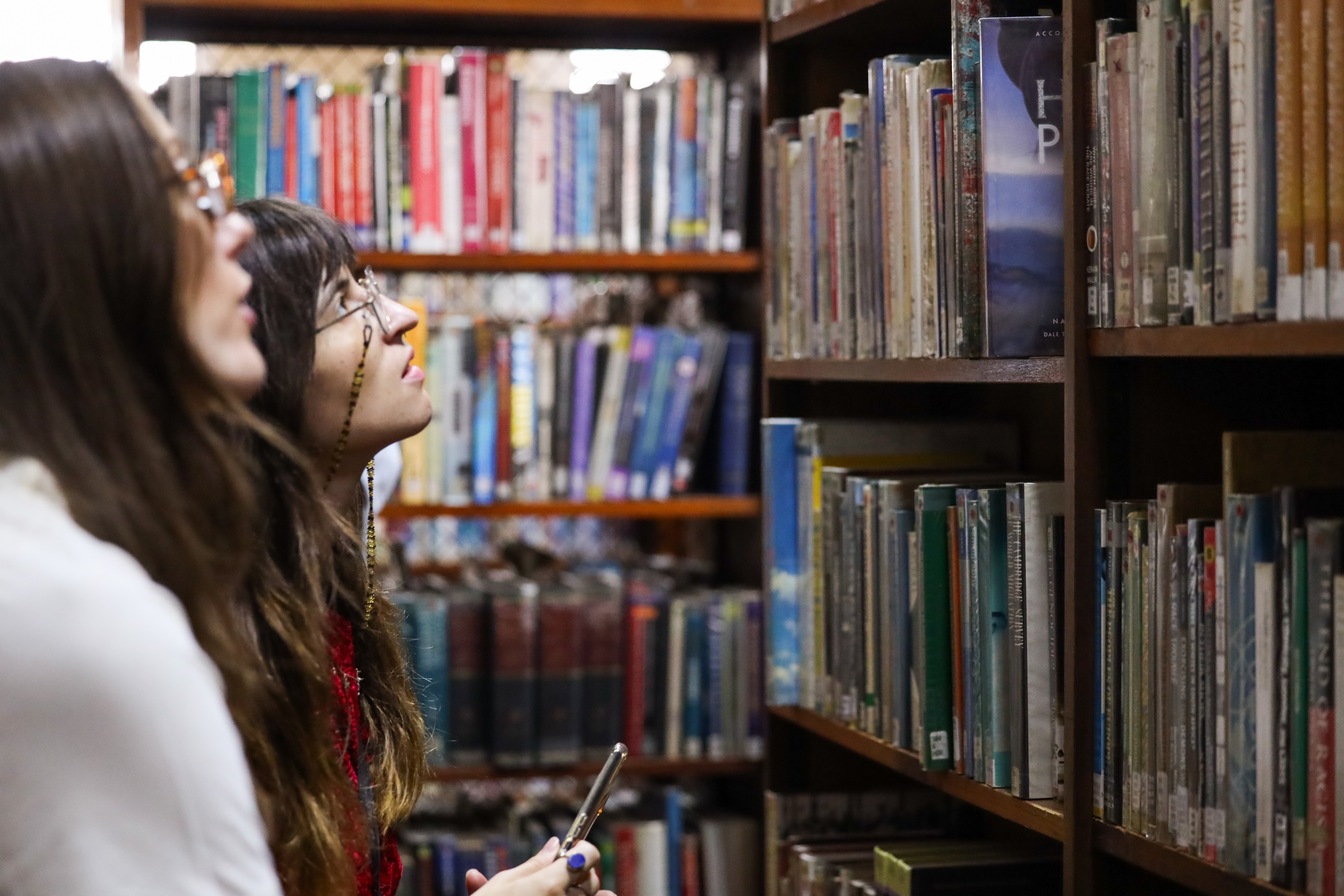
 Phase one opening of the Johannesburg City Library on 21 March 2025. (Photo: Gallo Images/Lubabalo Lesolle)
I’m hesitant to write this, because I know there are a million reasons to lament our city’s current state of dilapidation, as Anna Cox and others at Daily Maverick have shown us.
But also, this is home.
I’ve always said to people new to Joburg that it is a terrible city to visit but a wonderful city to live in. It holds its cards close to its chest. You need to make an effort to get to know it.
But if you love Joburg, it will love you back. This was proven again when a trip to the Standard Bank Art Gallery’s Homecoming exhibition on Thursday, 28 May turned into a personalised tour of the city library’s underground stacks.
A friend and I drove into town, parked at Standard Bank and made our way around the gallery. We finished and said to each other, we’ve been meaning to go to the reopened Johannesburg City Library for some time, let’s just walk there now – so we did. The skies were blue, the streets were clean, and the people friendly.
We made our way down Simmonds, past the premier’s office, which is opposite the gutted Clegg House, and left into Market at Beyers Naudé Square, which faces the back of our City Hall.
The library gardens, once filled with foreboding barbed wire, are open and clean, people sitting in the Highveld winter sun.
As we entered the library I was filled with nostalgia. Not for this library, but for every library I have ever been in.
I wrote my entire PhD thesis in the William Cullen library at Wits, I grew up as a child of the Bellville Public Library where my mom worked, I remember studying for exams in the carrels of the Rhodes University library.
I think one of the many side-effects of consumer culture is that people have forgotten how to use places that are free. Sure, these spaces are used by students and schoolkids, but what about those of us who work from home or coffee shops? Wouldn’t it be nice to go somewhere quiet to do some work that didn’t cost anything? Guess what? It exists!
The reference section, on the immediate right to the entrance, is a huge hall surrounded by books, with many available desks, high ceilings and free Wi-Fi.
The reference librarian saw us poking around and sensed our curiosity. He asked us if we had ever been down into the archives. You know Substack, the all-the-rage blogging site? Well, it gets its name from the original stacks (aka shelves) in the library. And underground there are the magical archival stacks. Would we like a tour? Would we ever! (Both of us whipped out our phones and jotted off messages cancelling all further plans for the morning.)
Duncan Sebone, who has been working in the reference section for years, was all too pleased to show us around. He said anyone can come for a tour. He took such pride in his work and was immensely knowledgeable.
Hating on government employees is something of a national sport for us, and this really is unfair to all those dignified, hardworking civil servants who carry on carrying on in trying circumstances.
He showed us the antiquated pneumatic tube dispatch system. I was enthralled. I had read about these in 1984 and thought they were an invention (showing my age and miseducation). These are small tubes, the size of pool pipes, connecting the lending desks to the stacks below. You write a note on a piece of paper and dispatch it. Air pumps create a vacuum to pull the note, or compressed air to push it through the tubes to the person waiting on the other side. They then send the required material up on a mini conveyer belt that snakes through the many floors of the underground stacks.
According to the Johannesburg Heritage Foundation the stacks occupy an area of 3,840 square metres and house about 40km of shelving.
These are the kinds of serendipitous discoveries analogue research provides. It brings you into contact with a history you didn’t even know to look for.
We saw copies of the Cape Times from the 1800s, we saw municipal valuation rolls from the 1950s, we saw a family Bible from 1730 (should probably be in a museum, but okay). It made me feel connected to the history of my city and my country in a very tangible way.
The kids library is a charming space, with happy murals and brightly coloured furniture. Plenty of local story books in all our languages and the general lending area is well stocked with contemporary novels. Our library functions on a filial system, so if you take out a book in the city, you could return it in Parkview, for example. And vice versa.
Why not plan a working morning in the city, pick up a novel, and when you’re finished reading it, return it to your local library? You’re not a member, you say? Get on it!
We left the library and ambled along Helen Joseph to Bridge Books’ new premises for a coffee.
Bridge Books is a literary force in the city and turns 10 years old this week. The owner, Griffin Shea, has done remarkable work in what could be considered one of the inner city’s toughest decades. They were pivotal in getting the City Library back open. Their shop is beautiful, peaceful and offers a remarkable selection of local fiction and non-fiction books.
All in all it was a perfect morning out: Art, books and coffee. All in walking distance.
In Griffin’s 1 June newsletter, he writes that “the city can sometimes – OK, many times – demand an awful lot of us to get through the day. But it also gives back in ways that are hard to quantify.”
He notes that kindness is not “a word we associate with Johannesburg very much […] but Joburg has always been kind to me.” I’ve made Joburg my home for the past 20 years, and I completely agree. DM
Hannah Botsis is the author of A Clergyman’s Daughter (Modjaji Books, 2025), which has been long-listed for the Sunday Times Literary Award in the nonfiction category. She writes a weekly column offering down-to-earth insights into family life, social issues, and cultural critique.
Comments
Scroll down to load comments...