



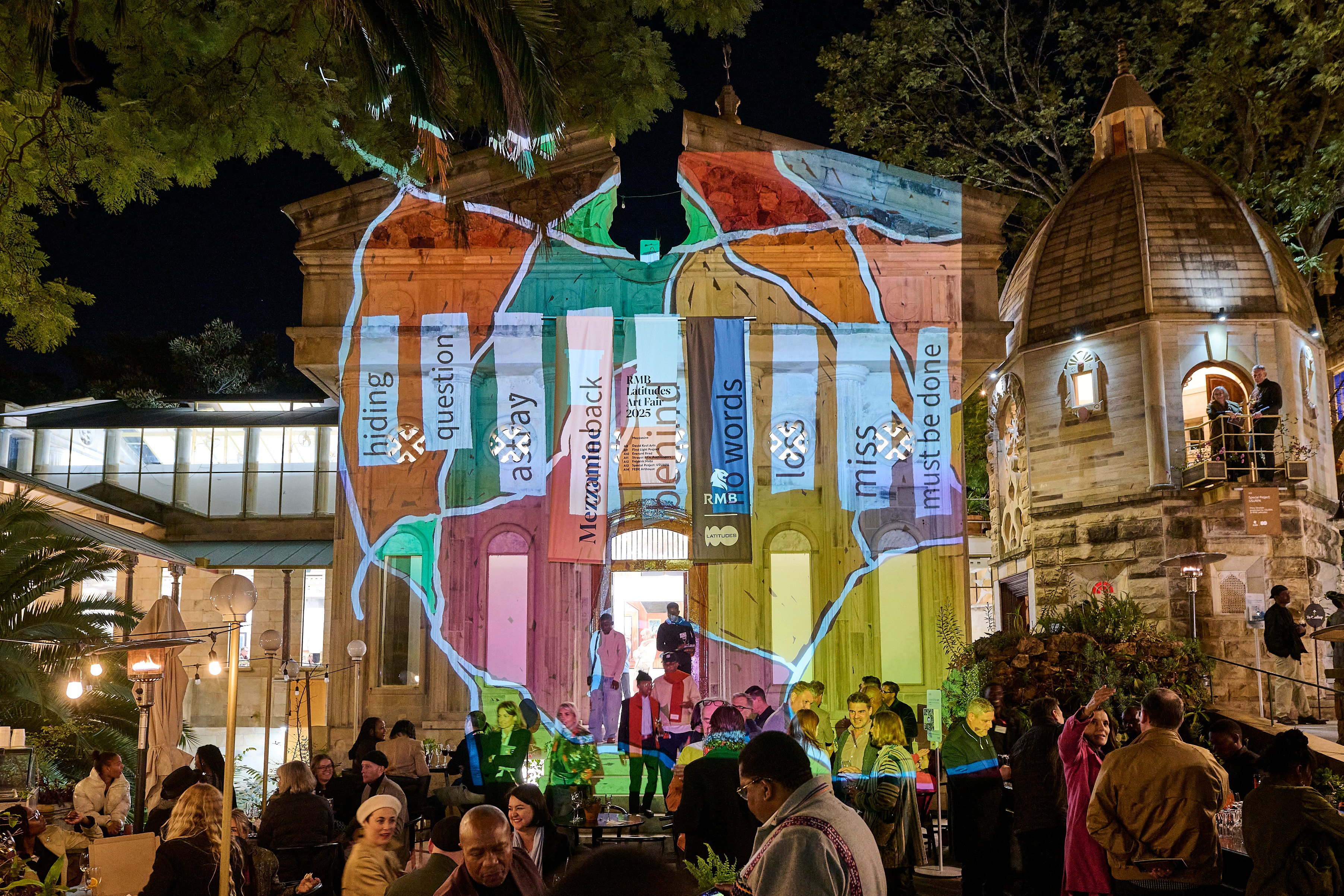
 The RMB Latitudes Art Fair in Johannesburg. (Photo: Chelsea Selvan)
Overheard on opening night at what is arguably Joburg’s warmest art fair: “Why should people be here for free?”
It landed oddly in a space built on proximity. Artists, collectors, patrons, journalists, curious first-timers, old friends and accidental attendees all rubbing shoulders in the way Joburg occasionally allows when its cultural life is working at its best.
The comment stayed with me because only a day earlier, at the memorial service of Maria McCloy, an extraordinary publicist and cultural connector, there was a similar feeling in the room. Different context, same city truth: worlds touching. People from vastly different circles, histories and means gathered around someone who had spent years stitching community together through generously creating access.
It made me think about access – and what happens when barriers are removed. Art, perhaps more than most worlds, is built on unequal relationships. The artist and the patron. The maker and the buyer. The emerging creative trying to survive in a city where cultural production is abundant but economic reward is uneven. Yet Joburg has always had a curious ability to collapse distance, if only for an evening.
/file/attachments/orphans/FNBArtJoburg2023-phsupplied5_251249.jpg "The FNB Art Joburg art fair. (Photo: FNB Art Joburg)")
Opening nights matter because they democratise proximity. They create moments where someone who has never bought a work of art finds themselves in conversation with an artist. Where a young creative meets a future collaborator. Where someone wandering in for a glass of wine leaves curious and newly attentive.
You cannot build audiences without access. You cannot create collectors without curiosity. And curiosity grows through welcome.
This is one of Joburg’s great cultural strengths. Post-1994, despite all our fractures, there has been a steady opening – an understanding that bringing people together matters. Culture grows stronger when it becomes porous rather than precious.
It is part of what makes Joburg one of the continent’s most compelling cultural cities: a place where art is made with urgency, where worlds collide, and where status can shift through a single introduction or conversation.
Lived experience
In May, I travelled to Venice for the Biennale and found a similar dynamic at work. Not in the fantasy of Venice, but in the lived experience of it. For the occasion, the city itself becomes an exhibition space. Wander down an alleyway, and you find an installation in a church, a palace, a former warehouse or a forgotten courtyard. Yes, there are VIP openings and velvet ropes, but so much of the experience spills into the city itself.
The most memorable moments were not at the official Biennale sites. They happened off-site, unexpectedly, when we stumbled across something extraordinary because the city rewarded wandering and encounter.
Perhaps that is the lesson.
A cultural scene does not deepen through exclusivity alone. Status matters. Patronage matters. Collectors matter. But openness matters too. The strongest cultural ecosystems understand that today’s curious visitor may become tomorrow’s collector, commissioner, advocate or artist.
This is where patronage plays its most valuable role – not as a branding exercise, but as belief in cultural life.
/file/attachments/orphans/Straussco1_250055.jpg "Strauss & Co goes beyond traditional auctions and focuses on gathering. (Photo: Strauss & Co)")
Strauss & Co understands this instinctively. What used to be simply auction previews are now lunches, conversations, and opportunities to break bread. Art has become not only about acquisition but about gathering. Relationships are formed around those tables because context is shared, confidence grows, and people who may once have felt excluded begin to feel welcome.
Sasol’s long-standing support of the arts in the Sasol New Signatures award for emerging artists reveals another truth: careers are built through sustained opportunity. Emerging artists become established voices not through a single breakthrough moment, but through ecosystems that support growth, experimentation and risk over time.
/file/attachments/orphans/SASOLNEWSIGNATURES04092024_-124_424687.jpg "The Sasol New Signatures competition offers opportunities to emerging artists. (Photo: Sasol New Signatures)")
Point of contact
And then there is the annual Contra.Joburg fair, which approaches access from a different angle altogether. What Contra understands is that the power of art is often found in the encounters that happen around it. By taking people out of the gallery white cube and into an artist’s studio and the spaces where artists actually create, it collapses distances that in Johannesburg can feel enormous – not only physical distances, but social, economic and psychological ones.
A visitor from a pristine northern suburbs home finds themselves climbing the stairs of an inner-city studio building. The artist is no longer an abstract figure represented by a work on a wall, but a person embedded in a place, navigating the realities and possibilities of the city. The studio becomes a point of contact between lives that might otherwise never overlap.
/file/attachments/orphans/Latitudes2025_479178.jpg "The RMB Latitudes Art Fair in Johannesburg. (Photo: Chelsea Selvan)")
There is an honesty to these spaces. They reveal the conditions of making: the improvisations, ambitions and daily realities that shape creative work. Visitors engage not only with the artwork but with the context from which it emerged.
In a city as fragmented as Johannesburg, that matters. We spend much of our lives moving within familiar circuits. Contra invites people across those invisible boundaries. The artwork may be the reason for the visit, but the deeper exchange happens between neighbourhoods, backgrounds and experiences. Its quiet radicalism lies not in opening studios, but in opening pathways. Creating opportunities for people who might otherwise remain strangers to discover a shared stake in the city’s cultural life.
A healthy cultural city understands this balance: patrons and public, collectors and curiosity, exclusivity and openness.
Art worlds flourish not when they become gated, but when they make room for encounter. DM
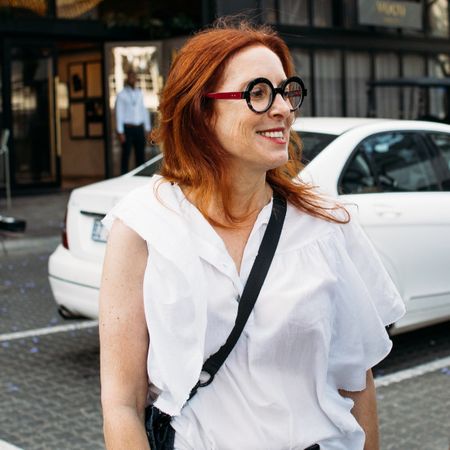
Laurice Taitz-Buntman is an avowed urbanist and the founder of Johannesburg In Your Pocket, a city guide and media platform dedicated to reframing Johannesburg through storytelling, travel and urban experience.
Comments
Scroll down to load comments...