




 Illustration by Kevin Momberg. (Photos: Facebook)
 /file/attachments/orphans/Election2026LogoInarticle_260133.jpg)
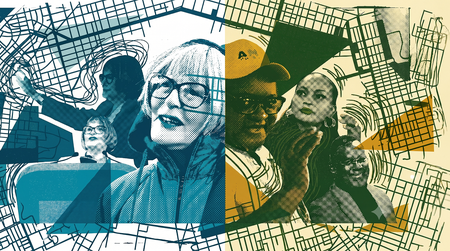
On the campaign trail for nine months now, the DA’s mayoral candidate for Johannesburg, Helen Zille, has changed persona.
From the Margaret Thatcher-style leader who ran the DA with an iron fist and who wrote a book against ‘woke-ism’, the political ideology under attack by the white right everywhere, Zille is now DJ Gogo, who wants to run Joburg. In a rather nice leather jacket and GOAT T-shirt combo, as a DJ dancing in the city’s clubland, you can ring the changes. Joburg is a party, woke and progressive city, so a persona change was deftly executed.
Her innovative campaign uses skits and clever memes to highlight the collapsed service delivery in the city. She’s canoed in flooded roads, fished in abandoned and decayed public swimming pools and ziplined over plentiful dongas that make mobility a real hassle.
/file/attachments/2993/0405HelenZiller_343294.jpg)
On The Common Sense podcast, she said that the party could achieve an overall majority of about a million votes (two per voter), and recently said the DA needed 470,000 votes to win. Earlier, Zille told Daily Maverick that the aim was to be the largest party in Johannesburg after the 4 November election so that she could become mayor and form the government.
The ANC has not yet decided on a candidate, so the race for Joburg now is between Zille and Action SA leader Herman Mashaba. The businessman turned politician is an icon and the first leader to have got ANC voters in the Soweto heartland to turn out for a different candidate.
Both are campaigning hard, putting in campaign stops every day. This, for now, is the real race for Joburg. Daily Maverick editor-at-large Mondli Makhanya says the campaign hasn’t started, and he does not think Zille can win an overall majority.
The campaign has made Zille more confident, but low registration numbers could put a damper on her plans. Only 2.349 million citizens have registered out of an estimated eligible voting population of between 3.2 million and 3.4 million – an increase of just over 17,300 voters after the registration weekend.
When Joburg voters get gatvol with politics, they tend to stay away from the voting station. “As in the case of the rest of the country, there is little trust in political parties and politicians in Gauteng, and many people believe the country is going in the wrong direction. In Gauteng, that’s six in 10 people,” says Mari Harris, political analyst and director at polling company Ipsos.
“There is general discomfort with the state of public services in the province and severe dissatisfaction with service delivery in the province. There is also deep dissatisfaction with the way the municipalities in Gauteng do their jobs, with 65% (or two-thirds of people in a representative sampling) saying the municipalities are not doing a good job.
“Helen Zille has her work cut out for her, mainly to convince people the DA can do a better job, getting both the black and white middle-class to vote en masse,” says Harris.
The Social Research Foundation (SRF) has found that the DA is now leading the ANC in Gauteng 37% to 31%. (See this report by The Common Sense, which is paywalled and well worth a subscription. The SRF polls are by telephone and largely urban.)
“Our benchmark is 2016, when the DA received 490,000 votes in Johannesburg. That’s the highest number of votes the party has ever achieved in the city,” says campaign manager Nicole van Dyk, a long-time councillor in Johannesburg metro.
Van Dyk says the DA will not enter a coalition with the ANC in Johannesburg. “The GNU [the national power sharing agreement with the ANC and other parties] happened under very specific circumstances. In local government, we would only align with parties that share our principles. And those principles are good governance and no corruption.”
Pollster and analyst Gareth van Onselen, who has worked for the DA in the past, but is now independent, said, “The DA’s goal of approximately 500,000 voters would almost certainly deliver a 51% majority. Had the DA got 500,000 votes on the proportional representation (PR) ballot in 2021, it would have got around 54% (it actually received 235,120 PR votes, for 25.5%). So basic maths says, if the DA can double its vote, and vote share, 51% is likely.
“The most votes the DA has ever received in JHB was 483,000 on the PR ballot, in 2016. So those 500,000 DA voters do exist. The biggest obstacles to the party achieving its goal are apathy and turnout – the two being intricately linked.
“The DA relies on its voters being more enthused than general in local government elections and turning out in disproportionate numbers, giving it a ‘bump’. The ANC’s decline will likely continue, but it is the raft of new, smaller parties, eating into the DA more than the ANC, that are the unknown. Fragmentation is the strongest growing force in Johannesburg politics, and it will likely determine the election outcome in the metro.”
Q&A
Daily Maverick sat down with campaign manager Nicole van Dyk and campaign spokesperson Kyle Jacobs for a wide-ranging assessment of South Africa’s most talked-about local government campaign yet.
Question: Where is the campaign now? It started in September 2025, and we’re already at the end of June 2026, so it’s been running for nine months. At first it felt very social-media driven — the canoeing, the potholes, the stunts. It feels as though you’ve moved beyond that and into a more mayoral phase. Is that fair?
Answer: Yes, I think that’s fair.
One of the things we’ve picked up is that, although residents have been very aware of what’s going on in the city, I don’t think people always stop and think about how bad things have become because we’re dealing with so much bad news all the time. We become accustomed to it. We’ve become like frogs in boiling water.
Seeing the city through a fresh perspective – through Helen’s eyes – allowed us to show just how serious many of the issues are. It also helps that Helen speaks from a position of authority. She has governed before. She doesn’t speak from a place of excuses; she speaks from a place of what can be done.
Q: I remember going out with Helen Zille in the first week after she was announced (as mayoral candidate in September 2025). We visited places like Vrededorp and the (then stalled) Brixton reservoir, and she was visibly shocked. What was her reaction later on?
A: It definitely never stops being a shock.
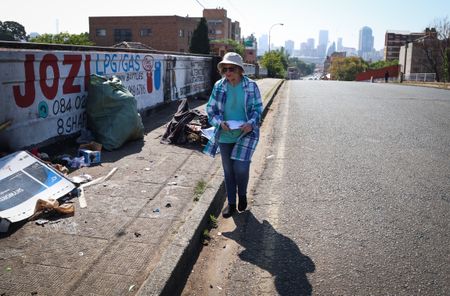
The aesthetics alone are shocking: endless streetlights that don’t work, traffic signals knocked over, parks that are overrun, pavements that have simply collapsed. Then you go into parts of the inner city and some of the older CBDs and discover things that are even worse than what you’ve already seen.
You think you’ve seen the worst, and then you find something worse. She’s become more accustomed to it now, but the shock doesn’t completely disappear.
Even for us – people who sit in council, read the reports, deal with officials and see these issues every day – residents continue to bring things to us that leave us asking: what exactly are we looking at here?
Q: What are residents bringing to you now?
A: A lot more people are coming forward. Right now, you’ll see us putting out a lot more around City Power.
We’ve broken the campaign into different themes, and the current theme is City Power. We’re heading into winter and electricity becomes critical. What we’re uncovering around City Power is going to form a significant part of the campaign over the next few months.
Q: We’re investigating extortion inside City Power. It seems to filter all the way down. Ordinary residents are being asked for cash payments to reconnect electricity. Are you seeing that?
A: Yes. We were raising concerns about this last year and were effectively accusing the city of extortion.
To be honest, I think it’s going to get worse because the city is under enormous financial pressure. Residents are often told there is a problem [with] their account and that they must pay first and only afterwards will the issue be investigated.
We’re also seeing cases where residents who buy lower amounts of prepaid electricity are flagged as possible bypass cases. Officials arrive and say: pay a large penalty upfront and then we’ll investigate your meter.
Q: How are you feeling politically?
A: We’re feeling strong. At public meetings, we’re consistently seeing very positive responses. We’ve visited most parts of the city already and will have covered every ward by the end of October. The voters are there. We know they are there.
Q: If coalition discussions become necessary, what principles would guide you? The ANC’s possible leadership slate appears to include people like Reverend Frank Chikane, David Makhura and Parks Tau. Would you align with an ANC-led coalition, as happened nationally through the GNU?
A: No. The GNU happened at national level under very specific circumstances. In local government, we would only align with parties that share our principles. These are good governance and no corruption.
We want people who are here to improve the city, not people who are here for positions, patronage or access to contracts.
Q: How do you define corruption in Johannesburg? What is your plan?
A: It’s become institutionalised. The starting point is transparency. If there is something residents are not allowed to see, that’s usually where the problem begins. We want maximum transparency – tender processes, board appointments, committee meetings, council proceedings and budget processes.
A major problem today is the absence of consequence management. Officials implicated in wrongdoing are rarely disciplined, dismissed or held accountable.
Q: Residents often feel completely cut out of local government.
A: That’s something that has to change.
The IDP [integrated development plan – the city blueprint] process should be the residents’ voice between elections. Residents should be able to see what was requested previously, what their councillor submitted and what progress has been made. Council agendas should be published in advance and participation must happen at times that actually suit residents.
Q: What would you do with the municipal entities? (Joburg is the only city governed largely by 13 quasi-privatised entities, nearly all of which are fiscal drains.)
A: The current view is to keep them but reform them.
What we need are properly constituted boards, competent management and real accountability. Trying to dismantle everything would consume years and create chaos.
Q: What about a highly politicised administration?
A: The first challenge is simply understanding what we’re dealing with. Even basic organograms are difficult to access. The first year would focus heavily on finances and institutional review. We need to understand how the administration is structured, where resources are going and how entities are functioning.
Q: Business leader and Business Leadership South Africa CEO Busi Mavuso argues that visible change can happen within a year. Helen has said fixing Johannesburg could take 10 years. How do you think about the timeline?
A: A year is incredibly ambitious.
[Speaking as if the DA wins.] We would inherit a budget midway through a financial year. Our first real budget would only be in July 2027. The first year is about stabilising finances, understanding the entities, reviewing institutions and establishing what we’re actually dealing with.
Q: So what will residents actually see (assuming you win enough to form a government)?
A: We’ve made commitments around basic services.
Water is the number one priority. Certain systems – the Commando system, the Yeoville-Berea system, the Midrand system and the Deep South system – require focused intervention because they’re consistently under pressure.
At City Power, a lot of the focus is on getting the depots functioning properly again. We need to decentralise equipment and make sure depots have what they need to deal with day-to-day maintenance. One of the things nobody ever talks about is the importance of what we call the “ladder bakkies” — the ordinary maintenance vehicles that respond to faults. [Literally a bakkie with a ladder.]
People think every electricity problem requires a major infrastructure project, but often it doesn’t. Sometimes a resident doesn’t need a new substation. They simply need somebody to arrive with a ladder, spare fuses, connectors and the right equipment to make a quick repair.
Those teams need to be properly equipped. The vehicles need to be stocked. The depots need to have supplies available. If a fuse needs replacing, the team should be able to do it immediately rather than log the problem, order parts and return weeks later.
It’s about restoring the city’s ability to do the basic things efficiently.
Q: And what about roads?
A: Before we can fix potholes at scale, we need functioning asphalt plants. At the moment, the asphalt plant is inconsistent. [The Johannesburg Roads Agency owns an asphalt plant, which it says is working.] Some weeks it works and some weeks it doesn’t. There isn’t proper oversight of what leaves the plant and where it’s going.
That’s why governance matters. Before we can fix potholes, we need to make sure the asphalt exists and that the system managing it is functioning properly.
We’re also looking at formal agreements that would allow residents and community organisations to undertake repairs without fear of being fined or stopped.
Q: What about streetlights? (Streetlights are a big issue for most Joburg residents, Daily Maverick has repeatedly reported.)
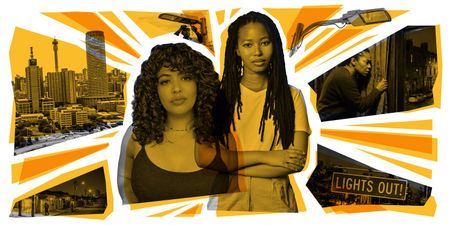
A: Streetlights are a perfect example of how basic maintenance has broken down. Every depot used to have dedicated streetlight teams. They worked reasonably well between 2016 and 2019. Then they disappeared.
We need dedicated streetlight teams again. We need functioning cherry-pickers. We need proper logging systems. Residents shouldn’t log faults only to have tickets closed without repairs being completed.
Q: Safety?
A: There are serious capacity issues. In some regions, there are only two or three patrol vehicles available at any given time. There isn’t enough by-law enforcement. Officers often lack training, equipment and basic resources.
Illegal advertising is a perfect example. The fines already exist. The companies advertise openly with their names and phone numbers displayed. Enforcement simply doesn’t happen.
Q: How are you doing in black communities? In Soweto, Orange Farm, Diepsloot… (The DA has not been able to break through into a black vote.)
A: Honestly, it’s been remarkable.
Helen has spent more time in townships than in suburbs during this campaign. Everywhere we go, people stop, talk, engage and take photographs. Many people know her history. They know she opposed apartheid. They know her family history. They know her role in exposing wrongdoing.
The latest by-election results also suggest traditional voting patterns are becoming less predictable. The response has been overwhelmingly positive.
Q: What has Helen Zille learnt about Johannesburg in nine months?
A: Johannesburg residents have a uniquely can-do attitude. Despite everything, people don’t sit back. They get involved. They clean parks. They organise. They try to improve their communities.
One of the great challenges facing the city is growing public apathy. Residents are exhausted. They’re paying rates, residents’ associations, private security and private service providers just to maintain a basic quality of life.
Our campaign is built around the idea that Johannesburg can be fixed. It’s more than a slogan. It’s a belief. And what we’ve learnt is that residents desperately want a reason to believe again. DM