



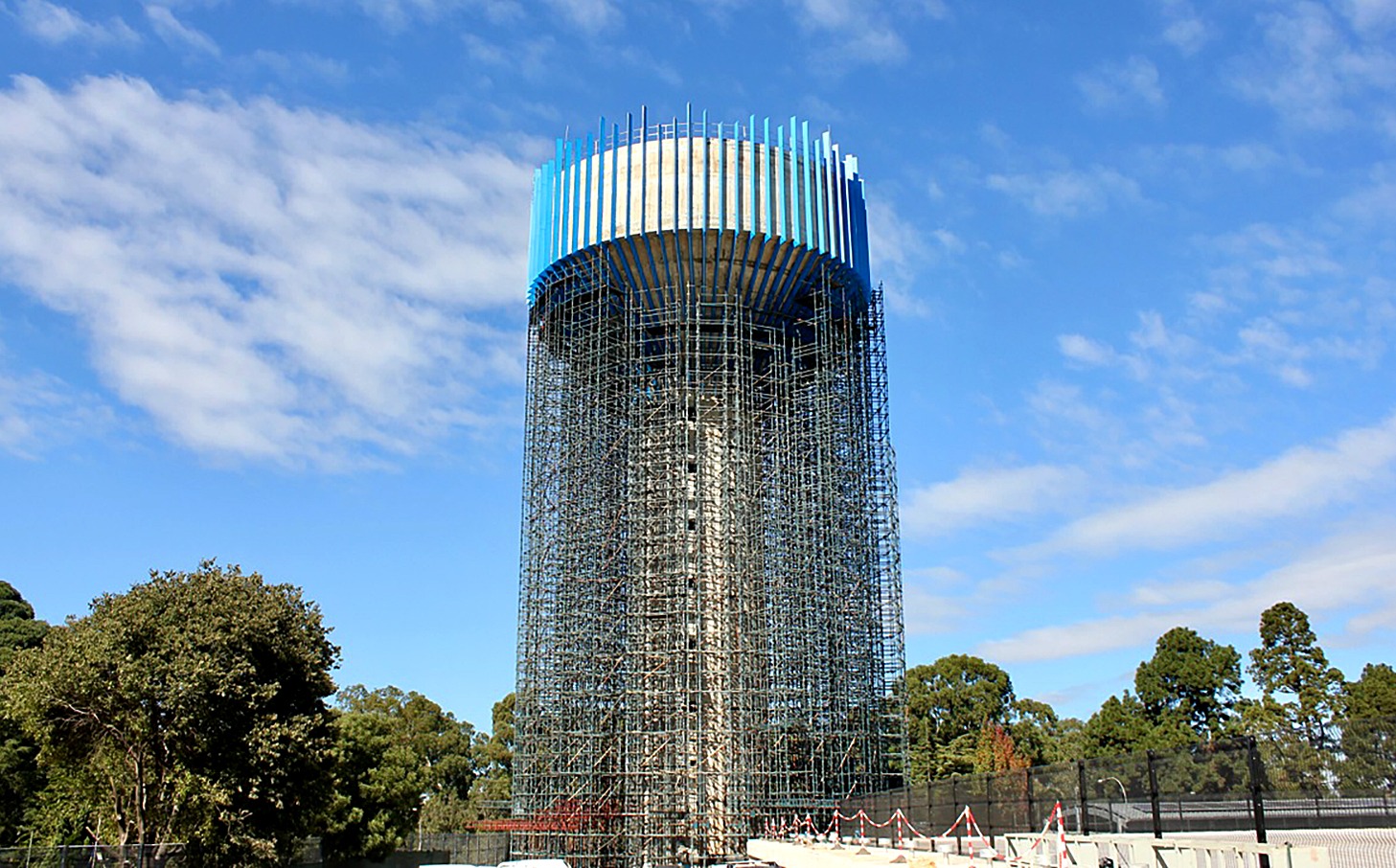
 The City of Johannesburg officially opened Brixton Reservoir on Wednesday, 29 April 2026. (Photo: Reitumetse Pilane)
Civil society group WaterCAN welcomed the completion of Johannesburg’s long-awaited Brixton Reservoir and Water Tower project, but cautioned that its impact would only be proven when the City’s strained water system comes under pressure.
WaterCAN’s executive director Dr Ferrial Adam said the reservoir looked positive “in theory”, but warned that broader network failures would still determine whether it delivered in practice.
“The leaks are still there. That doesn’t go away.”
She said its effectiveness would only become clear during the next major outage or network disruption.
The completed project was officially launched by the City of Johannesburg on Wednesday, 29 April 2026, and described by Mayor Dada Morero as “another step forward in Joburg’s commitment to reliable and sustainable water services”.
Storage and pressure relief
The new system includes a 26-megalitre ground reservoir, a two-megalitre tower, and pump station infrastructure, aimed at improving storage capacity and pressure in the Commando Water Supply System.
/file/attachments/orphans/IMG_7949_496223.jpeg "Executive Mayor of Johannesburg Dada Morero presides over the official launch of the Brixton Reservoir and Water Tower Project on Wednesday, 29 April 2026. (Photo: Reitumetse Pilane)
<br>")
Morero said the project would help address long-standing water supply challenges in Brixton, Crosby, Hurst Hill and surrounding areas by increasing storage capacity and improving pressure in the local network.
He added that the City had increased Johannesburg Water’s capital budget to R1.7-billion, an investment aimed at refurbishing ageing infrastructure and addressing high water demand. This, however, falls short of the estimated R27-billion required for pipe and infrastructure upgrades.
Local benefits
Provincial and national government representatives attended the launch. Officials from Rand Water and Johannesburg Water expressed pride and excitement, hailing the project as a major success.
The reservoir was built beside Brixton Primary School, with learners in attendance at the opening. Morero thanked the school principal and the Department of Education for making the site available, promising future educational partnerships that would expose pupils to careers in water engineering and infrastructure.
/file/attachments/orphans/IMG_7947_953047.jpeg "Minister of Water and Sanitation Pemmy Majodina speaks at the launch of the Brixton Reservoir and Water Tower Project on Wednesday, 29 April 2026. (Photo: Reitumetse Pilane)")
Attendees at the launch applauded as Minister of Water and Sanitation Pemmy Majodina said the benefits of the project would be felt far and wide, restoring a reliable water supply to key institutions, including Rahima Moosa Mother and Child Hospital, Helen Joseph Hospital, and the University of Johannesburg.
“This will ensure that healthcare services are delivered without disruption,” she said, adding that institutions would function with “greater certainty”.
She joked that the SABC was also a “beneficiary” of the project, but earnestly argued that it would continue to work with “enhanced reliability” given the location of its headquarters in Auckland Park – an area regularly affected by outages.
Criticism and caution
While City officials patted themselves on the back, DA Councillor Kyle Jacobs accused Morero, Environment and Infrastructure MMC Jack Sekwaila and Premier Panyaza Lesufi of claiming credit over a “stolen victory”.
“It was the DA, during its time in government, that initiated this project, and ensured it was included in the budget,” Jacobs claimed, adding that the ANC, along with its coalition partners, allowed the project “to stall and, at times, stop entirely”, following the DA’s departure from local government.
“It was only through sustained mobilisation by residents and DA councillors that work on this critical project was eventually restarted and brought to completion,” said Jacobs.
Adam noted that scrutiny of the project’s delays was still needed. Construction began in July 2023, and the project was originally scheduled for completion in early 2025. The project was delayed first because the administration failed to pay the contractor and second because of water-quality testing, which was a legitimate and necessary process.
While Adam welcomed the development, the Johannesburg Water Crisis Committee’s co-convener, Ravin Singh, said residents needed clear communication and consistent delivery, not empty promises.
It would not be the first time taxpayers have been disappointed, with nearly R19-billion lost to water system breakdowns linked to ageing infrastructure and poor governance across the country.
“There must be full transparency in how funds are allocated and spent, with regular public reporting on budgets, projects and progress so that residents can see where money is going and what is being delivered,” Singh told Daily Maverick. “Without this level of accountability, confidence in the system will not be restored.”
Political battlefield
During his address, Morero said he would not address broader political issues, stating that his focus was to ensure delivery.
“Yes, delays do happen in bigger projects for whatever reason, but we have finally delivered on this reservoir,” he said.
After the DA’s Helen Zille’s widely publicised swim in a flooded pothole, he also joked that the reservoir contained enough water for swimming, adding that “the risk is that it’s a reservoir. You are likely to drown, of course.”
Majodina addressed criticism from opposition parties who had suggested the delayed project would never be completed, saying: “There were those who said this reservoir was just a pipe dream… Here we are today.”
Adam rejected the minister’s framing, arguing that the criticism stemmed from the department’s service delivery failures.
With the 2026 local elections approaching, water shortages, infrastructure failures and service-delivery frustrations are expected to feature prominently in campaigning.
“We cannot escape the fact that the systems within the City of Johannesburg are in trouble,” Adam said. “And, of course, political parties are going to use that to garner votes, whether or not they have the solutions.”
One project vs citywide crisis
Jacobs echoed Singh’s cautious optimism about the project, stating that significant work still lay ahead and that sustained intervention was required to ensure long-term stability and proper functionality.
“This includes the rehabilitation of the Hurst Hill 1 and 2 reservoirs, the upgrade of the Crosby pump station, and the installation of a new main pipeline to increase supply from Rand Water into the Commando system,” he said, adding that “the system is highly interdependent and remains fragile.” DM
Comments
Scroll down to load comments...