




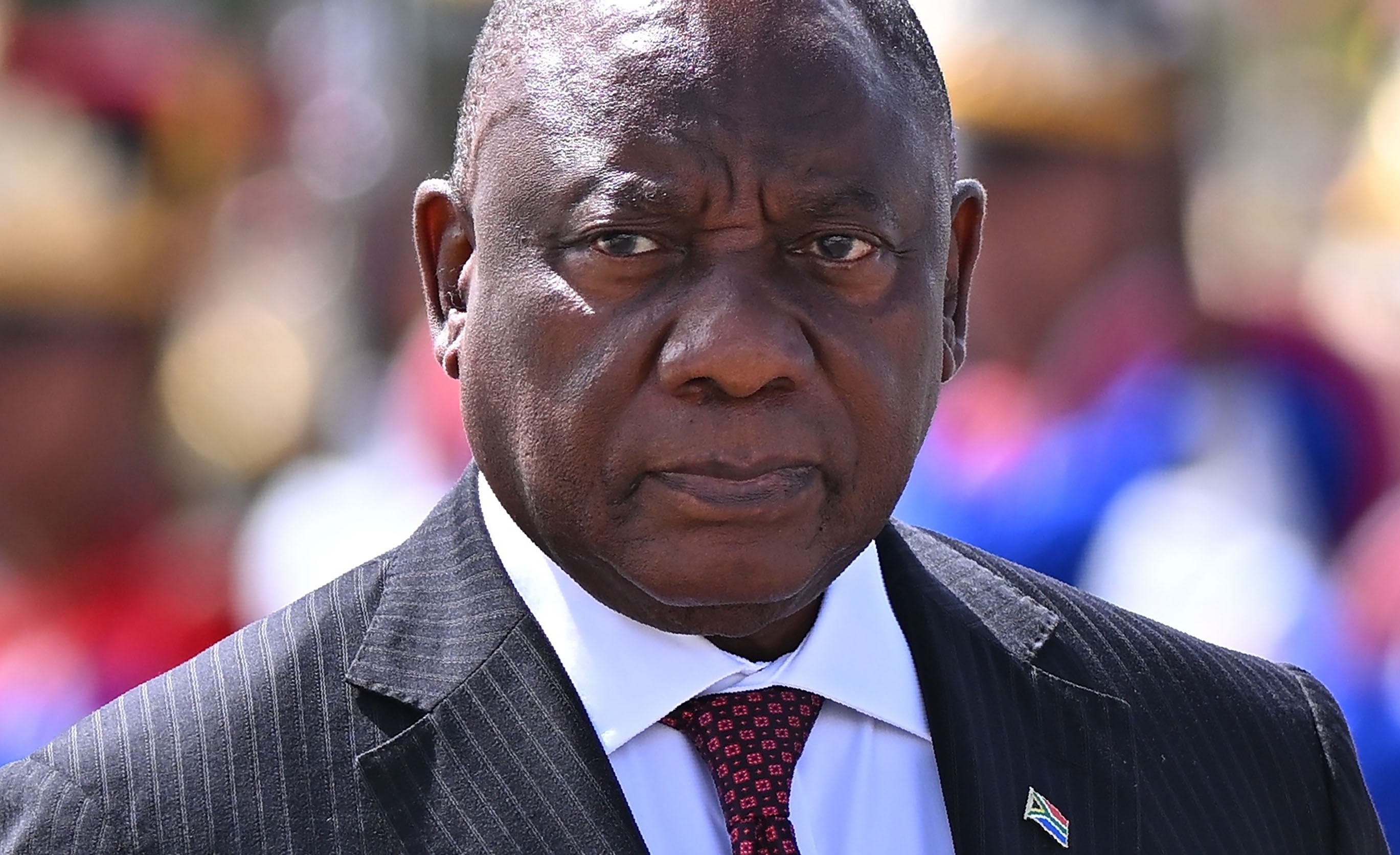
 South African President Cyril Ramaphosa (Photo: Andre Borges / EPA)
 /file/dailymaverick/wp-content/uploads/2025/10/label-Op-Ed.jpg)
President Cyril Ramaphosa’s 7 June 2026 address on migration will likely be remembered as a disappointing attempt to give political and policy expression to what the government has described as a five-pillar comprehensive approach to tackling illegal immigration.
Delivered amid growing anti-immigrant mobilisation, increasing public anxiety and calls for mass deportations, the speech sought to reassure South Africans that the government is taking migration seriously while simultaneously warning against xenophobia, vigilantism and attacks on foreign nationals.
In many respects, however, the address represents a continuation rather than a departure from the contradictions that have increasingly characterised the government’s migration discourse.
A few days ago, in response to remarks made by the President during the Budget Speech in Cape Town, we argued that South Africa was witnessing Ramaphosa’s migration contradiction: Acknowledging xenophobia while feeding the myth. The central criticism was that while the government publicly condemned xenophobia and cautioned against blaming migrants for South Africa’s social and economic difficulties, it continued to frame migration as a central explanation for challenges that are fundamentally rooted in governance failures, economic stagnation, inequality and institutional decline.
The migration address appears to deepen rather than resolve this contradiction.
Yet beneath its language of balance, legality and constitutionalism lies a more troubling question: what exactly is the crisis that the President is responding to?
When does an issue become a crisis?
Not every policy challenge constitutes a crisis.
Every country faces irregular migration. Every country regulates entry, residence, employment and citizenship. Every sovereign state has both the right and the responsibility to secure its borders and enforce its immigration laws.
The existence of undocumented migration, in itself, does not constitute a crisis. A crisis implies something more specific: a measurable condition that exceeds the capacity of institutions to respond, threatens social stability and requires extraordinary intervention.
The speech never demonstrates that such conditions exist.
To date, no evidence has been presented showing that South Africa is experiencing an unprecedented influx of migrants. Migrants constitute approximately 4% of the country’s population, a figure that is neither exceptional by international standards nor indicative of a migration crisis.
No evidence is presented showing that migrants are responsible for the unemployment crisis nor the declining livelihood opportunities available to citizens. To the contrary, migrants contribute positively to the economy.
No evidence is presented showing that migration has overwhelmed public services such as hospitals, clinics or schools. The persistent challenges facing these institutions are more convincingly explained by decades of corruption, maladministration, underinvestment, weak planning and declining state capacity across all spheres of government.
The speech’s most significant admission only reinforces this point. The President explicitly states that “illegal immigration is not the cause of all our economic challenges”. If migrants are not responsible for South Africa’s major economic difficulties, then the burden rests on the government to demonstrate why migration should be understood as a national crisis.
The speech does not do so. The existence of a migration crisis is assumed rather than demonstrated.
The politics of association
/file/attachments/orphans/ED_604669_353826.jpg "Protesters gather for the Kopanang Africa Against Xenophobia march in Johannesburg on 18 April 2026, in commemoration of Freedom Month. The group highlighted the issues xenophobia and scapegoating and their negative impact on communities, cities and the country as a whole. (Photo: Sharon Seretlo / Gallo Images)")
Perhaps the most troubling feature of the speech is the way migration is repeatedly associated with a range of social harms.
Throughout the address, migration is discussed alongside unemployment, labour market competition, organised crime, service delivery pressures, security threats, trafficking, illegal mining and money laundering.
The President is careful not to say that migrants are responsible for these problems. Yet political communication operates through association as much as through direct claims.
The more frequently migration is discussed in the same breath as crime, insecurity, unemployment and social decline, the stronger those associations become in public consciousness.
The speech, therefore, attempts two contradictory tasks simultaneously. It tells South Africans not to blame migrants while repeatedly inviting them to understand migrants through the lens of social problems.
The result is that the disclaimer against xenophobia is overwhelmed by the narrative structure of the speech itself.
The problem is not that the government seeks to improve migration management. The problem is that the scale of the political response risks creating the impression of a crisis that has never been empirically demonstrated.
By dedicating a presidential address to migration, announcing specialised interventions and framing immigration as a major national challenge, the government transforms public anxiety into political reality without first establishing whether the underlying assumptions are supported by evidence.
The crisis that was never demonstrated
/file/attachments/orphans/ED_604679_258747.jpg "A Kopanang Africa Against Xenophobia march in Johannesburg on 18 April 2026. (Photo: Sharon Seretlo / Gallo Images)")
Every state has the right to regulate migration and secure its borders. The question is whether South Africa is confronting a genuine migration crisis or whether migration has become a convenient vehicle through which deeper social and political failures are being narrated.
President Ramaphosa’s speech never answers that question.
Instead, it reinforces the perception that migration is a major national problem despite presenting little evidence that such a crisis exists.
South Africa’s crisis is not fundamentally one of migration; it is one of migration governance. The Special Investigating Unit has repeatedly uncovered corruption within the Department of Home Affairs, exposing how the country’s sovereignty has at times been sold to the highest bidder by officials entrusted to protect it. In this context, the real scandal is not migration itself, but the erosion of state capacity, accountability, and institutional integrity in managing it. DM
Kopanang Africa Against Xenophobia is a national coalition of civil society organizations, community activists, migrant-led groups, workers, and individuals who together fight xenophobia, racism, and gender-based violence in South Africa.