



Delivering his budget vote address in the National Assembly on 2 June, 2026, President Cyril Ramaphosa made some remarks on migration which revealed a contradiction that has increasingly come to define South Africa’s (SA’s) approach to immigration.
On the one hand, he acknowledged an important truth.
“We must never give in to violence, to xenophobia and to vigilantism.”
On the other hand, he repeated claims that have become central to the country’s anti-immigrant discourse: that illegal immigration places pressure on public services and undermines efforts to create decent work.
The result is a message that attempts to condemn xenophobia while simultaneously reinforcing some of the assumptions upon which xenophobia thrives.
The first issue is conceptual.
SA does not have an immigration crisis. It has an immigration governance crisis. These are not the same thing.
An immigration crisis suggests that the country is being overwhelmed by immigrants. Yet the evidence does not support this claim. Statistics South Africa’s Census 2022 data shows that immigrants comprise approximately 3.9% of the country’s population. This is hardly evidence of a country being overrun.
The numbers matter because they expose the gap between perception and reality.
Perception vs reality
Public discourse often creates the impression that SA is experiencing an unprecedented influx of foreigners who are fundamentally reshaping the demographic character of the country. This narrative has become politically useful, but it remains unsupported by credible demographic evidence.
What SA does face is a profound crisis in the governance of migration.
For years, the Department of Home Affairs has struggled with permit backlogs, dysfunctional asylum systems, delays in visa renewals, corruption, administrative errors, and chronic capacity constraints. The President admits to “stamping out corruption in the immigration system”.
Thousands of migrants find themselves trapped in bureaucratic limbo, unable to regularise their status despite attempts to comply with the law.
This distinction is crucial.
Many forms of irregularity are not simply imported into SA. They are often produced within SA through administrative failure.
A migrant whose permit renewal has been delayed for years because of Home Affairs inefficiency may suddenly find themselves classified as “illegal” despite having done everything required of them.
The state creates irregularity and then points to that irregularity as evidence of a migration problem.
Ramaphosa is correct when he says migration can contribute to economic growth when properly managed.
Indeed, migration has always been a feature of economic development. SA’s own mining industry was built on regional labour mobility. Contemporary sectors ranging from retail and hospitality to construction continue to rely on migrant labour.
Yet the President’s suggestion that illegal immigration undermines efforts to create decent work deserves closer scrutiny.
SA remains one of the most unequal countries in the world. It has one of the highest unemployment rates globally. These realities predate contemporary migration debates and stem from structural economic factors, skills mismatches, slow economic growth, labour market rigidities, governance failures and educational inequalities.
The suggestion that migrants are a significant driver of unemployment often rests on an implicit assumption: if immigrants leave, jobs will automatically become available for South Africans.
There is little evidence to support this.
With the departure of 300 Ghanaians due to xenophobia, the EFF leader Julius Malema has been quoted asking: “Ghanaians are gone now, 300 of them. How many 300 jobs were created after the Ghanaians left?”
The same applies to public services.
When the President argues that illegal immigration places pressure on public services, the statement contains a partial truth.
Every additional resident, regardless of nationality, creates some demand for services. But this is not the same as saying immigrants are responsible for the collapse of those services.
The real cause
SA’s healthcare system is not struggling because of immigrants. It is struggling because of governance failures, budgetary constraints, corruption, infrastructure backlogs and poor management.
The Auditor-General’s reports have repeatedly documented widespread maladministration and irregular expenditure across government departments and municipalities. The Zondo Commission exposed systemic State Capture. More recently, allegations emerging from the Madlanga Commission point to concerns about criminal syndicates operating within state structures.
The evidence consistently points to governance failure as the principal driver of institutional decline.
Blaming immigrants for failing hospitals, dysfunctional schools or collapsing municipalities risks confusing symptoms with causes.
Perhaps the most revealing aspect of Ramaphosa’s remarks is his closing statement.
“We must never give in to violence, to xenophobia and to vigilantism.”
This is an important acknowledgement.
Xenophobia is real
For years, many politicians and public figures have sought to minimise the extent of xenophobia in SA, describing anti-immigrant sentiment as isolated incidents or denying its existence altogether.
The President’s statement implicitly recognises what migrants, civil society organisations and researchers have documented for years: xenophobia is real.
The difficulty, however, is that the state’s actions often tell a different story.
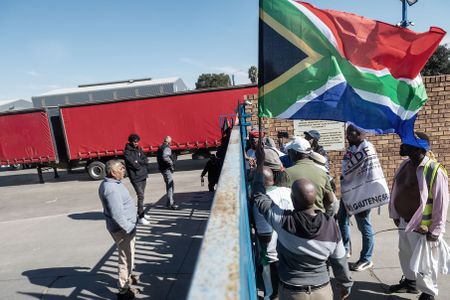
South Africans have witnessed Operation Dudula activists conducting anti-immigrant campaigns in the presence of police officers. We have seen immigrants harassed and assaulted while law enforcement officials looked on. We remember the death of Mozambican taxi driver Mido Macia after he was dragged behind a police vehicle in Daveyton, in Johannesburg’s East Rand. We continue to see reports of migrants being denied healthcare or subjected to discriminatory treatment in public institutions.
This raises an uncomfortable question.
If all people are equal before the law, why do some appear to enjoy greater protection than others?
In Animal Farm, George Orwell warned of a society in which “all animals are equal, but some animals are more equal than others”.
The hierarchy of ‘belonging’
The danger facing SA is no longer simply xenophobia.
It is the gradual emergence of a hierarchy of belonging, where constitutional rights become conditional upon nationality, documentation, language, ethnicity or public sentiment.
For years, the targets were Zimbabwean, Mozambican and Malawian migrants. They were accused of taking jobs, overwhelming hospitals and driving crime. Their exclusion was justified as an exception.
Then the logic expanded.
Boundaries of exclusion
Last week, amid anti-immigrant tensions in Mossel Bay, South African teenager Nhlamulo Sambo lost his life. The full circumstances surrounding his death remain subject to official investigation. Yet the incident serves as a stark reminder that once societies begin sorting human beings into categories of belonging and non-belonging, the boundaries quickly become blurred.
His death should force us to confront a difficult truth: xenophobia was never really about foreigners. It was always about deciding who belongs and who does not.
Once a society accepts the principle that some people are less deserving of dignity, protection and rights than others, the boundaries of exclusion rarely remain fixed.
Today, it is a migrant.
Tomorrow, it could be a South African who speaks the wrong language, comes from the wrong province, has the wrong surname, or simply looks like they do not belong. That is how democratic societies begin to unravel.
SA’s challenge is, therefore, not to defeat immigration.
It is to fix governance.
It is to restore the integrity of Home Affairs.
It is to strengthen the rule of law.
And it is to ensure that constitutional rights remain universal rather than selective.
The greatest threat facing SA is not migration. It is the growing willingness to blame migrants for problems created by the state itself. DM
Kopanang Africa Against Xenophobia is a national coalition of civil society organizations, community activists, migrant-led groups, workers, and individuals who together fight xenophobia, racism, and gender-based violence in South Africa.
Comments
Scroll down to load comments...