



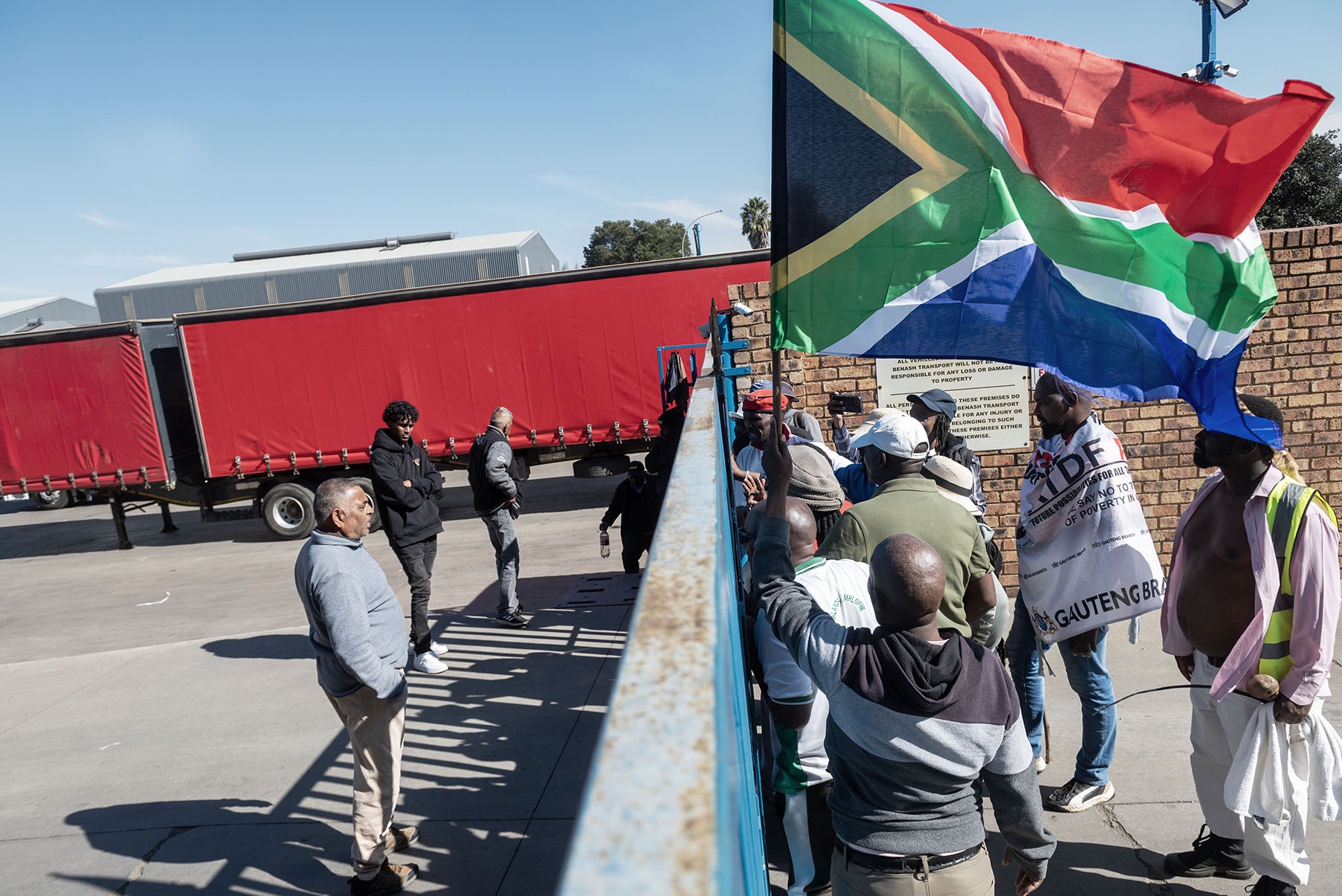
 Anti-foreigner protesters marched to various companies alleged to be employing foreign nationals in the Boksburg and Benoni areas on Monday, 8 June 2026. Some companies refused to open their gates. (Photo: Leon Sadiki)
On Monday, 8 June, anti-foreigner marches continued in Ekurhuleni’s industrial hubs, including Boksburg, Springs and Benoni. The protest included members of March and March as well as the All Truck Drivers Forum and Allied South Africa (ATDF-ASA).
The demonstration began on Monday morning along Benoni’s Main Reef Road, where marchers moved from one business to another, stopping to engage with business owners. Many marchers carried golf clubs, wooden sticks and sjamboks as they walked under SAPS escort. It remained peaceful throughout the day, with no reported incidents of violence or unrest.
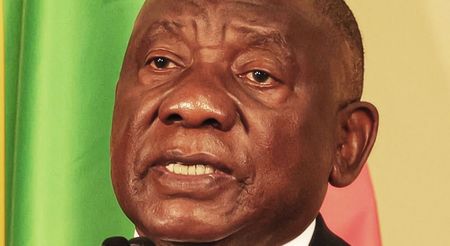
The protest followed President Cyril Ramaphosa’s address on Sunday, which focused on cracking down on illegal immigration and protecting local labour. He said the government would increase workplace inspections to stop companies from hiring undocumented migrants and penalise employers who break the law.
Ramaphosa also warned against vigilantism and intimidation of foreign nationals. On Monday, marchers largely dismissed his policy reforms.
According to organisers, the purpose of the march was to urge businesses to terminate the employment of foreign nationals, regardless of their documentation status, before 30 June 2026, a deadline set by anti-foreigner groups for undocumented migrants to leave the country.
At several stops, marchers addressed business owners directly and said they were giving them time to make alternative employment arrangements.
Bongani Mthethwa from ATDF-ASA was one of the organisers of the march. For years, the ATDF-ASA has campaigned against foreign truck drivers being employed in the sector and has often led protests closing major roads.
When asked whether there would be consequences for businesses that failed to comply, Mthethwa told Daily Maverick that the group was not requesting that foreign nationals leave the country, but rather informing them to do so.
He maintained that the campaign was being conducted peacefully and that employers were being given sufficient notice.
/file/attachments/orphans/MARCH25_419866.jpg "ATDF-ASA leader Bongani Mthethwa, centre, at an anti-foreigner march in the Boksburg and Benoni areas on 8 June 2026. (Photo: Leon Sadiki)")
Several marchers told Daily Maverick that they would like all foreign nationals to leave South Africa (SA), not only those without legal documentation. “They can come to visit but not to work,” said Mthethwa.
The most common justification offered by marchers was that foreign nationals occupy jobs that should be filled by South Africans. Some also argued that most foreign nationals are employed illegally, citing visa and permit restrictions as evidence.
Daily Maverick attempted to obtain a comment from the business owners whose companies were targeted, but most were reluctant to speak on record. Some businesses in Benoni’s business park closed their business for the day due to the marches.
When demonstrators arrived at Benash Transport, they were met by staff who confirmed that the business employed some foreign nationals, but stated that the business owners were not on the premises. Staff members said they would relay the marchers’ message to the owners.
Ramaphosa’s address
On Sunday, Ramaphosa asserted that state authorities alone are responsible for enforcing immigration laws and warned against xenophobia, condemning illegal acts performed under anti-foreigner movements.
He said the state would “act against forces who are exploiting the concerns of our people about illegal immigration to further their own political, personal or criminal agendas”. Critics denounced the address as reinforcing “the idea that black migrants are responsible for South Africans’ suffering”.
Many marchers rejected the president’s speech, saying it failed to address what they see as a lack of employment opportunities for South Africans and the perceived preference for foreign nationals in some workplaces.
Theo Khosa, a demonstrator from March and March, said that Ramaphosa does not care about South Africans.
“He is threatening to arrest us for marching, while failing to do much about foreigners. What Ramaphosa has done is painful. He has failed us as president,” said Khosa.
/file/attachments/orphans/MARCH23_345696.jpg "March and March member Theo Khosa speaks to the media during a demonstration in the Boksburg and Benoni areas on 8 June 2026. (Photo: Leon Sadiki)")
Beyond arguing that foreign nationals are favoured for employment opportunities, Khosa claimed that undocumented migrant children are taking places in schools that would otherwise be available to South African children.
One demonstrator, Mpiliso Khumalo, said he did not watch the President’s address as he was not interested in what he had to say. “He is not our president. He is the president of the foreigners,” said Khumalo.
Khumalo claimed that South Africans face greater barriers to employment than foreign nationals, claiming that foreigners are required to provide fewer documents when seeking work. He also alleged that taxpayers’ money is used to support migrants through social grants, citing this as one of the reasons he believes all foreign nationals should leave SA.
Such misinformation has become common during the latest anti-foreigner flare-ups.
Khumalo even questioned Ramaphosa’s nationality, suggesting that the president’s stance on immigration indicated that he might be a foreign national himself. There is no evidence to support this claim. Ramaphosa was born in Soweto and is a South African citizen.
Such assertions reflect a broader tendency within some anti-immigration discourse to question the national identity of people perceived to be sympathetic to migrants or who are seen as culturally or linguistically different.
Similar claims have previously been directed at South Africans from minority ethnic groups and communities whose identities are sometimes mistaken or contested on the basis of language, appearance or ancestry.
Political parties respond
Herman Mashaba described the President’s response to illegal immigration as “weak” and “reactionary”. The ActionSA leader called for mass deportations and argued that the ANC, and subsequently the Government of National Unity (GNU), had failed to address illegal immigration and secure SA’s borders.
“It increasingly appears that the government is acting only in response to manufactured outrage from foreign governments that are unwilling to confront the consequences of their own failures. Rather than acknowledging the immense and real social and economic burden that unchecked illegal immigration places on South Africa,” said Mashaba.
/file/attachments/orphans/MARCH16_371392.jpg "Anti-foreigner protesters marched to various companies alleged to be employing foreign nationals on Monday, 8 June. (Photo: Leon Sadiki)")
DA leader Geordin Hill-Lewis welcomed the President’s address, arguing that SA’s economic challenges stem from weak economic growth rather than the presence of foreign nationals. Hill-Lewis said those who incite violence against foreign nationals should be arrested and warned that economic hardship should not be used to justify attacks on vulnerable people.
“The GNU must move much faster to implement the economic reforms needed to attract investment, unlock opportunity, cut red tape, fix infrastructure, and create the environment in which millions of South Africans can find work,” he said.
Other parties broadly welcomed the government’s commitment to tackling illegal immigration, while questioning whether the measures announced would be effectively implemented.
ACDP MP Steven Swart condemned xenophobic violence but said Ramaphosa’s address would be judged by the actions that follow. UDM MP Nqabayomzi Kwankwa also argued that government failures to enforce existing measures had contributed to recurring tensions around immigration, pointing to previous outbreaks of violence in 2008 and 2015. The MK Party has also called for stronger enforcement of immigration laws.
Anti-foreigner sentiment
Anti-foreigner sentiment has persisted in SA for decades, at times erupting into violence, most notably during the xenophobic attacks of May 2008, which claimed 62 lives. In recent years, anti-foreigner sentiment has peaked.
Recent tensions have been escalating since the beginning of the year, with online campaigns organising mass demonstrations. Demonstrations have been growing into widespread vigilante-style actions.
Prominent groups like March and March and Operation Dudula have led marches in cities including Johannesburg, Pretoria and Durban near the end of April.
/file/attachments/orphans/MARCH20_574920.jpg "Protesters, made up of community members and civic organisations, march to various companies alleged to be employing foreign nationals in the Boksburg and Benoni areas, east of Johannesburg, on 8 June. (Photo: Leon Sadiki)")
Adding to tensions is the widely circulated claim that undocumented foreign nationals must leave SA by 30 June. The claim gained traction after an AI-generated poster bearing the South African coat of arms and details of the Department of Home Affairs began circulating on social media in May.
The government has publicly dismissed the poster as fake and said there is no such deadline. Nevertheless, the date continues to be referenced by many anti-immigration activists. It has been widely shared online, contributing to the perception that it carries official government backing.
The recent protests as well as fear over the 30 June deadline, has already led a number of other African countries to start repatriating their citizens.
/file/attachments/orphans/WHOSREPATRIATINGv2_174269.png)
Two Mozambicans, aged 27 and 43, and a South African, aged 19, were murdered on 29 May 2026 in Asla Park informal settlement in KwaNonqaba, Mossel Bay, during an anti-immigration unrest.
However, police allege that the South African was killed in a separate criminal incident involving an attempted theft at a shack. DM
Comments
Scroll down to load comments...