



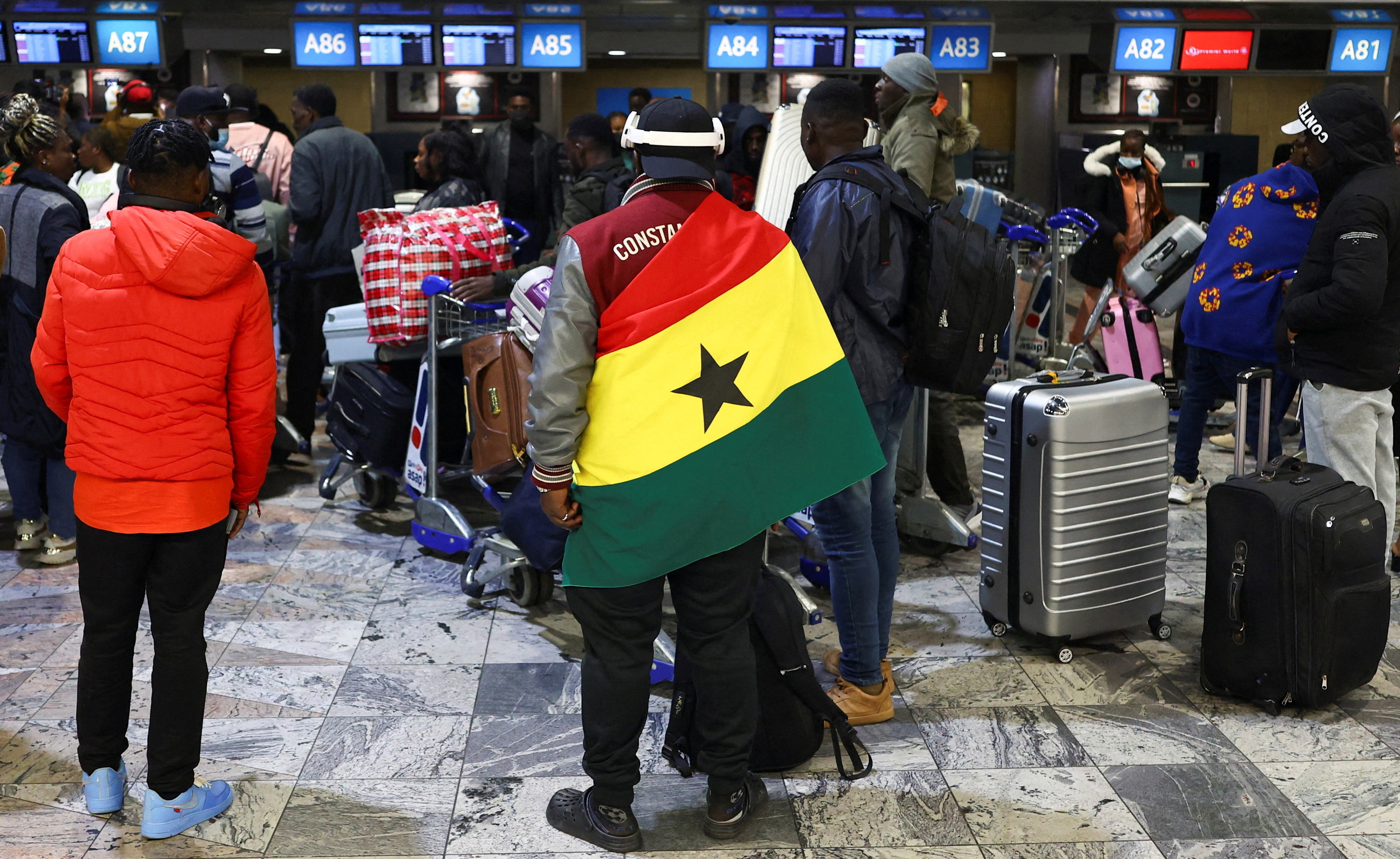
 A man draped in a Ghanaian flag stands among compatriots at OR Tambo International Airport in Gauteng on 27 May 2026 as Ghana repatriates hundreds of its citizens from South Africa after violence against migrants. (Photo: Reuters / Siphiwe Sibeko)
 Exactly a week after Cyril Ramaphosa addressed the nation and announced a five-point plan to tackle irregular immigration, the Inter-Ministerial Committee (IMC) on Migration held a media briefing explaining the work that has been done on migration issues touched on by the President.
In response to renewed anti-foreigner sentiment and protests that have recently swept through parts of South Africa, President Ramaphosa set out a series of measures to tackle illegal migration, which included:
- zero tolerance for immigration law violators;
- strengthening border security;
- stamping out corruption within the immigration system;
- closing loopholes in immigration law; and
- working with other African countries to tackle the migration challenge.
/file/attachments/orphans/WhatsApp-Image-2026-06-07-at-1852_392780.jpg "President Cyril Ramaphosa addresses the nation on the government’s management approach to illegal migration and the recent surge in protests against foreign nationals. (Photo: Siyabulela Duda / GCIS)")
The IMC, which is mandated to implement Ramaphosa’s migration strategy, is chaired by Minister of Justice and Constitutional Development Mmamoloko Kubayi, who gave a comprehensive update on Sunday, 14 June, on the work the government was doing.
The briefing comes amid heightened social friction over migration and sustained anti-migrant protests across the country. Minister Kubayi sought to reassure the public that state departments were working in a highly unified, multi-pronged approach.
Implementing the five-point strategy
“The South African Government will not tolerate the circumvention of our immigration systems and laws,” Minister Kubayi said.
/file/attachments/orphans/WhatsApp-Image-2026-06-14-at-1512_478380.jpg "The Inter-Ministerial Committee on Migration leading a media briefing to give an update on the actions outlined during the address by the President on 07, June 2026 on issues related to migration. (Image: GCIS)")
To enforce this, Minister Kubayi said that the Border Management Authority had deployed advanced technologies, including drones and body-worn cameras, to intercept illegal crossings across land, air, and sea.
According to Kubayi, the strategy was already yielding massive results, even though most of the progress she reported predated the President’s address. Kubayi said that in the past month, the South African Police Service arrested more than 7,400 illegal immigrants for contravening the Immigration Act. Moreover, since 1 January 2026, national law enforcement operations had led to more than 40,000 arrests of undocumented people.
Durban realities
Kuyabi also directly addressed the ongoing humanitarian and administrative crises in KwaZulu-Natal, specifically focusing on the Che Guevara Street and Sherwood Park areas in Durban.
At Che Guevara Street, where 457 foreign nationals have gathered outside Home Affairs offices, official audits revealed that only three people lacked legal status.
In saying this, Minister Kubayi also reiterated South Africa’s policy stance on refugee camps:
“South Africa does not have refugee camps, and there is no intention to create camps even on a temporary basis.”
Consequently, legal foreign nationals were advised to safely reintegrate into their respective communities or opt for voluntary repatriation.
Many concerned migrants have called for extra protection from the state because they do not feel safe in their communities. However, Kubayi said the migrants would not be afforded “special treatment”, and no extra law enforcement would be deployed. Migrants would be given the same protections ordinary South Africans were given daily.
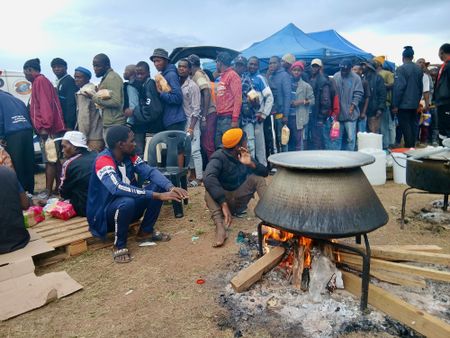
Meanwhile, in Sherwood, a massive gathering of Malawian citizens seeking repatriation has grown to an estimated 7,000 people. Deputy Minister of Home Affairs Jabulani Nzuza confirmed that officials had processed and verified 1,140 people so far, all of whom were confirmed to be in the country unlawfully.
/file/attachments/2993/gu1_629721.jpeg "More than 1,000 Malawians, who fled their homes in Durban’s Burnwood informal settlement, are camped out in an open field in nearby Sherwood. (Photo: Tsoanelo Sefoloko)")
The Malawian government has commissioned eight buses to begin moving its citizens, a repatriation effort bolstered by 10 additional buses provided by the South African state. These actions follow the recent deportation of 980 Malawians from the Lindela Holding Centre.
To expedite future deportation and repatriation cases, Minister Kubayi announced that the re-establishment of a dedicated court infrastructure at Lindela was at an advanced stage and would be operational within a month.
Plans are also under way alongside the legal system to pilot a priority immigration court directly at OR Tambo International Airport to fast-track the prosecution of organised crime and illicit border activities.
/file/attachments/orphans/RC2FHLA6ET2D_459155.jpg "Passengers wait to be checked in at OR Tambo International Airport in Gauteng on 27 May 2026 as Ghana repatriates hundreds of its citizens from South Africa after instances of violence against migrants amid a wave of protests against illegal immigration. (Photo: Reuters / Siphiwe Sibeko)")
Corrupt officials, exploitative employers warned
A core pillar of the government’s migration framework is rooting out internal rot.
Following President Ramaphosa’s directive, the Border Management Authority initiated aggressive anti-corruption awareness campaigns, starting at the Oshoek port of entry along the eSwatini border. To counter systemic vulnerability, the Department of Home Affairs (DHA) is heavily prioritising lifestyle audits and using extensive Special Investigating Unit (SIU) data sets to proactively clean system data and revoke thousands of unlawfully obtained visas.
Simultaneously, the state is clamping down on local businesses. Multidisciplinary law enforcement inspections across the Western Cape, KwaZulu-Natal and Gauteng have targeted employers flouting labour laws. Recent raids in Mossel Bay, Newcastle and Tshwane led to the arrest of multiple construction and manufacturing business owners who were caught illegally employing undocumented migrants.
“We also call upon employers to refrain from transgressing immigration and labour laws,” Kubayi warned.
Xenophobia denounced
Amid a wave of planned public protests and social media mobilisation, the IMC took a firm stance against rising xenophobic rhetoric. Kubayi vehemently rejected the narrative that South Africa was inherently unwelcoming.
/file/attachments/orphans/ED_606606_797642.jpg "People protest against illegal immigration at a march in Mary Fitzgerald Square, Johannesburg. March and March has demanded tighter immigration controls. (Photo: Gallo Images / Luba Lesolle)")
“South Africa has historically welcomed and continues to host people from diverse countries across the globe,” Kubayi said, emphasising the nation’s continued alignment with the African Union Agenda 2063.
The government explicitly warned against a targeted digital disinformation campaign using staged, old, or manipulated visuals designed to stir panic and incite violence against foreign nationals.
Officials noted that while citizens had a constitutional right to protest, the Gatherings Act imposed strict civil and criminal liability on organisers for any lawlessness or property damage.
Most crucially, the minister issued a severe warning against citizen-led immigration checks and vigilantism.
“Only the state has the responsibility to enforce immigration laws and no one else... Criminal Procedure Act Section 42 clarifies that there can be a citizen arrest, but it doesn’t allow you to do victimisation and intimidation.”
/file/attachments/2993/JACINTA-NGOBESE-866x5771_321287.jpg "March and March leader Jacinta Ngobese-Zuma. (Photo: Facebook)")
Minister Kubayi highlighted that the targeted disinformation campaigns and xenophobic attacks are directly damaging South Africa’s hard-earned international reputation and global standing.
She revealed that the backlash is already hitting citizens financially, noting that South African companies operating abroad require urgent consular support, while local artists are suffering an immediate loss of income from cancelled performances across the continent.
To protect the country’s image and preserve domestic social cohesion, the minister made a final, passionate plea for unity:
“Our message to everybody within the borders of South Africa is to say that let’s treat each other like human beings. Let’s treat each other with respect, let’s treat each other with dignity... Hence, we are calling for vigilantism to be rejected by our communities for attacks on foreign nationals... if we don’t deal with this both internally, it can also hurt us internally and externally.” DM
Comments
Scroll down to load comments...