




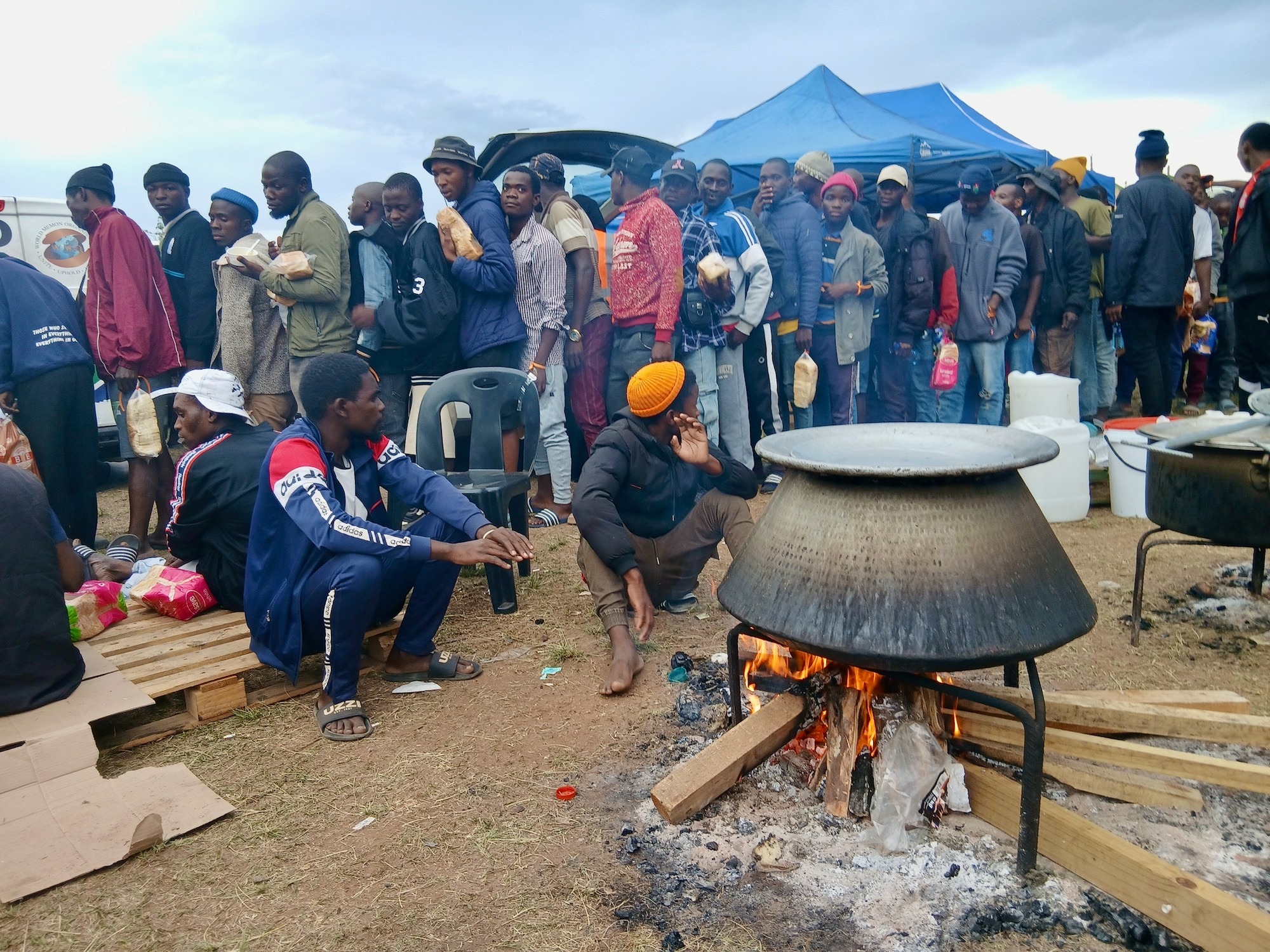
 More than 1,000 Malawians, who fled their homes in Burnwood informal settlement, Durban, are camped out in an open field in nearby Sherwood. (Photo: Tsoanelo Sefoloko)
More than 1,000 immigrants, mostly from Malawi, have fled their homes in Burnwood informal settlement, Durban, after South African residents told them to leave on Sunday. Immigrants GroundUp spoke to said people had been interrogated about their nationality and some had been assaulted. Many fled without their belongings.
Hundreds of people have spent days camped out in the open in a field in nearby Sherwood. Humanitarian organisations have provided blankets, mattresses, food and supplies for babies. Volunteers have been cooking meals on open fires.
“I ran for my life after seeing a group of people approaching my shack,” said Ernest Machwela. “I took whatever I could carry and ran away with my wife and our [seven-month-old] child. The group was shouting, ‘Abahambe, abahambe!’, meaning we must go back home.
“Some were carrying sjamboks, golf sticks, and bush knives. It’s not easy to open a case because I escaped unharmed. We hope the South African government and police will help us so we can be safe.”
Jennifer Moses, who is seven months pregnant, said she had been in SA for four years.
“We were chased from our shack, and I fell while running away from the group. They were shouting, ‘Abahambe!’ and singing.”
Moses said she was stabbed and robbed two years ago by two men who took her bag with her passport.
/file/attachments/2993/gu2_287754.jpeg "‘We were chased from our shack, and I fell while running away from the group,’ said Jennifer Moses, who is seven months pregnant. (Photo: Tsoanelo Sefoloko)")
Sydenham SAPS spokesperson Simo Joli said that on Sunday at about 8pm, about 10 intoxicated local men went to shacks in Burnwood settlement demanding that immigrants leave.
“Approximately 75 Malawian nationals initially sought refuge at the Sherwood grounds next to Sherwood Hall. Members of the local Muslim community provided meals and blankets. By Tuesday, 9 June, the number had increased to more than 1,000,” said Joli.
He said arrangements were being made with the immigration authorities and the Malawian embassy for repatriation.
eThekwini Metro Police spokesperson Colonel Boysie Zungu said: “It is going to be against the law to integrate those immigrants who don’t have proper documents into the community. Our Metro Police will patrol the area to keep them safe until they get repatriated back to their countries.”
Adam Ali, from the Malawian embassy’s disaster response team, said: “Most people told us they are ready to be repatriated because they no longer feel safe in SA. We are grateful for the humanitarian assistance, especially as many women are heavily pregnant. Security has also improved with the presence of police and private security. We expect the first group to be repatriated early next week.”
He said there were now about 1,200 Malawians at the site.
/file/attachments/2993/gu3_779599.jpeg "Humanitarian organisations have provided mattresses, blankets and food. (Photo: Tsoanelo Sefoloko)")
Fiaz Magid, Director at the Gift of the Needy, said their organisation had provided water, instant porridge, biscuits, cereals and oranges as well as baby formula, nappies, wet wipes, toilet paper and sanitary products.
eThekwini Municipality had not replied to our request for comment by the time of publication.
Ward 31 councillor Remona McKenzie (DA) said the number of displaced people was increasing fast and called for urgent intervention by the municipality.
“While communities may have concerns regarding undocumented foreign nationals, these matters must be addressed through proper legal channels and not through intimidation or harassment.
“This situation has also instilled fear and uncertainty among residents, who are witnessing these events unfold in their own communities. Such fear undermines social cohesion and threatens the stability we are working hard to build,” said McKenzie. DM
Originally published by GroundUp.
Comments
Scroll down to load comments...