



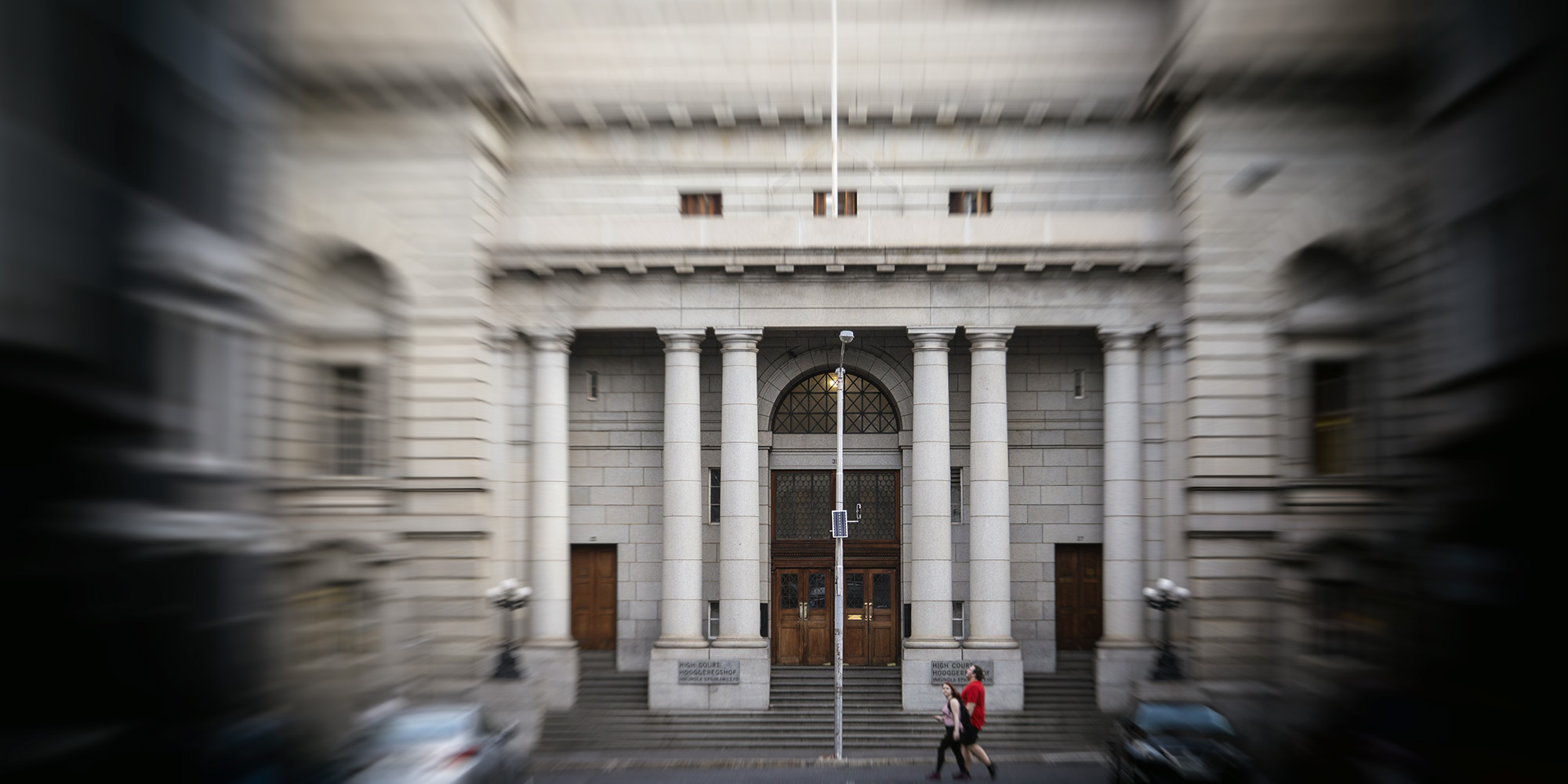
 The Western Cape Division of the High Court in Cape Town, where the UCT Children’s Institute and a group of parents are taking on the Department of Home Affairs. (Photo: Leila Dougan)
 On Wednesday, 10 June, the UCT Children’s Institute and a group of South African parents, represented by the Legal Resources Centre, were in the Western Cape High Court fighting for a structural interdict that would compel the Department of Home Affairs to develop a comprehensive, transparent plan to address the late registration of birth applications backlog.
At the hearing, presided over by Judge Ncumisa Mayosi, the legal team representing the Children’s Institute argued that there were systemic problems at Home Affairs contributing to a large and growing backlog of undecided late registration of birth applications, which are requests for birth certificates lodged more than 30 days after a child’s birth.
According to the institute, yearslong delays in accessing birth registration due to the backlog were a massive violation of children’s constitutional rights. Without a birth certificate, young people were denied recognition of their existence and identity, and locked out of accessing other rights such as basic education and further education, social services, healthcare and social security.
/file/dailymaverick/wp-content/uploads/2022/03/MC-Zim-Permit.jpg "The Department of Home Affairs offices in Motherwell, Gqeberha. (Photo: Joseph Chirume)")
“We are dealing with the most vulnerable people in our society: unrecognised children,” said advocate Daniel Linde, representing the Children’s Institute and other applicants.
The Department of Home Affairs has denied that there is a systemic backlog of late registration of birth applications, claiming that the number of undecided applications has been reduced significantly, removing the justification for judicial intervention.
“We emphasise that the legislative scheme allows for the late registration of births, and [the number of applications] will never be zero, and this must be accepted. Secondly, the actual number is not static; it is a moving target,” said advocate Adiel Nacerodien, representing the Department of Home Affairs.
“The numbers in this context of the [application for] structural relief are irrelevant for the consideration of the court, because the point is that there has been no systematic failure in the sense of an exponential increase.”
Is the backlog systemic?
When the Children’s Institute launched litigation against the department in December 2024, it was joined by the caregivers of 19 children, as well as one adult, whose late registration of birth applications were undecided. These additional applicants had been waiting between two and seven years for documentation.
The applicants were seeking a court order compelling the department to:
- Decide the applications of the 19 children and one adult involved in the court case, and issue their birth certificates if approved;
- Diagnose the “systemic inefficiencies” that had resulted in the years-long backlog for registration of birth applications; and
- Draft a plan to ensure that present and future applications are decided without long delays.
Linde noted that as a result of the litigation, the individuals involved were prioritised by the Department of Home Affairs, with almost all receiving birth certificates before the case went to court.
However, he added, their experiences of applying for documentation at Home Affairs were indicative of the systemic problems hindering the late registration of births process, including:
- A lack of communication between Home Affairs offices in different provinces;
- Long waits for the processing of supporting documents;
- Delays in the interview procedure; and
- Instructions to return to their provinces of birth to file applications.
In one case, an individual who applied for her child’s birth certificate in 2023 and did not receive a request to come for an interview followed up at the Home Affairs office, only to be told there were still applicants from 2021 waiting to be called, said Linde.
The Department of Home Affairs noted in its heads of argument that the relief sought for the individual applicants was moot, as it had issued birth certificates for all but one of them.
It added, “The fact that there have been delays in these limited instances does not ... meet the threshold for the intrusive level of structural relief that the applicants contend for. Structural relief of that nature should be exercised as a matter of last resort, not first.”
The department stated that it had been implementing “effective measures” to address and reduce the backlog.
Linde argued that it was an “absurd notion” that the individual applicants in the Children’s Institute’s case were “just the 100% unlucky few”.
What is the size of the backlog?
In May 2023, the then minister of home affairs, Dr Aaron Motsoaledi, told Parliament that a backlog of more than 250,000 undecided late registration of birth applications had accumulated between 2018 and 2022.
/file/attachments/orphans/ED_5195951_890060.jpg "The former home affairs minister Dr Aaron Motsoaledi. (Photo: Brenton Geach / Gallo Images)<br>")
The Children’s Institute has argued that the Department of Home Affairs has no plan to address the “massive and growing” backlog, improve the systems through which late registration of birth applications are processed, or ensure that the backlog does not continue to grow.
In October 2025, the department filed an answering affidavit to the litigation, with Director-General Livhuwani Makhode arguing that there was no systemic backlog of applications in that year. He said that as of 31 May 2025, the total number of undecided late registration of birth applications had been brought down to 33,386.
The Children’s Institute rejected this claim in its replying affidavit, filed in November 2025, stating that it was “inconceivable” that the backlog as it stood in 2022 could have been reduced by 87% to just over 30,000.
“The submission is that if the [department’s] version is that the total backlog stands at 33,000, which would indicate an unbelievably successful bureaucratic programme, there would have had to be some explanation of how that was achieved [and] of how the department even knows that to be the case,” said Linde, noting that there had been no indication that the department had shifted from a manual system of storing late registration of birth applications in provinces to a virtual tracking process.
In expert analysis accompanying its replying affidavit, the Children’s Institute used Stats SA data on the number of late registration of birth applications approved in 2023 and 2024 to argue that the maximum number of applications from the original backlog that could have been resolved by the end of 2024 was just over 118,000, leaving a further 140,000 unresolved.
This estimated number of undecided applications increased when taking into account new submissions that arose in 2023 and 2024.
What number is ‘acceptable’?
Nacerodien said that the central debate before the court was whether the structural relief sought by the applicants should be granted, noting that there was a “high threshold” for justifying this type of intervention by the judiciary.
On the backlog, he said, “What is too much? How do you test for this, and what is the threshold? Is it 33,000, is it 144,000, or is it what the actual case was — that it was 257,000 and it’s increasing exponentially?
“What would be the threshold for this court to intervene and grant its structural interdict? The applicants do not address this.”
Nacerodien said that the applicants were mistaken in their core contention that the baseline backlog reported in 2023 had increased unabated. He argued that as these allegations were incorrect, the structural relief should not be granted.
Judge Mayosi asked for his response to the argument that even if the backlog had been reduced to 33,000, this number would still be unacceptable.
“We must accept, because it is part of the legislative scheme, that there must be a number of late registration of births, but my client was never asked to justify the actual number. The case that was argued was that the number ... was increasing exponentially,” Nacerodien responded.
Difficult ordeal for families
At the court hearing, Daily Maverick spoke with a 20-year-old who was still struggling to get her late registration of birth application approved. She requested anonymity out of concern for backlash.
“In 2019, we went to Home Affairs, and we were told that in order for us to get birth certificates, our mother must have a birth certificate, which she did not have. So, we had to wait for her to get her process done, get her ID done,” she said.
Her mother applied in 2019. When she returned to the Home Affairs office in 2023 to find out why she had not received a follow-up call, she was told that her case had been closed, with no explanation given.
When her mother tried to get her documents from Home Affairs to restart the application process, she was told they had been lost.
“She was told that she needs to go back to Eastern Cape [for her supporting documents]. There’s no money. We don’t have any income, so you can imagine how much these expenses are,” said the 20-year-old.
Reflecting on the litigation brought against the Department of Home Affairs by the Children’s Institute, she said, “We’re grateful ... because I’m sure there are a lot of kids like us, but their cases are unknown.. It’s not only happening to us but other kids too. It’s like we’re being given a voice.” DM