




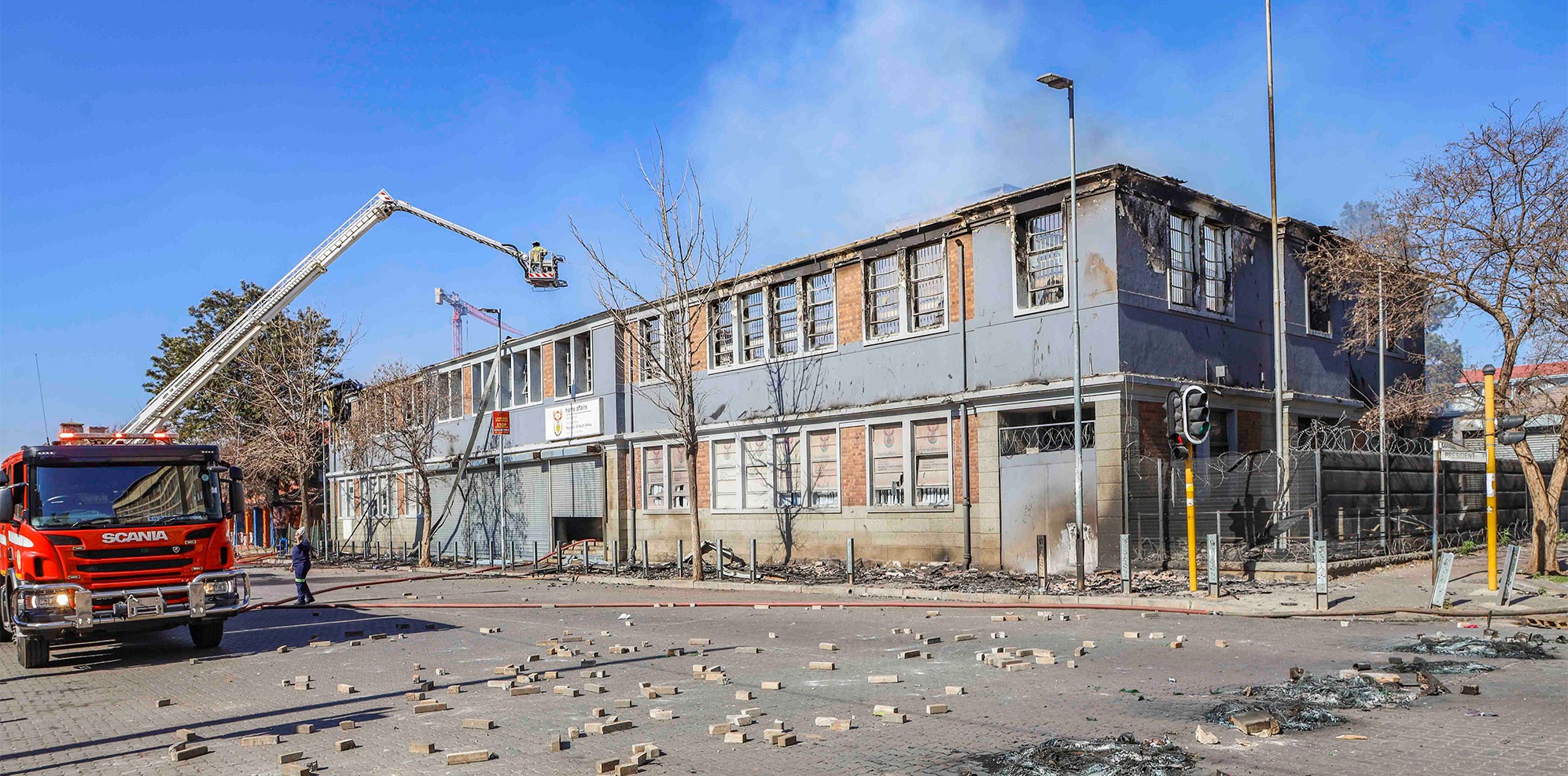
 The Home Affairs Germiston building closed after being set ablaze on 12 August 2025. (Photo: Gallo Images / OJ Koloti)
In August 2025, a fire at the Germiston Home Affairs office in Gauteng, reportedly started by residents protesting against evictions in the area, caused significant damage to the building. This included the floor where paper files for late registration of birth applications were kept. Ten months later, individuals whose records were destroyed in the blaze are still struggling to get their requests for documentation back on track.
Daily Maverick spoke to two people who lost their late registration of birth applications due to the fire. Both reported that after years-long efforts to secure birth certificates, they were told by Home Affairs officials that they needed to begin the process from scratch because their records had been destroyed.
/file/attachments/orphans/ED_568503_465609.jpg "Ekurhuleni Emergency Services on the scene of the Home Affairs building fire in Germiston on 12 August 2025. (Photo: Gallo Images / OJ Koloti)")
*Nomvula, a 66-year-old woman living in Ekurhuleni, Gauteng, first submitted late registration of birth applications for two of her nieces at the Germiston Home Affairs in 2023. One of the children, who is now 17 years old, is still without a birth certificate three years later.
Nomvula became the primary caregiver for her two nieces after her sister died during the Covid-19 pandemic in 2020. Her sister did not have an identity document and had not registered the births of any of her seven children.
When Nomvula first submitted late registration of birth applications for the two girls in 2023, with the help of the University of Cape Town’s (UCT) Children’s Institute, they were 13 and 15. Despite attempts to follow up on the progress of the applications over the next year, it was only in mid-2024 that the Home Affairs office contacted her to bring the children in for interviews to secure documentation.
By that time, the younger child was older than 15, which meant she needed to go through an additional process of providing fingerprints in order to proceed with her late registration of birth application.
In early 2025, the Germiston Home Affairs office issued a birth certificate for the older child, but not the younger, since they were still waiting for feedback from head office about her fingerprints.
However, after the younger child’s application was destroyed in the fire at the Home Affairs office later that year, Nomvula was told that she would need to start the process of registering her birth all over again, submitting new copies of the supporting documents.
/file/attachments/orphans/ED_568514_922774.jpg "The fire at the two-storey Home Affairs office in Germiston on 12 August 2025 was reportedly started by protesters. (Photo: Gallo Images / OJ Koloti)")
Delays and despair
The whole ordeal, measured in taxi fares, sun-scorched queues and the frustration of repeated delays, has been hard on Nomvula.
“Maybe I must wait another three years. I don’t know... Why must we wait so many years?” she said.
Starting again meant finding a copy of the letter from the Eastern Cape school where the child attended Grade 1, as well as travelling to the health facility in Gauteng where she was born for a proof of birth form. Nomvula estimated that the process of collecting everything took close to a month.
Her repeated visits to Home Affairs have drawn suspicion from staff there. “They asked me, ‘What are you doing here? Every day you are here’,” she said. “They accuse me [of being]... a person who makes an ID or a birth certificate for people.”
She has also found the interview process difficult to navigate. “They ask stupid things. Where is your mother? Where do you stay? [The children] were born here.”
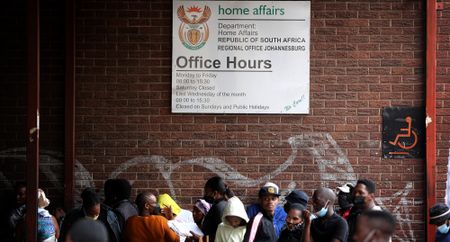
The physical demands of the process have worn her down. Queues at the Germiston Home Affairs office meant standing outside for hours in the heat.
“When I came back home, I was shaking,” she said. “I am sick and tired... This up and down, it’s killing me.”
/file/dailymaverick/wp-content/uploads/2024/07/ED_338706.jpg "People wait in long queues at the Soweto Regional Home Affairs Office. (Photo: Gallo Images / Fani Mahuntsi)")
In April 2026, the South African Social Security Agency (Sassa) suspended the Child Support Grant payments Nomvula had been receiving for her younger niece because the child did not have a birth certificate. The family had originally secured the grant using alternative proof of the girl’s identity.
During that month, the family struggled to afford food and transport to school. Nomvula said they were grateful when the grant was reinstated after a month through the intervention of a UCT Children’s Institute representative.
The child, meanwhile, has been struggling owing to her lack of documentation. Afraid of being singled out by teachers asking for documents she cannot produce, and lonely because she isn’t allowed to take part in sports and other activities, she was increasingly reluctant to go to school and failed last year.
“She lost her hope,” Nomvula said. “She’s got trauma from it.”
Paper-based filing system
Late registration of birth applications are used in cases where the registration process is initiated more than 30 days after a child’s birth. They are lodged at local Home Affairs offices and stored in paper files.
The UCT Children’s Institute noted that there was no electronic register at the Department of Home Affairs to track the number of applications at a national or provincial level, and no digital system for storing submissions and the supporting documents attached to them.
The institute argued that the paper-based files were more susceptible to loss and neglect.
“We are asking for there to be a track-and-trace and a register system, because we’ve seen these files lying around in [Home Affairs] offices across the country. They’re in paper folders. Anyone can pick it up and walk away with it... and no one would know, because there’s no register that says, ‘We’ve got so many in this office’,” said Paula Proudlock, senior researcher at the institute.
“We would like to see them making this into an electronic system, so that when someone registers, the form is electronic and the supporting docs are scanned and stored... by Home Affairs.”
/file/attachments/orphans/ED_568500_399923.jpg "Ekurhuleni Emergency Services attend to the fire at the Department of Home Affairs building in Germiston on 12 August 2025. (Photo: Gallo Images / OJ Koloti)")
Generational struggle
*Miriam, a 42-year-old Gauteng resident whose late registration of birth application was destroyed in the fire at the Germiston Home Affairs office, first submitted her request for documentation in 2023. Her mother, who gave birth at home rather than in a health facility, did not have an ID at the time of Miriam’s birth and did not register her.
Raised by her father and paternal aunt, Miriam only reconnected with her mother in 2020, when she sought her out for help with applying for a birth certificate.
Even before the fire, Miriam experienced a number of delays in the registration process. A DNA test linking her to her mother was rejected by Home Affairs because officials said it did not prove where she was born. She faced challenges in securing a proof of birth form from the hospital her mother took her to as a newborn.
After Miriam’s files were destroyed, she was told she would need to begin the entire application process again. This involved further costs, including bringing Miriam’s mother to Gauteng from her home in Mpumalanga to assist with getting a new copy of the proof of birth form.
Miriam’s latest interview with Home Affairs officials, for which her mother again travelled to Gauteng, took place in mid-May 2026. She has yet to receive confirmation of whether she will receive a birth certificate.
In the meantime, Miriam’s two children, aged eight and 13, are also without birth certificates. She has initiated late registration of birth applications for them as well, with no success.
The lack of an ID has shaped Miriam’s whole life. Though she earns a living as a traditional healer, she has never been able to secure formal employment, and has been blocked from opening bank accounts, taking out insurance and joining burial societies. Even accessing care at government health facilities has been a challenge.
Miriam told Daily Maverick that she didn’t want to see her children suffer the way she had because of a lack of documentation.
Court case
According to the Children’s Institute, there are a growing number of caregivers and their children stuck in the backlog for late registration of birth applications.
In May 2023, the then minister of home affairs, Aaron Motsoaledi, told Parliament that a backlog of more than 250,000 undecided late registration of birth applications had accumulated between 2018 and 2022.
In December 2024, the institute and a group of parents, represented by the Legal Resources Centre, launched litigation against the Department of Home Affairs in the Western Cape High Court. Aside from decisions on the applications of the 19 children and one adult involved in the case, the applicants were seeking a court order compelling the department to:
- Diagnose the “systemic inefficiencies” that had resulted in the years-long backlog for registration of birth applications; and
- Draft a plan to ensure that present and future applications were decided without long delays.
A hearing for the case is due to be held on Wednesday, 10 June 2026.
The current size of the backlog of undecided late registration of birth applications is a matter of contention. In October 2025, an answering affidavit filed in response to the litigation brought by the Children’s Institute and other applicants saw the director-general of the Department of Home Affairs, Livhuwani Makhode, arguing that there was no systemic backlog of applications in that year. He said that, as of 31 May 2025, the total number of undecided late registration of birth applications had been brought down to 33,386.
The Children’s Institute rejected this claim, filing an expert affidavit in November 2025 that stated the backlog of late registration of birth applications was likely to have been above 240,000 in 2024.
Responding to a parliamentary question on the late registration of births backlog in February 2026, Home Affairs Minister Leon Schreiber said the number stood at 33,386 – the same number reported by the department in its answering affidavit the previous year.
Daily Maverick asked the Department of Home Affairs for further information about the fire at its Germiston office and the overall late registration of birth applications backlog, but had not received a response by the time of publishing. DM
*These are pseudonyms ascribed to sources who chose to remain anonymous out of fear of a backlash.
Comments
Scroll down to load comments...