



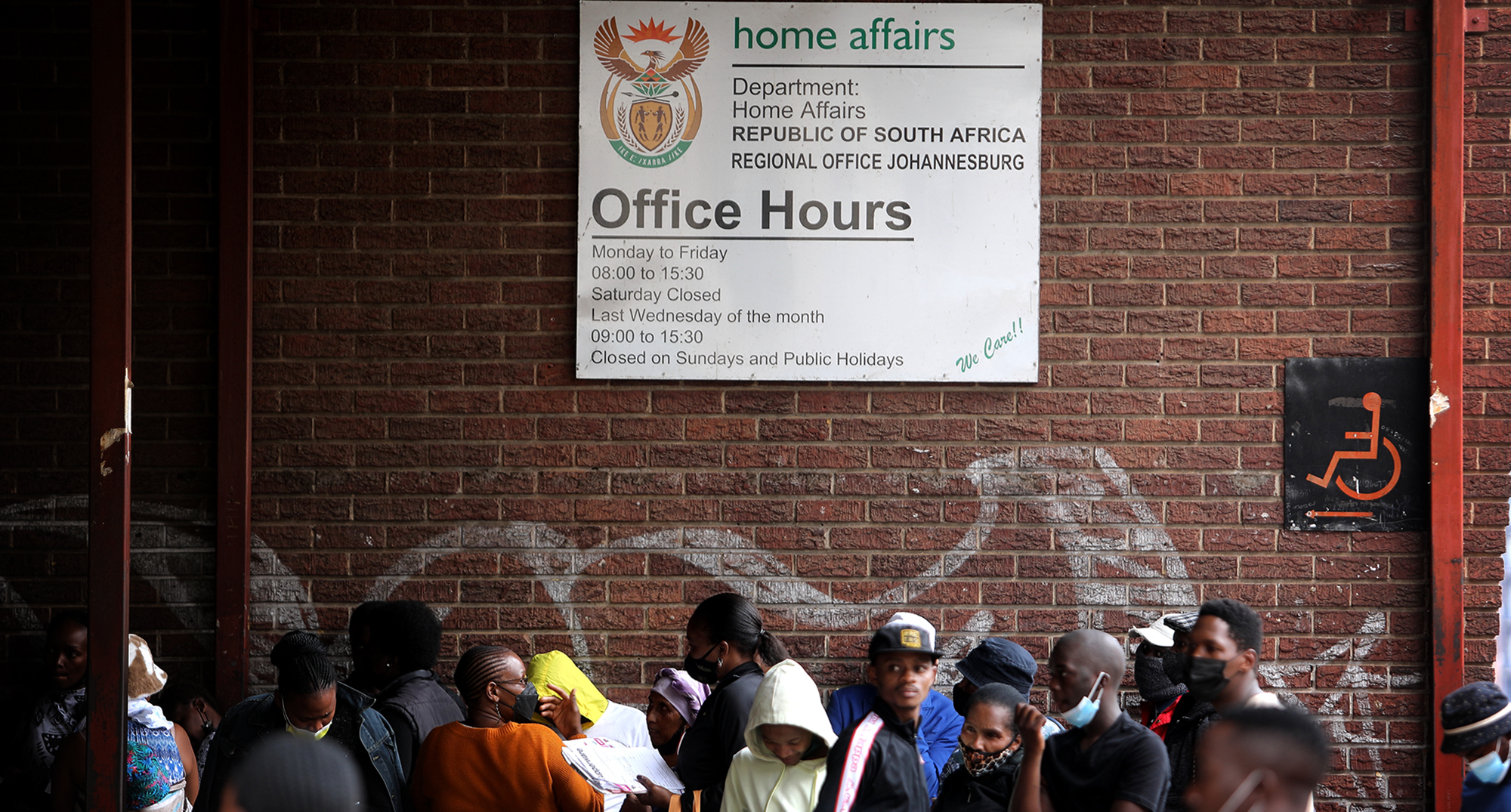
 People queue outside Home Affairs Offices on 22 April 2022 in Johannesburg, South Africa. (Photo: Gallo Images / Fani Mahuntsi)
Thandazile Xulu lives every day in the shadow of a great fear: that she will die before the birth of her grandson, Sbongakonke is registered. She has seen the barriers faced by people who grow up without a birth certificate or an identity document (ID), and she worries that he will be forced to struggle in the same way.
Sbongakonke is five years old. Xulu has been his primary caregiver for most of his life.
His mother did not have an ID at the time of his birth at King Edward VIII Hospital (now Victoria Mxenge Hospital) in Durban, KwaZulu-Natal, and could not register him. She had long-standing drug use problems and left Sbongakonke’s life shortly after he was born. Since then, Xulu has raised the child as her own at her home in Langa, Cape Town.
Xulu works as an HIV counsellor for the parents and caregivers of patients at Red Cross Children’s Hospital. Aside from Sbongakonke, her household is made up of her son and his child, and her partner, who no longer works due to his age.
“If I die, the child is going to live without a birth certificate, because I’m old now… and still the mother is on the road. I don’t know, even now, where she is,” said Xulu, adding that she had never known the identity of Sbongakonke’s father.
“I’m very, very worried, and I try my best. I even take days off work because I need to help my child to get a birth certificate, but it’s too difficult.”
/file/dailymaverick/wp-content/uploads/2021/09/Merten-perm-residency-take2-option-2.jpg "The Home Affairs office in Cape Town, South Africa. (Photo: Leila Dougan)")
Delays at Home Affairs
Xulu’s efforts to get Sbongakonke’s birth registered go back years. She first travelled to Durban to obtain a proof of birth form from King Edward VIII Hospital, before lodging a late registration of birth application at the Cape Town Department of Home Affairs in April 2023. This type of application is used when the birth registration process is initiated more than 30 days after a child’s birth.
Xulu included a letter from a social worker at Cape Town Child Welfare, confirming she was her grandson’s primary caregiver.
For two years, she waited for Home Affairs to call her with an update, but no communication was forthcoming. In 2025, with Sbongakonke approaching the age when he would need to start school, Xulu returned to the department to find out what was going on.
/file/attachments/orphans/IMG_9361_675859.jpg "Thandazile Xulu, an HIV counsellor at Red Cross Children’s Hospital in Cape Town, is the primary caregiver for her five-year-old grandson. She has struggled for years to get his late registration of birth application approved by the Department of Home Affairs. (Photo: Tamsin Metelerkamp)")
“Home Affairs told me that in my file, they don’t have that [proof of birth] paper that I got from King Edward VIII Hospital… They said they need that paper, so now I am stuck. I need to go back to [the hospital] again to go and fetch it for the child… I’m busy trying to save money to go,” she explained.
“It’s very unfair for me. They lost my document. I need to go again, because I want my child to have a certificate, but I’m going to spend my last cent… to get there.”
Even the trips to the local Home Affairs Department were a challenge, said Xulu, as it meant taking time off work to queue from 5am, at an office that was often too full.
“I’m always in the line with another grandparent. You find most of the people are grandparents, standing in the line. Some of them, the mother died because of drugs, or the mother died because of HIV, and all of those things,” she noted.
Stuck in the backlog
Xulu’s case is far from an isolated one. Across South Africa, people are battling to overcome bureaucratic barriers and delays in the late registration of births process. A growing list of caregivers and their children are becoming stuck in the backlog, according to the Children’s Institute at the University of Cape Town (UCT).
The problem was first thrust into the spotlight in May 2023, when then minister of home affairs Dr Aaron Motsoaledi told Parliament that a backlog of more than 250,000 undecided late registration of birth applications had accumulated between 2018 and 2022.
/file/attachments/orphans/ED_597708_675008.jpg "Former minister of home affairs Dr Aaron Motsoaledi. (Photo: Gallo Images / Jeffrey Abrahams)")
During 2023 and 2024, the UCT Children’s Institute and the Legal Resources Centre (LRC) sent three letters to the minister and the Department of Home Affairs detailing certain cases of children whose applications were stuck in the backlog, and requesting urgent intervention for those and others. These letters received no response, according to the institute and LRC.
As a result, in December 2024, the Children’s Institute and a group of parents, represented by the LRC, launched litigation against the Department of Home Affairs in the Western Cape high court. The applicants were seeking a court order compelling the department to:
- decide the applications of the 19 children and one adult involved in the court case, and issue their birth certificates if approved;
- diagnose the “systemic inefficiencies” that had resulted in the years-long backlog for registration of birth applications; and
- draft a plan to ensure that present and future applications were decided without long delays.
A hearing for the case is due to be held on 10 June 2026.
Paula Proudlock, senior researcher at the Children’s Institute, noted that the parents involved in the case had waited between two and seven years for an outcome in their late registration of birth applications.
After the Department of Home Affairs indicated its awareness of the litigation in May 2025, it began prioritising the finalisation of applications for those directly involved in the case, issuing birth certificates for all but one by September of the same year.
“When the department did finally start processing the applications, showing that it was possible, it also showed that in some cases, they hadn’t even opened the application files until this court case. And I think what we wanted to show is that these files effectively just get left there and lost, and no one is checking that they get decided or processed, because there is no register of these cases. There’s no tracking system.
“It shouldn’t be that one has to go to the high court to get the cases to the top of the pile,” said Proudlock.
Tracking the numbers
The size of the backlog of undecided late registration of birth applications is a matter of contention.
In October 2025, an answering affidavit filed in response to the litigation brought by the Children’s Institute and other applicants saw Director-General of the Department of Home Affairs Livhuwani Makhode arguing that there was no systemic backlog of applications in that year. He said that as of 31 May 2025, the total number of undecided late registration of birth applications had been brought down to 33,386.
The Children’s Institute rejected this claim in its replying affidavit, filed in November 2025, stating that it was “inconceivable” that the backlog as it stood in 2022 could have been reduced by 87% to just over 30,000. An expert affidavit was provided with findings that the backlog of late registration of birth applications was more likely to have been above 240,000 in 2024.
Among the issues pointed out by the Children’s Institute were anomalies in the data provided by the Department of Home Affairs. The department had claimed there were only 297 undecided applications on hand in the Western Cape. However, the institute stated that at just two local offices in the province, there was a combined backlog of more than 2,400 such applications.
/file/attachments/orphans/ED_597178_692372.jpg "Minister of Home Affairs Dr Leon Schreiber. (Photo: Gallo Images / Frennie Shivambu)")
In response to a Parliamentary question on the late registration of births backlog, published in February 2026, current Home Affairs Minister Dr Leon Schreiber stated that the number stood at 33,386 – the same amount reported by the department in its answering affidavit from October 2025.
The minister noted that while birth certificates were issued “on the spot” in cases where applications were approved, delays had occurred in some instances where clients did not turn up for interviews; had cases that required further investigation; or had not submitted outstanding supporting documents.
In KwaZulu-Natal alone, the number of applications pending in February 2026 stood at 4,495, according to another Parliamentary question put to Schreiber.
Daily Maverick asked the Department of Home Affairs to further clarify the issues around the late registration of births backlog, but had not received a response at the time of publishing.
Life in limbo
The Children’s Institute and the LRC note that there were many reasons why a parent or caregiver might fail to meet the Births and Deaths Registration Act requirement to register a child’s birth within 30 days of the baby being born. These include isolation in rural areas; health complications after birth; the challenges facing mothers without IDs; and the complex processes surrounding the registration of babies who have been abandoned by their mothers.
At the level of Home Affairs offices, the institute and the LRC said that some causes of the backlog included:
- Applications sitting in paper piles at local offices for many years before they were processed for verification;
- DHA officials requesting supporting documents that were not legally required when the application was lodged, due to processing delays that resulted in the child having aged considerably while waiting for an outcome;
- Unreasonably long delays by the DHA in the verification of applicants’ supporting documents; and
- A lack of interprovincial cooperation between DHA offices to verify births that occurred in another province
/file/attachments/2991/Merten-HomeAffairs-Sita1_712351.jpg)
The consequences for the children living without birth registration are severe. They experience a life in limbo, struggling to access many of the services to which they are entitled, including enrolment in early learning programmes and schools, support through social grants and even access to public healthcare services and private medical aid, according to the Children’s Institute and the LRC.
*Buhle, a 19-year-old South African from KwaZulu-Natal who has been unable to secure birth registration or an ID, told Daily Maverick that she had missed out on many opportunities due to her lack of documentation.
“It feels so difficult in that there’s nothing I can do. The only thing that I can do is work in a salon… I cannot be hired in a place where I can earn… sufficient income… I couldn’t get to university like my peers did... It’s very painful. I don’t even like to talk about it,” she said.
When Buhle was born at a hospital in the Free State, her mother did not have an ID and could not register the birth.
“[My mother] left me with my father in the Free State… and my father didn’t have any experience in arranging a birth certificate… I moved to live with my mother in KZN in 2017, so since then we started making arrangements with Home Affairs, and there have been so many delays, declines,” said Buhle.
Buhle does not have a proof of birth form, and neither she nor her mother have been able to afford the trip back to the hospital in the Free State to fetch one. In the lead-up to writing her matric exams, Buhle travelled to her local Home Affairs office almost monthly, trying to organise her birth registration and ID, but was unable to do so. She was permitted to write after receiving an affidavit from the school and a document from Home Affairs confirming she was still waiting for an ID.
Now, Buhle is striving to save money for a R1,500 DNA test that could help her prove her parentage and obtain her documentation.
“The only thing that I want right now is to get that identity document, so I can continue to live my life, go to [university], do anything I wish to do, like everyone else can as a citizen,” she said. DM
*This is a pseudonym ascribed to a source who chose to remain anonymous out of concern for backlash.
/file/attachments/orphans/ChildrensReporterV2_187851.jpg)
Comments
Scroll down to load comments...