



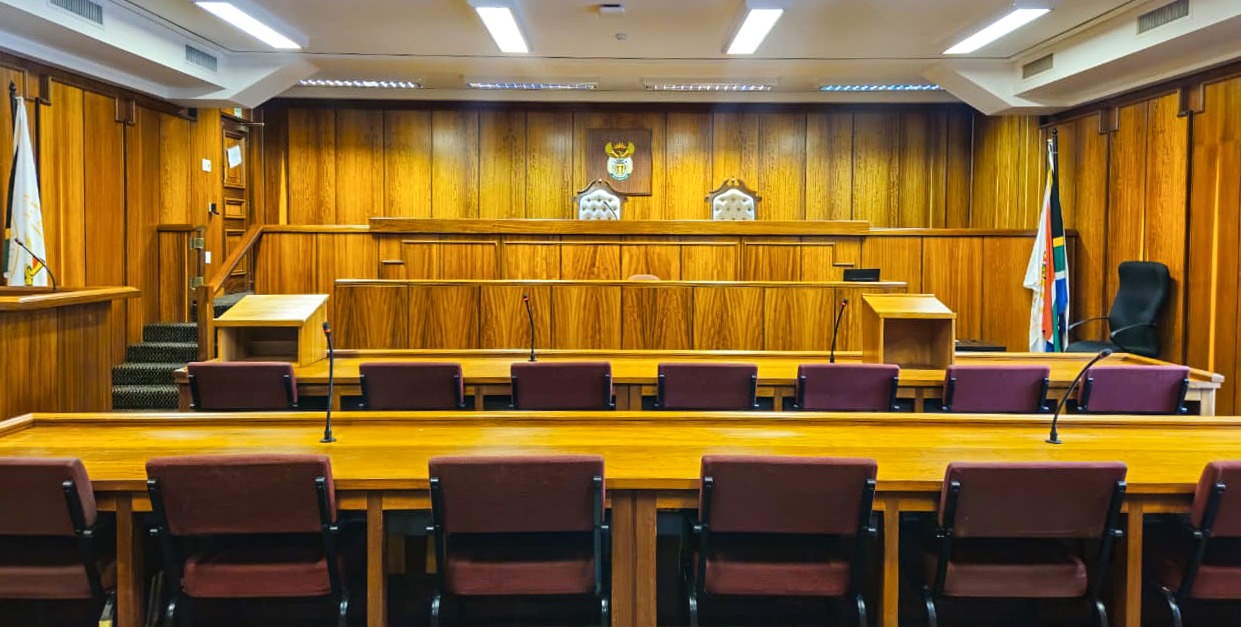
 The inside of the motion court room in the Gqeberha High Court on 13 February 2026. (photo: Andisa Bonani)
Concern about whether South Africans trust the country’s legal system has been growing for years.
From at least 2021, more than half of those asked by Afrobarometer have said they trust the judiciary “just a little” or “not at all”.
At the same time, other polling has found that a military government may in fact be more popular than the democratic system we have now.
Recent events have raised serious questions about the integrity of the judiciary. While every case involves unique facts and explanations, the underlying pattern fuels a growing public perception that individuals with wealth and resources can easily evade justice.
Two weeks ago, the taxi mogul Joe Sibanyoni and several others were arrested and charged with extortion.
/file/attachments/orphans/HIGhuEzW4AAQkut_179767.jpeg "Taxi boss Joe 'Ferrari' Sibanyoni. (Photo: Facebook)")
The initial magistrate was told that Mpumalanga’s chief magistrate, Tuletu Tonjeni, would take over the case. Despite the prosecutor, Mkhuseli Ntaba, warning that he had a scheduling conflict, the next hearing date was set anyway.
When Ntaba subsequently failed to appear, Tonjeni — now presiding — struck the case from the roll, freeing Sibanyoni and his co-accused. The National Prosecuting Authority (NPA) later re-enrolled the matter and moved it to a larger court facility, where a new magistrate granted bail, allowing the case to finally proceed.
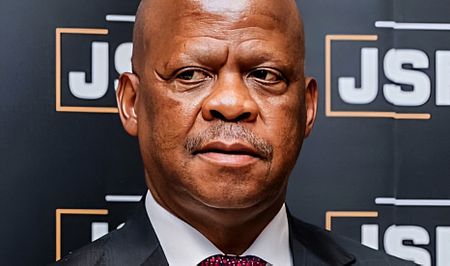
In the meantime, NPA head Andy Mothibi told Newzroom Afrika that Ntaba had not appeared in court because he had been threatened.
The NPA then lodged a complaint against Tonjeni at the Magistrates Commission. She then retired.
There may be an innocent explanation for this. But if a prosecutor was threatened in a case, would it not follow that the magistrate might have been threatened too?
Meanwhile, as journalist Anna Cox reported, the Alexandra Magistrates’ Court struck a fraud case against Johannesburg Development Agency (JDA) CEO Themba Mathibe off the roll this week under questionable circumstances. Although the NPA plans to re-enrol the case, the court’s decision clears a path for Mathibe to return to work, where he could potentially influence JDA spending decisions.
/file/attachments/orphans/ED_551075_488953.jpg "Johannesburg Development Agency CEO Themba Mathibe. (Photo: Lubabalo Lesolle / Gallo Images)")
State Capture cases
Unfortunately, this pattern of sudden dismissals is not confined to recent events or lower courts.
The Nulane Investments case was meant to be the National Prosecuting Authority’s (NPA’s) flagship entry into prosecuting the Gupta family’s sprawling State Capture network. Centred on a fraudulent R25-million agricultural feasibility study in the Free State — where R19-million was rapidly siphoned off to Dubai — the trial saw high-profile businessmen like Iqbal Sharma and former government officials in the dock.
/file/dailymaverick/wp-content/uploads/2023/05/ED_430476.jpg "Iqbal Sharma appears at the Free State Division of the High Court in Bloemfontein on 23 January 2023. (Photo: Mlungisi Louw / Gallo Images / Volksblad)")
However, the high-stakes matter was placed before Acting Judge Nompulelelo Gusha, who abruptly derailed the prosecution. At the close of the State’s case, she granted Section 174 discharges, outright acquitting the accused and lambasting the prosecutors for what she called a “lackadaisical” case built on “zilch” evidence.
Refusing to back down, the NPA appealed to the Supreme Court of Appeal (SCA), which issued a scathing rebuke of Gusha’s ruling. The SCA found that her judgment suffered from a “litany of errors,” misapplied fundamental laws of fraud and common purpose, and resulted in a profound “failure of justice.”
The only dissenting voice on the SCA panel was Judge Cagney Musi, who was serving there on an acting basis. In his permanent role as the Judge President of the Free State, Musi was the very individual who had appointed Gusha to hear the case in the first place.
Absent a public explanation, what conclusions are one to draw from this?
In another State Capture case, another acting judge, Stanley Jacobs, was appointed to hear a case involving former Eskom CEO Matshela Koko. After ruling that the Investigating Directorate was “overselling” its case, it emerged that Jacobs had a financial interest in Eskom through a contract with another company.
Judge President Mbenenge
And then there is Eastern Cape Judge President Selby Mbenenge. Legalities aside, a senior official who targets a vulnerable junior colleague with lewd messages and images fundamentally breaks the public trust. In the corporate world, a JSE-listed CEO would be fired instantly for such behaviour. Yet, the Judicial Conduct Tribunal initially protected Mbenenge, finding him guilty of misconduct but stopping short of recommending impeachment.
It was left to the Judicial Service Commission to correct course, overturning that ruling in favour of impeachment.
/file/attachments/2987/mbenengepic_605915.jpeg "Eastern Cape Judge President Selby Mbenenge. (Photo: Office of the Chief Justice)")
Meanwhile, in another Eastern Cape controversy, Judge Belinda Hartle faces accusations of directing a racial slur at a black employee in her chambers.
While Hartle admits to speaking harshly, she denies using a racist term — yet she refuses to disclose what she actually said. Given her position, no alternative word could inflict more damage on her career and reputation than the one she is accused of using. Her silence, therefore, simply defies logic.
Political attacks
Staying in that province, it has not been explained why a white magistrate was assigned to the Julius Malema firearm case. It was always predictable that Malema would make an issue of her race and ethnicity and that he would target her on these grounds.
This was a gift to Malema. He has every interest in ensuring that the rule of law and the judiciary are weakened.
He is not alone.
/file/attachments/2991/ED_604115_158672_224389.jpg "EFF leader Julius Malema appears in the East London Magistrates' Court for sentencing proceedings on 15 April. (Photo: Randell Roskruge / Gallo Images)<br>")
MK and its leader, Jacob Zuma, routinely attack judges and publicly dispute their rulings.
This is because Zuma faces corruption charges and was jailed by the Constitutional Court in 2021 (which sparked the violence in KwaZulu-Natal and Gauteng that year).
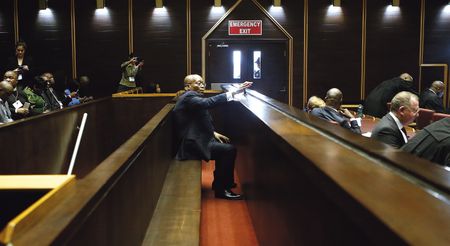
They will ignore the obvious fact that the majority of magistrates and judges spend more hours than they should to competently and fairly dispense justice to thousands of people. Considering the sheer number of cases they deal with, those that result in controversy are rare.
That’s a testament to their commitment to their duty. But the officials who create controversy do much to tarnish this work.
Accountability and awareness
To counter this, those who lead the magistracy and the judiciary should take much more assertive action.
First and most obviously, there must be accountability for those judicial officers involved in wrongdoing.
Tonjeni must go through a process at the Magistrates Commission despite her retirement. It may also be necessary for someone to lodge a complaint against the magistrate in the Mathibe case, if only to give them a chance to state their case.
Crucially, the Magistrates Commission must ensure that once its disciplinary processes conclude, the outcomes are fully publicised. True accountability cannot exist in the dark; finding a magistrate guilty or innocent means very little if the public is left entirely unaware of the verdict.
For our justice system to work, justice must be done and seen to be done, particularly when it involves judicial officers.
Consequently, the bodies overseeing disciplinary processes must act decisively. They must eliminate any public suspicion of favouritism or institutional protectionism, while urgently speeding up the timelines of these inquiries. Ultimately, managing these cases is not just about individual accountability; it is about safeguarding the integrity of the entire judicial system.
The right judges for the right cases
Those who decide which judicial officers hear which cases might wish to consider their future choices, too.
While a lottery system might work best when assigning cases over the longer term, some situations should be avoided — particularly if they involve political leaders with a history of using the identities of certain people against them.
More to the point, it is utterly baffling to the public that career-defining State Capture cases — which attract intense national scrutiny — are routinely handed to acting judges and magistrates. To anyone outside the system, it is painfully obvious: these monumental trials belong in the hands of seasoned, permanent senior judges.
There can be no doubt that campaigning on certain issues changes the minds of voters.
Over the years, there has been a calculated campaign against South Africa’s judiciary, which is one of the reasons so few people trust the judicial system.
This campaign will continue. It will be led by a wide coalition of people who have every interest in undermining the rule of law, whether they be Zuma and MK, Malema and the EFF, taxi bosses such as Sibanyoni, or those who lie routinely, such as xenophobic groups like March and March.
For the moment, it appears that those who make this argument are winning. It will require firm action by our judicial leaders to turn the tide. DM
Comments
Scroll down to load comments...