




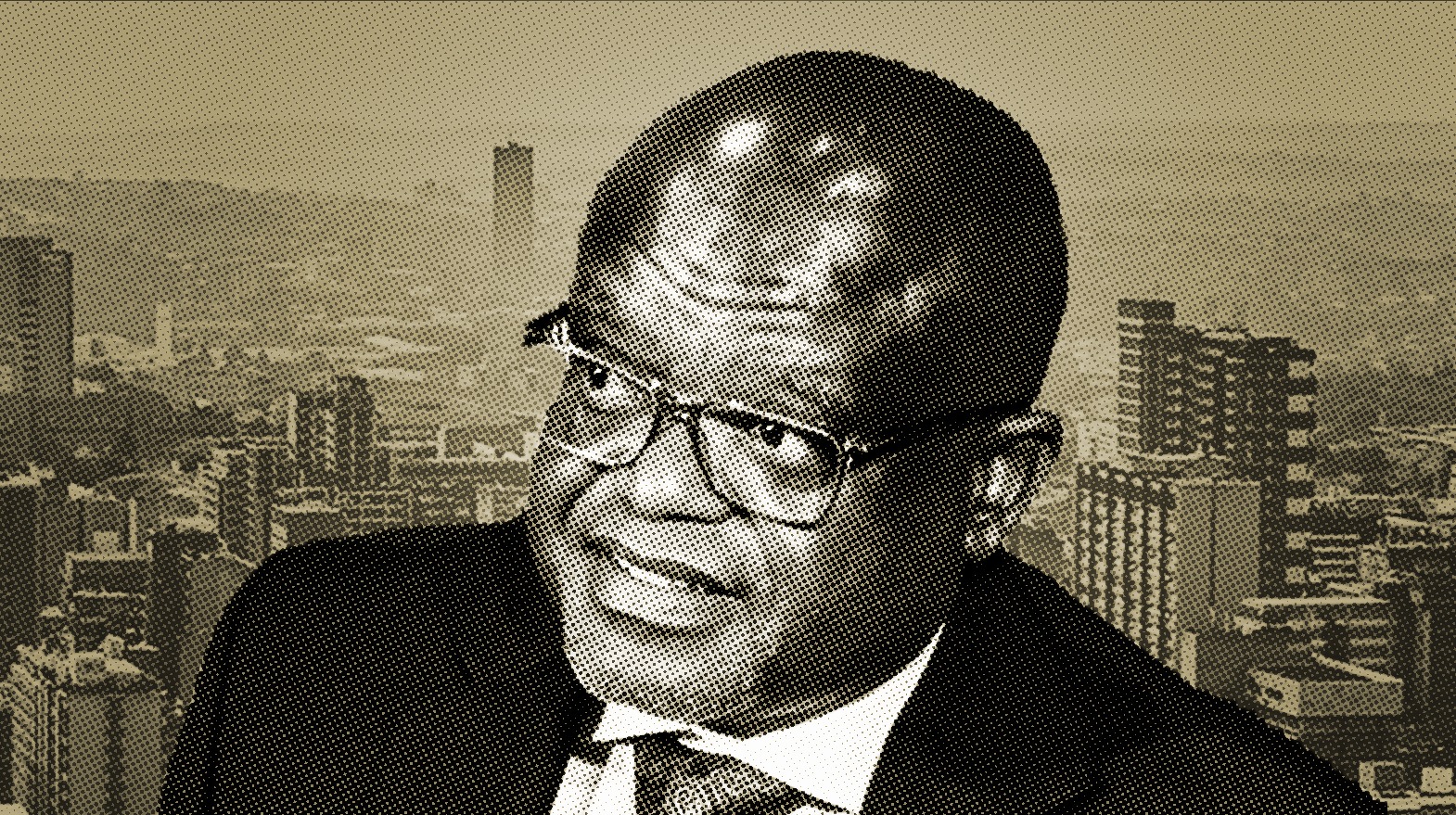
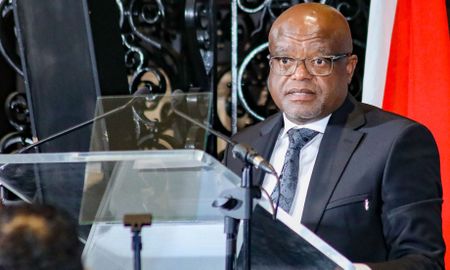
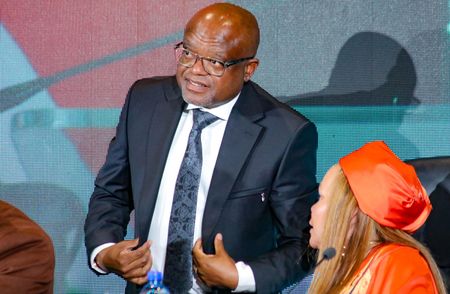
 Illustrative image | Johannesburg skyline. (Photo: Waldo Swiegers / Bloomberg via Getty Images) | Executive Mayor of the City, Cllr Dada Morero. (Photo: Gallo Images/Fani Mahuntsi)
The latest report from the Auditor-General on the City of Johannesburg’s consolidated financial statements shows that poor management, weak accountability mechanisms, and deteriorating infrastructure have led to high levels of irregular expenditure.
In the 2024/25 financial year, Joburg achieved an unqualified audit with findings for the 11th year in a row and recorded R3.69-billion in irregular expenditure, R2.38-billion in unauthorised expenditure, and R943-million in fruitless and wasteful expenditure.
These results were presented in a parliamentary briefing by the Auditor-General of South Africa on Tuesday, 2 June 2026. The Auditor-General’s Gauteng business unit leader, Fhumulani Rabonda, warned that nearly 80% of the City’s municipal entities were in the amber, and had been for several years, indicating that they had given “false assurances”.
“The reason we call it false assurance is that we cannot be comfortable with an environment that has credible financial statements that are published but they are not complying with the law, or their performance report has material misstatements,” explained Rabonda.

Key basic infrastructure entities like City Power, Johannesburg Water, Pikitup and Johannesburg Road Agency have been in the amber for more than 10 years, meaning that the Auditor-General has made material findings on their statements.
“It means that throughout the financial year, [leadership] may have been making decisions based on information that is not reliable, or you are actually maintaining an environment that has a disregard for the law, and we know that an environment that has a disregard for the law is a fertile ground for unscrupulous conduct to happen.”
Rabonda said that separate municipal entities received qualified audits with opinions due to weak accountability mechanisms, which inconsistently enforced compliance, financial management and effective oversight. Their material findings included significant backlogs that delayed investigations into unauthorised, fruitless and wasteful expenditure, and poor compliance controls.
The City, on its own, received a qualified audit, but was categorised as unqualified with findings when its various entities were considered.
Underfunded maintenance budget
One of the key issues the Auditor-General flagged was Johannesburg’s 2024/25 budget being unfunded, meaning that the expenditure had been planned to be funded from “unrealistic revenue targets”, leading to unauthorised expenditure of R2.38-billion.
Other issues flagged included capital expenditure being just 9% of the budget – below norms of 10-20%, meaning the City lacked sufficient funds to invest in expanding its infrastructure. The amount of money budgeted for maintenance was just 4%, well below the norm of 8%.
/file/attachments/orphans/Presentation228_732415.jpg "City Power Johannesburg. (Photo: City of Johannesburg website)")
“It means that while there may be a need to maintain infrastructure, there is no money made available for that maintenance,” Rabonda said.
The lack of budget for infrastructure maintenance has exacerbated Johannesburg’s backlog. In his State of the City address, Mayor Dada Morero acknowledged an infrastructure backlog of more than R220-billion.
Civil society organisations like JoburgCAN have warned that the City’s latest budget, tabled on Wednesday, 27 May, is also unfunded, which could have a knock-on effect on service delivery.
In 2024/25, debts to bulk service suppliers such as Eskom and water boards sat at R3.1-billion. The City’s Eskom debt has since risen to more than R5-billion.
Water losses, referring to water that is supplied but does not generate revenue, sat at 45%, equating to R2.8-billion, while electricity losses were at 27%, equating to R5.7-billion.
Further, the Auditor-General’s office noted more than 20 material irregularities in other municipal entities, and at least two, one from waste collection agency Pikitup and the other from Johannesburg Water, resulted in “substantial harm to the general public”.
“There is significant concern due to deteriorating infrastructure, poor maintenance and failure to meet water-related guidelines,” Rabonda said.
In particular, Rabonda pointed to instability in political and governance leadership as being one of the major factors that had contributed to noncompliance, weak accountability mechanisms and inconsistent oversight over service delivery.
“While the City has implemented financial stabilisation and recovery initiatives and engaged the National Treasury for support, these interventions have not yet resulted in a material improvement. The financial health of this city remains concerning due to liquidity pressures, high debt and the inability to timeously collect revenues,” he said.
“Ongoing lapses in budget discipline, revenue and asset management continued to put pressure on cash flows and constrained the City’s ability to fund service delivery and infrastructure adequately.”
The Auditor-General called for the City to stabilise its senior management and fill critical vacancies, restore basic compliance controls, and enforce consequence management and compliance. DM
Comments
Scroll down to load comments...