



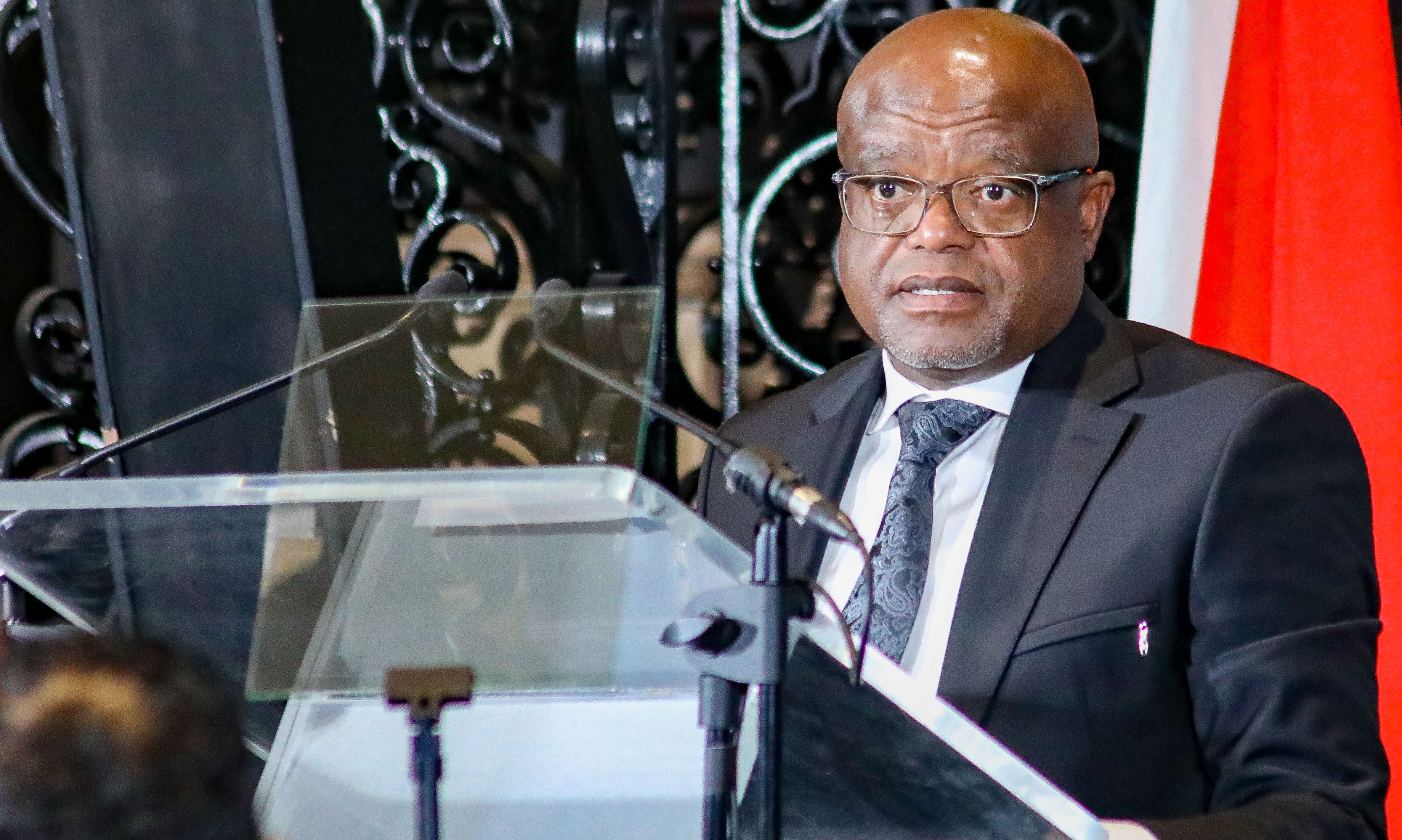
 Johannesburg Mayor Dada Morero delivers the State of the City Address at St Mary’s Cathedral on 20 May. (Photo: Fani Mahuntsi / Gallo Images)
Johannesburg Mayor Dada Morero delivered his final State of the City address (Soca) on Wednesday, 20 May, at the historic Cathedral of St Mary the Virgin in the newly-renamed Archbishop Desmond Tutu Precinct in the Johannesburg CBD.
His optimistic tone was belied by persistent service delivery failures across the city, which have worsened in recent months.
Morero took office in 2024, after the mayoral chains had repeatedly changed hands over the previous nine years. He will not be the ANC’s next mayoral candidate, making this Soca a declaration of his successes, rather than his promises for the upcoming year.
He tried to keep an upbeat attitude throughout the address, fitting for a farewell, while, bizarrely, taking jabs at the City of Cape Town. Perhaps this was intended as a swipe against the DA’s mayoral candidate for Johannesburg, Helen Zille, who was present in the room and was formally acknowledged by Morero to a chorus of boos.
Nearly every speech of Zille’s mayoral campaign has included numerous comparisons between the two cities, positioning Cape Town as a shining beacon of good governance that she will emulate in Johannesburg if elected.
/file/attachments/orphans/ED_609702_411571.jpg "Mayor Dada Morero arrives at St Mary's Cathedral on 20 May before delivering his State of the City Address. (Photo: Fani Mahuntsi / Gallo Images)")
The way Morero tells it, Johannesburg is the more desirable place to live as 14,000 people moved to the city during the past year, compared to 11,000 in Cape Town. Furthermore, he said, Johannesburg fared better on unemployment, weathering a minor 0.9% increase while Cape Town’s rate climbed by 1.6%.
Even Johannesburg’s health facilities are better, as proven, according to Morero, by the fact that there are more people on private medical aid schemes in Cape Town than in Johannesburg.
Throughout his address, Morero described Johannesburg as a city on the rise.
“Every time I hear someone say that Johannesburg remains Africa’s richest city, it warms my heart. It means we have not collapsed; we must be doing something right,” he said.
But the jabs towards Cape Town and references to Johannesburg’s wealth conceal deeper issues of broken promises and a city on the brink of collapse.
The R5.2bn Eskom debt
Hanging over the mayor’s head was the notice issued by power utility Eskom on Tuesday, 19 May, threatening to reduce, interrupt or terminate the supply of electricity to certain bulk supply points in Joburg over an unpaid debt of R5.2-billion to the power utility.
For Johannesburg residents, this represents an additional existential crisis on top of the multiple service delivery failures stemming from ageing infrastructure and poor maintenance, particularly regarding water and waste removal.
In February 2026, large swathes of the city had interrupted supplies of water, culminating in protests. And in March 2026, Pikitup protests left piles of rubbish in parts of the city, including Cosmo City and Randburg.
All this came despite Morero’s promises in previous addresses to upgrade municipal services and his claims in this speech that access to electricity, water and sanitation had improved throughout the city, while municipal entities achieved “record-breaking” response times during the July 2025 and January 2026 water crises.
/file/attachments/orphans/Mayor-Dada-Morero-six-key-promises_765613.jpg "A scorecard showing Mayor Dada Morero's election promises between 2024/25, comparing the promises he's met and the ones he's broken. (Graphic: Ferial Haffajee)")
To his credit, Morero tackled the Eskom threat during his address.
“We are concerned about Eskom’s latest notice, and we are taking it seriously. This challenge is not only affecting the City of Johannesburg but several municipalities across the country. We will not fight Eskom. We will work with the minister of electricity and energy, and Salga [South African Local Government Association] to resolve this challenge,” he stated.
Morero said City Power would implement a turnaround plan, which included implementing guidance issued by the National Treasury and the Department of Cooperative Governance and Traditional Affairs to strengthen municipal trading entities to improve governance, financial sustainability, operational efficiency and accountability within the entities.
In addition, he said, the City had entered into an agreement with KfW, a German development bank, to secure a loan of €200-million to fund “energy-related projects”.
He acknowledged the widely reported estimate of the City’s R220-billion infrastructure backlog, saying the City had taken “immediate steps” to stabilise its finances.
These steps included:
- Adopting a fully funded R89.4-billion budget;
- Achieving a revenue growth of 9.3% supported by tariff increases;
- Achieving a debt-to-revenue ratio target of 30%; and
- Putting in place a debt relief programme offering a 50% write-off and 100% interest waiver to eligible debtors. (Finance Minister Enoch Godongwana recently warned that Joburg’s budget was not, in fact, fully funded.)
‘Cherry-picked statistics’
Morero’s speech was poorly received by civil society organisations, including JoburgCAN, and the Organisation Undoing Tax Abuse (Outa), which slammed the optimistic speech as not reflecting the lived experiences of residents in the city.
/file/attachments/orphans/ED_609709_522797.jpg "Guests at the Soca at St Mary's Cathedral on 20 May. (Photo: Fani Mahuntsi / Gallo Images)")
“The speech attempted to present Johannesburg as a city on a path to recovery, yet many of the City’s own admissions point to a municipality under severe strain,” said Julius Kleynhans, Outa’s executive manager.
“Residents living through collapsing infrastructure, water outages, refuse failures, billing chaos and deteriorating roads are unlikely to recognise the picture presented in this address.”
JoburgCAN accused the mayor of using “cherry-picked statistics to create the impression of a city in recovery”. It also pointed out inconsistencies in the statistics the mayor presented.
“If the mayor’s optimistic picture of Johannesburg is accurate, then why are only around 60% of residents satisfied with service delivery?” asked JoburgCAN managing director Julia Fish.
“The mayor reportedly referred to 47,000 homes at Southern Farms, while also saying the project has broken ground. Both cannot mean the same thing. The city must clarify exactly what has been delivered, what is still planned and what residents can verify on the ground.
“Residents do not experience service delivery through percentages on a slide. They experience it when there is water in the tap, refuse is collected, traffic lights work, roads are repaired and billing queries are resolved.” DM
On a lighter note
One positive is that there were signs around the church that the mayor’s promised urban renewal project is beginning to take shape. The roads were clean around the newly named precinct, and trees had been recently planted.
Joubert Park and the area around it also seem to be maintained, in line with the mayor’s promise to rejuvenate the area. The renewal project will extend to include Hillbrow Hospital and the Johannesburg Art Gallery, which is currently undergoing restoration.
So, at least residents have that to look forward to. DM
Comments
Scroll down to load comments...