




 Illustrative Image: Tap. (Photo: Unsplash) | Joburg skyline. (Photo: Herman Verwey) | Water. (Image: Freepik) | Building plans. (Image: Freepik) | (By Daniella Lee Ming Yesca)
 About six months ago a politician (some of my best friends are politicians) asked me what thoughts I would have on finding a financial solution to support Joburg’s devastating water problems.
First of all, I said, focus on the problem. Take water out of the mire, the sludge, the swamps that are Joburg’s more general funding problems. This is required for two principal reasons:
- To get a clear picture of the specifics as they pertain to water – maintenance, capital, payment structure, pricing, economic model… certainty and truth; and
- To take the problem out of the hands of those who seemingly know little or nothing about sustainable water supply dynamics or money and give it to the experts to solve.
There are obvious problems in not doing this, such as unclear cross-subsidisation, obscured oversight and corruption (off a higher base), but more about those later.
The real purpose is to produce a clear, uncontaminated view of the water supply chain problems and opportunities. Only then can we begin to finance it optimally. Clarity, predictability and the absence of outside interference are huge factors in determining the cost of capital.
I was therefore encouraged when I read that the minister and the mayor were seeking a solution to fund Joburg’s indebtedness to Eskom (and to avoid a cut-off in supply) within the principle of ring-fenced electricity revenue contractually being applied to settle electricity debt. Obvious, really – but then most things in finance are – it’s just sums, not opinions and promises.
Of course, collection of revenue from Joburg’s diverse electricity users is another matter entirely (which sits at the kernel of the problem), but this will bring clarity to that problem/opportunity as well. I don’t know the full spectrum of users who don’t pay, but it would include those who simply can’t afford to, those who refuse to out of protest, those businesses failing because input costs (like electricity) have driven them out of business because they simply can no longer compete with international competitors (part of the reason Eskom now reports excess capacity), and, of course, there are those of us who pay, in full, on time.
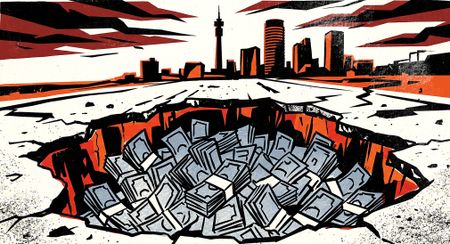
Like so many other revenue sources (tax is a prime example) this latter group of payers is subsidising the non-payers and, as rates keep going up as a direct consequence (at rates way in excess of inflation) that ever-smaller group will, per force, or protest or departure, keep getting smaller. A recipe for disaster.
This general problem is pervasive throughout all mismanaged funding models. It is hard to find an exception in local, provincial and national government.
There is a limit to all of this, for the time being defined by the tolerance of our debt providers (all sources, at all levels) which will eventually either dry up one day or be ignored as we descend into anarchy and a mafia state.
Instead of continuing to fund Joburg and other municipalities as they are now (it clearly isn’t working), elements of the solution will be better found in what I might describe as the Honeycomb Finance Model.
Honeycombs are built by bees in nature, in which they raise offspring and store honey. They are incredibly efficient and strong structures which have found numerous applications in engineering, construction and elsewhere, capable as they are of handling extraordinary stress. Just what our municipalities need, don’t you think?
In practice, every discernible product or service within the complex ecosystem that is a municipality could be at once considered an insulated hexagon of focus and part of an integrated, functional city.
The integrity of each cell would be held sacrosanct while they all come together as a cohesive, functional organism. Imagine.
I am prepared to warrant that the weighted average cost of capital (that’s where the aggregation should take place, not in a common account) would go down, the oversight would be simpler, problems and opportunities would be visible, and specialist expertise could be drawn in earlier.
I’m opposed to cross-subsidisation (which is different from purposeful, specific subsidy for, say, funding social needs) as a matter of principle. It is, however, found in both public and private sector enterprises.
If you ask your fastest runners to piggy-back your slowest laggards, let me assure you that you’re never going to win any races. If you mix dirt (I’m being polite) and ice cream, you won’t enjoy the taste of the result.
Beyond the economic benefits of specialised project funding, its absence, as importantly, leads to obscure oversight. Everything is just an opaque soup – easy to hide things in (which some seem to want) but grossly inefficient.
All fields of endeavour have world authorities, experts and pools of informed, enthusiastic risk capital that support them. We need to create that environment here to attract the foreign direct investment capital that our country so desperately needs to compete internationally, grow locally and earn (rather than borrow) or way out of trouble.
I propose Honeycomb Financial Models for all our municipalities, for starters. DM
Mark has spent some 35 years in positions of leadership in finance, banking, private equity and, more recently, in government, since he graduated from University of Cape Town in Actuarial Science. Mark’s understanding of capital markets and his ability to distil the essence of business models have enabled him to effectively engage with all related stakeholders to bring about change. He is a devout South African and an ordinary man.
Comments
Scroll down to load comments...