




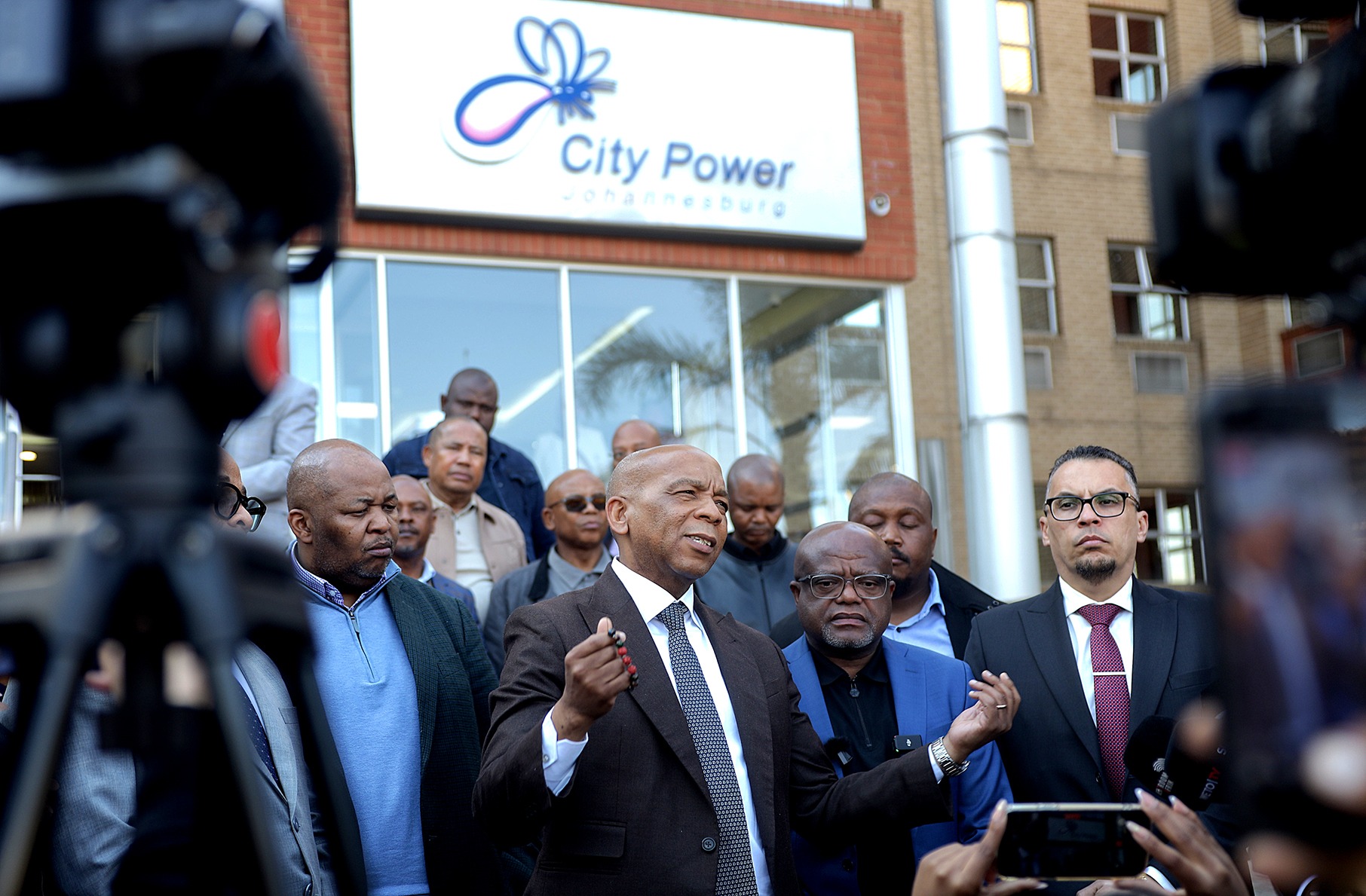
 The electricity and energy minister, Kgosientsho Ramokgopa, Joburg’s executive mayor, Dada Morero, and Eskom CEO Dan Marokane at a crisis meeting at Eskom Megawatt Park on 26 May. (Photo: Sharon Seretlo / Gallo Images)
“There will be no switching off of power,” said Johannesburg’s executive mayor, Dada Morero, after talks with the minister of electricity and energy, Dr Kgosientsho Ramokgopa, and Eskom over Johannesburg’s R5.2-billion debt to the power utility.
The mayor and Ramokgopa announced plans of a turnaround agreement on Tuesday, 26 May, following Eskom’s notice last week threatening to reduce, interrupt or terminate the supply of electricity to certain bulk supply points in Joburg over the unpaid debt.
The agreement will allow Johannesburg to keep the lights on while servicing its debt to the power utility.
It involves establishing a direct partnership between City Power and Eskom that will allow Eskom to provide “technical support” to the embattled municipal entity and to reduce technical and non-technical electricity losses. The plan also includes ringfencing revenues collected from electricity billing to service Johannesburg’s debt, beginning in July.
/file/attachments/orphans/ED_610267_550374.jpg "Joburg Mayor Dada Morero at a crisis meeting at Eskom Megawatt Park on 26 May. (Photo: Sharon Seretlo / Gallo Images)")
The duo proposed that Johannesburg enter into a distribution agency agreement (DAA) — a partnership that enables Eskom to provide direct technical support and handle electricity revenue collection for struggling municipalities.
Ramokgopa said, “The spirit and the letter of the DAA is that it’s not a hostile takeover. If anything, what we are seeking to do is to capacitate municipalities technically to become sound from a point of view of the capacity to discharge and prosecute what the expectation of the constitution is on municipalities.
“[We want to] make sure that we address the issues across the entire chain up to the point of collection, and we exit after a period of about a maximum of 36 months. We leave the municipalities and in this instance, City Power, in a much, much healthier situation.”
Details of the agreement will be finalised by the end of the week.
Eskom owed R130bn by municipalities
Eskom has been battling with municipal debt, which has ballooned to R130-billion. Ramokgopa warned that the municipal debt threatens the power utility’s liquidity and ability to expand its infrastructure. DAAs have already been implemented in three struggling municipalities, including the Merafong City Local Municipality, which signed an agreement with Eskom late last year.
The Eskom debt adds to the City of Johannesburg’s existing debt woes, which include an infrastructure backlog of more than R220-billion.
/file/attachments/orphans/ED_610262_876102.jpg "The minister of electricity and energy, Kgosientsho Ramokgopa, at the crisis meeting at Eskom Megawatt Park on 26 May. (Photo: Sharon Seretlo / Gallo Images)")
But Johannesburg’s size and contribution of 60% of South Africa’s GDP effectively means that it is too big to fail, and Ramokgopa acknowledged that customers who have been paying their rates in the city should not become “collateral damage”.
The problem, however, is largely rooted in technical losses and failures with revenue collections.
“We are experiencing losses of electricity, both technical and non-technical, and as a result of that, it means it impacts on your revenue, what you buy for and what you get back. It does not give you what it should, so it affects your surplus levels, which have affected us to get where we are,” said Morero.
“Our collection rate at the beginning of the year also indicated a drop, which contributed to us not honouring our payments to Eskom, and that is why this meeting was important, so that we can clear the air on the challenges that the City has. We can assure all our customers that there will be no shut-off in Johannesburg, and this meeting has cleared that situation.”
Despite escalating debts, Morero maintained that Johannesburg is “not bankrupt,” pointing to the continued collection of waste and the uninterrupted supply of water and electricity as evidence.
He said the loan of €200-million from German development bank KfW announced during his State of the City Address last week would be used for infrastructure projects. The strategy, he said, had been accounted for in the budget, which is due to be presented on Wednesday, 27 May. DM
Comments
Scroll down to load comments...