




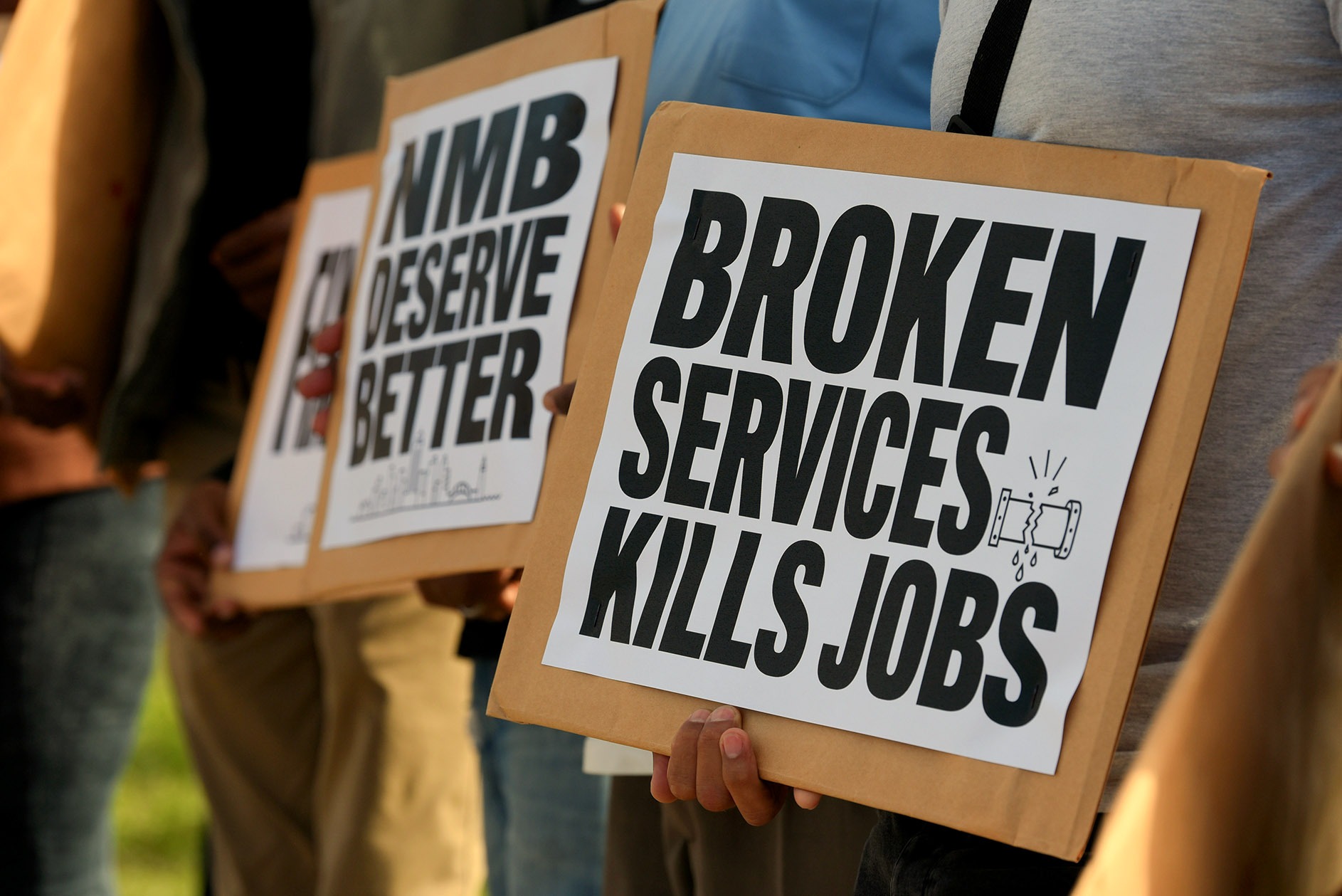
 The Nelson Mandela Bay Civil Society Coalition held a picket in Gqeberha on 28 May 2026, demanding better service delivery and governance from the metro’s leaders. (Photo: Deon Ferreira)
The jig is up: residents and organisations in Nelson Mandela Bay deserve a better, functional city from the city’s political leaders – one where services are delivered effectively, governance is driven by competent leadership and political stability is the order of the day.
This is according to the Nelson Mandela Bay Civil Society Coalition, which on Thursday staged a picket outside the Nelson Mandela Bay Stadium, where the metro’s political leaders had gathered for a council meeting, demanding improved service delivery and urgent intervention to address the metro’s governance failures.
The demonstration follows months of engagement between the coalition – made up of business leaders, church representatives and organised labour – and City officials over deteriorating infrastructure, chronic underspending, instability in senior management and governance concerns.
Although the coalition secured a meeting with mayor Babalwa Lobishe on Wednesday, chairperson Monga Peter said the discussions largely confirmed long-standing concerns, cautioning City officials that pressure to perform would intensify in the lead-up to 4 November.
“There has been engagement, and there will continue to be engagements in the boardrooms, but there will also continue to be protests like this until we reach a stage where we can say the demands have been addressed,” Peter said.
/file/attachments/orphans/Image1_279492.jpg "Chairperson of the Nelson Mandela Bay Civil Society Coalition Mongameli Peter at the picket in Gqeberha on 28 May 2026. (Photo: Deon Ferreira)")
He said the coalition had identified several key issues that were crippling the metro, including the prolonged vacancy of the city manager post, instability in senior administration, supply chain management challenges, deteriorating infrastructure, safety and security concerns and a lack of consequence management.
Peter said that while Wednesday’s meeting was constructive, it also paved the way for continued structured engagement with city officials.
“From next Friday, the team’s inaugural meeting is expected to sit and deal with the action plan going forward. We were clear that today’s action would continue as planned because this is not the first and will not be the last until we see results in terms of the demands on the table,” he said.
Bishop William Leleki, representing the South African Council of Churches and the Church Leaders Forum in Nelson Mandela Bay, also criticised the state of governance in the metro, saying key areas of administration were in disarray.
“The city manager’s position has been vacant for some time, and those who are meant to lead are not there. The city must ensure that competent people are appointed,” Leleki said.
“We are here to put pressure on the city and say, as civil society, we want to make sure things are done properly by those who have been given the opportunity and mandate to lead by the people of the city.”
/file/attachments/orphans/Image4_689370.jpg "The picket was supported by business and church leaders in Gqeberha. (Deon Ferreira)")
The coalition’s concerns come weeks after severe winds and heavy rains battered parts of Nelson Mandela Bay, leaving large areas without water and electricity.
Environmental scientist Dr Gary Koekemoer said effective local government remained the most important defence against climate-related shocks.
“If local government isn’t functioning, you don’t have effective defence mechanisms against climate change,” Koekemoer said.
“Unless government works, we are not going to be able to deal with the climate crisis, normal pollution or related environmental issues.
“It is not only local government – individual citizens and companies also have a role to play – but local government is critical,” he said.
/file/attachments/orphans/Image2_823213.jpg "Nelson Mandela Bay environmentalist Dr Gary Koekemoer, who is part of the civil society coalition, pickets in front of the Nelson Mandela Bay Stadium in Gqeberha with a poster calling for a permanent city manager. (Photo: Deon Ferreira)")
Former Nelson Mandela Bay mayor Zanoxolo Wayile said the “crisis” unfolding in the metro was “a microcosm of what is happening across the whole country and national government”.
According to Wayile, there is “institutional paralysis”, driven by a number of factors. One, he said, was a serious leadership crisis, “but also a crisis of poor governance and handling of affairs of these institutions as if they are the private properties of individuals”.
Wayile said that to turn the ship around, “fearless” leadership was required.
“You need leadership that will be able to assert authority irrespective of the party. But the bottom line is that the first thing is to unchain some of the leaders is to unchain some of the officials from unscrupulous and parasitic providers who are masquerading as business people.
“Because these institutions are not only paralysed by politicians, they are paralysed by unscrupulous providers who don’t care about the paralysis. Because they sponsor paralysis, they sponsor division,” Wayile said.
/file/attachments/orphans/Image5_685838.jpg "Former Nelson Mandela Bay mayor Zanoxolo Wayile also joined the picket. (Photo: Deon Ferreira)")
He said government had to now, more than ever, work closely with civil society, business and trade unions.
Earlier this week, the South African Municipal Workers’ Union (Samwu) called on the municipality to resolve governance challenges, warning that continued dysfunction was having a negative ripple effect on staff and could push workers toward protest action.
Congress of South African Trade Unions regional chairperson Jay Phillip said the organisation agreed with Samwu’s concerns, lamenting the deteriorating infrastructure across the metro, which he said was being worsened by the absence of senior officials.
/file/attachments/orphans/Image6_864993.jpg "The Nelson Mandela Bay Civil Society Coalition held a picket in Gqeberha on 28 May 2026 to demand better service delivery and governance from the metro’s leaders. (Photo: Deon Ferreira)")
“We cannot operate without a city manager. We cannot operate without full-time executive directors. That affects service delivery,” he said.
“There are potholes everywhere. Streetlights are not working. The city is dirty. If there is no stability – political stability and administrative stability, which is currently the case – then the province must consider placing the municipality under administration,” Phillip said. DM
Comments
Scroll down to load comments...