




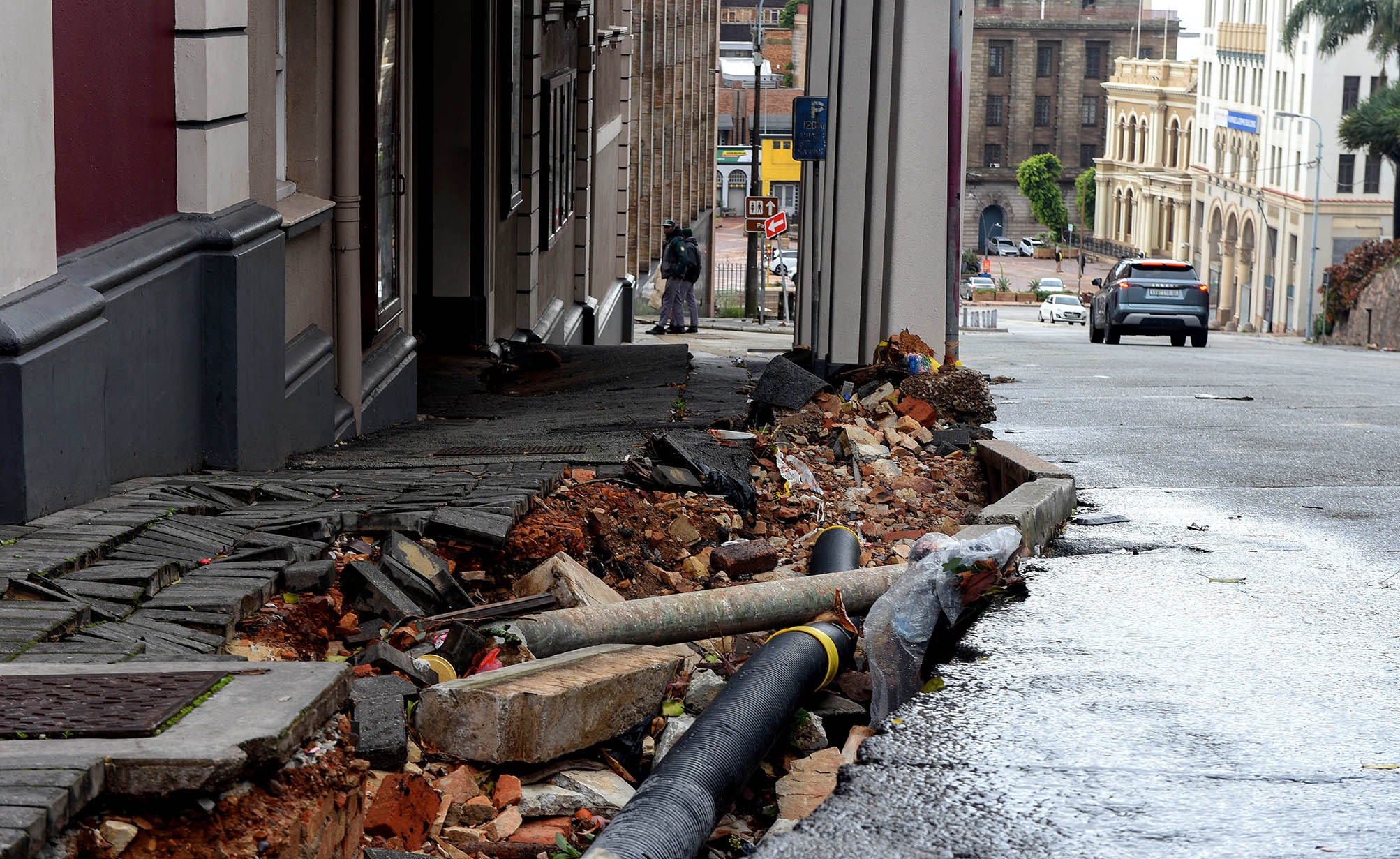
 The road and pavement outside the historic Opera House in Central, Gqeberha, were severely damaged by flooding. (Photo: Deon Ferreira)
Nelson Mandela Bay’s infrastructure came under visible strain during widespread flooding between 5 and 8 May, with municipal systems logging 101 infrastructure-related complaints in just three days as roads, power networks and burial sites were disrupted across the metro.
The reports point to widespread disruption across the city’s core infrastructure, with damage to roads, electricity networks, cemeteries and homes.
What the floodwaters laid bare, DA and ACDP councillors argued, was not just physical damage, but years of accumulated neglect — stormwater systems left uncleared, contractors unappointed and upgrades repeatedly deferred — turning a natural weather event into an avoidable municipal crisis.
Mayor Babalwa Lobishe said the full extent of the damage had not yet been costed, as assessments were being slowed by flood debris and capacity constraints. The Municipal Infrastructure Support Agency (Misa) is conducting a parallel assessment.
/file/attachments/orphans/ED_512819_542327.jpg "Nelson Mandela Bay Mayor Babalwa Lobishe. (Photo: Lulama Zenzile / Gallo Images / Die Burger)")
Lobishe said, “The impact on the infrastructure has not yet been quantified as we are still waiting for the Misa team to complete their assessment. Operationally, however, we are continuing to respond using our own budget to maximise our impact across all wards.
“We have committed to table the report within seven days, as we are of the view that by then, the Misa assessment will have been completed, allowing us to bring one report at once,” Lobishe said.
Lobishe said the metro was awaiting a formal disaster declaration, which would assist in unlocking funding.
“If the minister deems it fit, we will then get assistance, but there has been no indication at this stage for that. But we are in conversation with the national departments.
“The Minister in the Presidency responsible for Planning, Monitoring, and Evaluation (Maropene Ramokgopa) has deployed her staff to come and assist us through this period.”
A report tabled at Wednesday’s council meeting says damage to critical infrastructure has caused widespread disruption across multiple sectors.
Roads have been severely affected, with closures and the re-routing of traffic leading to delays and reduced access to key areas. Affected routes include the N2, M4, the 3rd Avenue dip in Newton Park and Old Grahamstown Road.
“Minimal impacts were seen on … water service provision. However, one impact highlighted is that some areas experience water outflow from the sewage/manhole drains,” newly installed acting city manager Charity Sihunu reported.
/file/attachments/orphans/IMG_4954_766752.jpg "Nelson Mandela Bay acting city manager Charity Sihunu. (Photo: ECCogta / Wikipedia)")
“Mop-up operations are still under way, addressing localised flooding. A total of 101 complaints were received across various reporting platforms, of which 45 have been addressed. These complaints primarily relate to blocked stormwater drains, overflowing ponds, damage to road surfaces, damage to stormwater infrastructure, road closures and flooded properties,” Sihunu said.
The complaints were mainly concentrated in Central, Walmer, KwaZakhele, Motherwell, Uitenhage, KwaNobuhle, Despatch and Zwide.
The city says it regularly clears stormwater drains, particularly after the 2024 floods, which were worsened by blockages. However, service providers had to be urgently appointed to help municipal depots, supplying jetting machines and super suckers to improve stormwater drainage capacity and speed up the clearing of blockages during heavy rainfall.
/file/attachments/orphans/Flooding4_615503.jpg "Ward councillor Terri Stander took it upon herself to clear a portion of Govan Mbeki Avenue in North End after heavy rain damaged the road and formed potholes and sinkholes in one of Gqeberha’s commercial hubs. (Photo: Deon Ferreira)")
Sihunu said safety concerns were a key constraint in addressing high flood risk areas, as some service providers were unwilling to work at night in high-crime zones. She also cited illegal dumping and limited access to plant and equipment as ongoing operational challenges.
“The supply of electricity to businesses and settlements has been unstable due to intermittent power outages. Most downed power lines and substations have been restored. However, the electricity and energy directorate is prioritising the restoration of power across all affected areas, as the situation has affected the water supply.”
The torrential rains also affected the city’s cemeteries, where waterlogged ground rendered several burial sites unsafe and unsuitable for the scheduled burials.
The main challenges included:
- Collapsed and eroded open graves that had been prepared in advance for burials;
- Graves filled with surface water by ongoing rainfall;
- Underground water ingress, with groundwater visibly gushing into grave sites; and
- Increased risks to workers, mourners and the structural integrity of burial sites.
ACDP councillor Lance Grootboom said the damage caused by the heavy rains and subsequent flooding was a clear indication of poor infrastructure maintenance by the municipality.
/file/attachments/orphans/LanceGrootboom_133737.jpg "ACDP councillor Lance Grootboom. (Photo: Deon Ferreira)")
“Kariega has over 161 overhead line cables that are damaged. There are about 50 underground ones now. They are sitting with more than 200 electricity faults. There are schools not operating in an area now.
“When I asked questions yesterday, I was told that there is no contractor appointed for that area. Yet there is R10-million that was allocated for the contractor to be appointed for those overhead lines, and that was not done.”
Grootboom said he had been informed by city officials that there was no capacity to deal with the situation unfolding in Kariega. However, he said an electricity contractor who had been working in Despatch would now carry out work in the area.
“No wonder the residents are burning tyres now, trying to get the attention of the municipality. This is unacceptable. People’s food is going off. People have been sitting without power since last week, and they now have to endure it again this week,” Grootboom said, also lamenting the unfolding water crisis across several parts of the metro, despite all dams being at capacity.
DA councillors Ondela Kepe and Gustav Rautenbach have called for the joint operations centre’s mandate to be extended by a further 14 days.
Rautenbach said much of the damage and resulting crisis could have been better managed, adding that the municipality had for years failed to adequately maintain and upgrade critical infrastructure.
/file/dailymaverick/wp-content/uploads/2025/06/DSC_0975-copy.jpg "DA councillors Gustav Rautenbach (left) and Rano Kayser. (Photo: Deon Ferreira)")
“The problem with this municipality, unfortunately, is that we are concentrating more on being reactive than proactive. For many years, all councillors have been crying out about maintenance and [the] upgrading of our stormwater system, especially,” he said.
He said that the intensity of the floodwaters had overwhelmed the sewerage system, resulting in widespread spillover issues.
“The floodwater was so heavy, it went into sewerage. I had many complaints about sewage that was pushed up because of the amount of water,” Rautenbach said.
Rautenbach also called on the newly appointed Sihunu to urgently prioritise infrastructure maintenance and upgrades, warning that the municipality was lagging in addressing long-standing service delivery challenges.
He cautioned that unless the city’s infrastructure was brought up to standard, future flooding events were likely to result in similar levels of damage.
Good party councillor Lawrence Troon had accused Speaker Eugene Johnson of acting unlawfully in relation to the tabling of the metro’s infrastructure damage report.
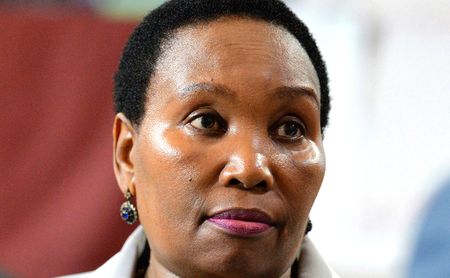
/file/attachments/orphans/LawrenceTroon_804254.jpg "Good party councillor Lawrence Troon Photo: Deon Ferreira)")
“Once again, speaker, you are doing something that is illegal. This report cannot be noted because the person [who] has been in that job was there illegally.
“If you continue to note this item, I am going to personally write to Dr Zweli Mkhize [chairperson of Parliament’s portfolio committee on cooperative governance and traditional affairs] that you are the one [who] is causing further damage to this municipality,” Troon said. DM
Comments
Scroll down to load comments...