



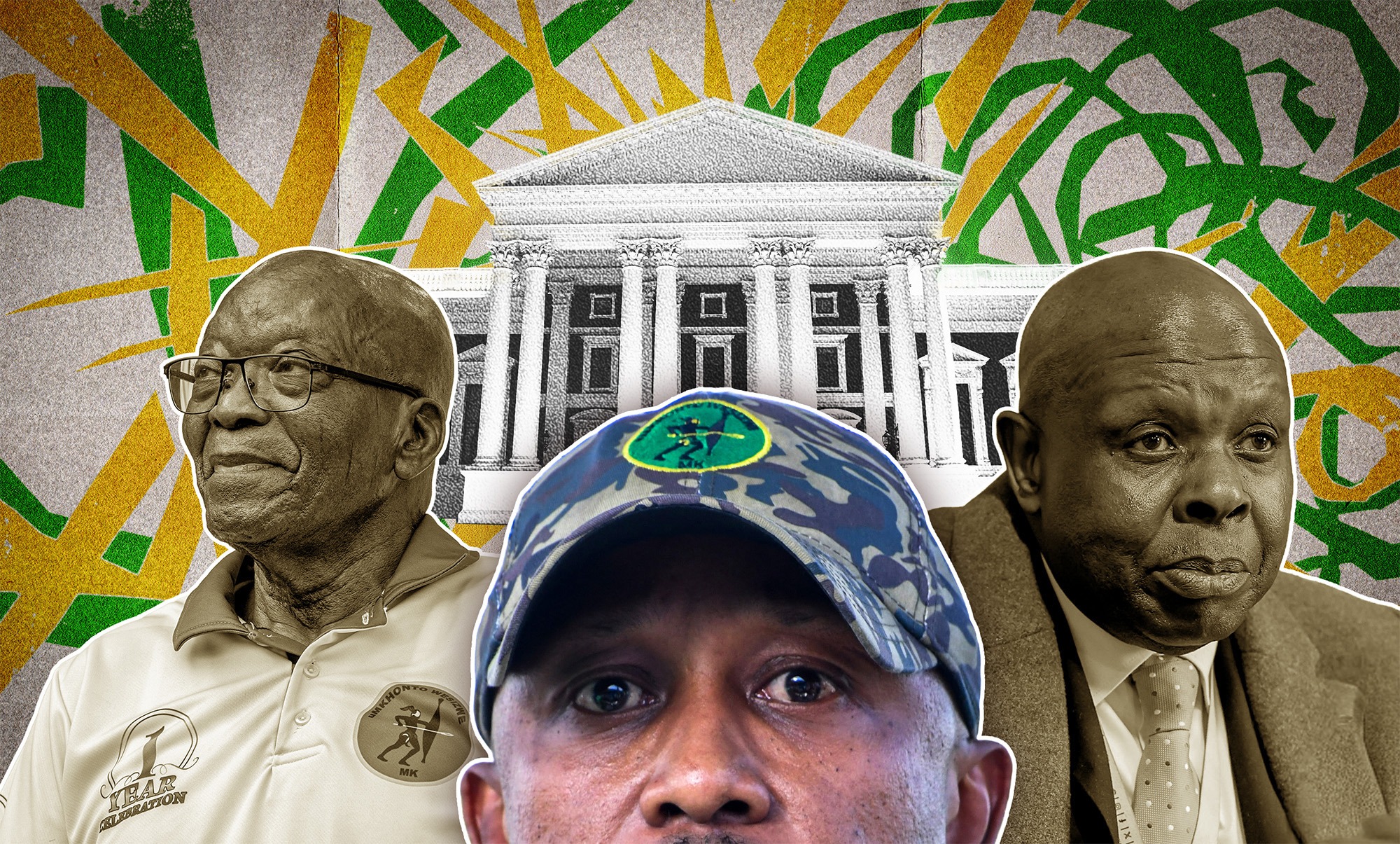
 Illustrative Image: Jacob Zuma. (Photo: Per-Anders Pettersson / Getty Images) | Ousted MK party spokesperson Nhlamulo Ndhlela. (Photo: Frennie Shivambu / Gallo Images) | John Hlophe (Photo: ER Lombard / Gallo Images/) | National Council of Provinces (Photo: parliament.gov.za)
 /file/dailymaverick/wp-content/uploads/2025/10/label-analysis-2.jpg)
Over the last few months, the MK party has claimed that it has been robbed of power in KwaZulu-Natal. It has also lied consistently about the results of the 2024 elections, claiming, with no evidence, that it was “robbed” by the Electoral Commission (there have been several court cases about this; when MK eventually withdrew its case, the Electoral Commission went to court to force a finding that the claim was not true).
The party insults anyone who opposes its claim to be a government-in-waiting. But it’s developments within the party, rather than the arguments of its critics, that reveal that the party is not ready to govern.
On Saturday, MK held a press conference and issued a statement in the name of its leader, former president Jacob Zuma. He announced the party was forming “the MK Party’s Institute”, which would be headed by John Hlophe.
The statement said this institute would run the affairs of MK, and the rest of the party would be subordinate to it. The decision was based on an “extensive 18-month Organisational Health, Ideological and Strategic Assessment Study”.
Zuma himself could be clearly seen at the briefing. He gave every indication that he was alert. After the announcement, he smiled when a journalist asked about Friday’s court ruling against his Stalingrad tactics.
/file/attachments/orphans/ED_567937_717759.jpg "MK leader Jacob Zuma at the media briefing. (Photo: Sharon Seretlo / Gallo Images)")
U-turn
Two days later, on Monday evening, MK published a statement from its “National Officials” about the MK Institute.
This statement completely retracted the contents of Saturday’s statement, saying, “The media statement does not reflect the views and decisions of the national leadership of Umkhonto we Sizwe Party.”
It admitted that Zuma had been present at Saturday’s briefing, but that “the President and National Officials were not fully aware of the entirety of the statement until the statement was made public, and in particular the propositions dealing with the party’s leadership architecture”.
Really?
Were Zuma, Hlophe and the other leaders there napping with their eyes open? Were they not paying attention? Did they think it might be rude to call a brief halt and take five minutes to speak privately to their spokesperson, Nhlamulo Ndhlela?
While this is not the first time that a political leader has been ambushed by a spokesperson in public, surely there was something he could have done.
This raises the question: Why did it take MK a full two days to issue its retraction? If the statement was wrong or an incorrect announcement had been made, it could have been amended within an hour.
Unless, that is, Zuma simply did not understand what was being said. Or doesn’t pay attention to the public statements of the party he leads.
‘Ready to govern’
MK came very close to governing in KZN. Just a few more votes would have resulted in either a coalition in the province with the EFF (something that is still possible, depending on developments in the National Freedom Party) or an outright majority.
Those who supported MK might well be wondering what would have happened had the party become the provincial government.
Unfortunately for MK, this type of incident, the retraction of an announcement made at an event attended by its leader, has become the norm rather than the exception.
The party has changed its chief whip in the KZN legislature at least nine times since June 2024. Its caucus in Parliament has changed several times, with figures like Colleen Makhubele appearing to come and go depending on changes in the wind (or Zuma’s mood…).
/file/dailymaverick/wp-content/uploads/2025/11/ED_563328.jpg "The former MK chief whip and MP Colleen Makhubele. (Photo: Brenton Geach / Gallo Images)")
Ndhlela, the most public face of the party after Zuma, has now been suspended and replaced as spokesperson by Sifiso Mahlangu.
Mahlangu is a former editor of The Star newspaper, where he led “Operation Hlanza”, an attempt by Iqbal Survé — sorry, Independent Newspapers — to ensure the ANC did not elect President Cyril Ramaphosa for a second term as party leader.
He is not the first person to clearly practise his politics while still claiming the role of “editor”.
Steve Motale, currently the spokesperson for the Patriotic Alliance, was once editor of The Citizen, where he published an opinion piece claiming he had been misled about the judgment that deemed Schabir Shaik had paid bribes to Zuma.
Then he too became the editor of an Independent title, the Sunday Independent, from where he tried to ensure that Ramaphosa did not win the ANC’s leadership battle at its Nasrec conference in 2017.
Absent opposition
All of this has consequences far beyond MK, its voters and KZN.
The two biggest parties in Parliament, the ANC and the DA, are in a national coalition that is fundamentally changing our country. While many of the changes involve reforms that are clearly necessary, they have gone virtually unchallenged.
In particular, from 2017, we have seen a wave of not-quite-but-close-to-it privatisation.
Private operators are generating and selling electricity, a foreign company is running Pier Two at Durban Harbour, private companies are operating on government-owned railway lines, and the communications minister and the President both want Elon Musk (no friend of South Africa) to be allowed to operate Starlink here.
Over the last 10 years, the role of the private sector in our society and economy has become bigger than ever before.
And, in a decision that will affect us all for generations, the inflation target has been reduced to just 3% (with a tolerance band of one percentage point).
While all of this may (or may not) be positive for the country, the point is that it is happening without proper ideological debates within our formal politics.
Parliament should be the site of questions and arguments about these major changes. Those questions should be coming from the biggest opposition party.
Instead, MK is focused on its internal squabbles.
While the EFF has opposed some of these changes (Julius Malema was virtually the only public voice of opposition to changing the inflation target), it is not big enough to ensure a proper debate.
/file/dailymaverick/wp-content/uploads/2025/02/ED_545423.jpg "EFF members arrive at the 2025 State of the Nation Address at Cape Town City Hall on 6 February 2025. (Photo: Brenton Geach / Gallo Images)")
Kingmaker without a campaign
MK’s almost complete failure to operate as an opposition party adds to the instability ahead of the local elections in Joburg.
While the current narrative is, probably correctly, focused on Helen Zille’s media-friendly campaign and the ANC’s inability to publicly counter it (or to pay Eskom what it is owed), the campaigns of those parties are not the most important variable.
In the 2024 Gauteng election, in Joburg, the ANC won 31.95%, the DA won 24.99% and MK won 12.22%. It could easily hold the balance of power there in November.
However, it is impossible to make any predictions because MK has not started campaigning. It has not publicly announced a candidate for Joburg, or, it appears, any candidates for any council. There is no public evidence of structures or campaigning machinery.
The MK party is not popular with the middle class. But its failure to act as an opposition party, to play the role assigned to it by the Constitution, leaves us all poorer — and makes South Africa’s political future less predictable. DM