




 EFF leader Julius Malema at the interviews for the position of chief justice in Johannesburg on 2 February 2022. (Photo: Felix Dlangamandla/Daily Maverick)
 The Helen Suzman Foundation (HSF) has approached the Western Cape High Court in a bid to force Parliament to consider whether EFF leader Julius Malema is still fit to serve on the Judicial Service Commission (JSC).
The foundation wants the court to set aside Speaker Thoko Didiza’s 30 April decision not to consider Malema’s suitability, as well as the National Assembly’s failure to assess and decide on the matter.
In papers filed on Thursday, 14 May 2026, HSF argues that the National Assembly has a constitutional obligation to assess whether Malema remains suitable to continue serving as one of Parliament’s designated representatives on the JSC, the body responsible for interviewing and recommending judges for appointment.
It maintains that it does not want Parliament to directly remove Malema, but to rather do its work.
“The application does not ask the Court to decide Mr Malema’s suitability; it asks the Court to require the National Assembly to fulfil its constitutional duty to consider that question.”
Included in the application are concerns over Malema’s conduct and criticism of judges and magistrates when they rule against him or his political party, which the foundation says drags “judicial officers into political skirmishes”.
Most importantly, however, HSF cites his recent sentencing of five years’ imprisonment for discharging a firearm during a public event in 2018, which Malema is appealing.
“Mr Malema thus sits on the body that appoints our judges, while at the same time maligns and undermines their credibility when they apply the law against him. The credibility of the judiciary is critical in a constitutional democracy.”
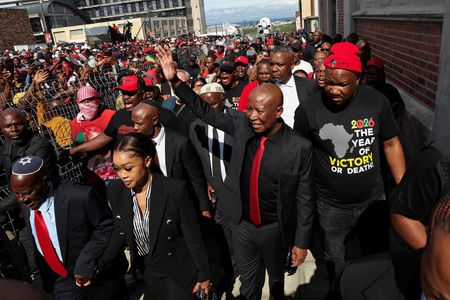
Perhaps the most recent attack by Malema on a magistrate came outside the East London Magistrates’ Court on 16 April 2026, where he addressed scores of supporters who gathered for his firearm case.
Malema first accused the magistrate, Twanet Olivier, of being racist, not being sober and later claiming she had failed to properly apply the law.
/file/attachments/orphans/RC2BQKAB98W5_651485.jpg "EFF leader Julius Malema waves to the crowd following court proceedings, after he was granted leave to appeal a five-year prison sentence by a magistrate’s court in KuGompo on 16 April 2026. (Photo: REUTERS / Esa Alexander)")
“Magistrate Olivier is a racist of note, and she must know that in her sleep that she’s a racist and she’s possibly a member of AfriForum. That’s why when you mention AfriForum, she cannot hide her emotions,” Malema told the crowd.
“She doesn’t read. She doesn’t know what is contained in the documents that are before her. So we are dealing with someone who doesn’t apply the law.”
This conduct has been occurring for quite some time, HSF says.
“But recent conduct of Mr Malema after his criminal conviction and sentencing for unlawful use of a firearm, requires the National Assembly to consider whether Mr Malema’s continued membership of the JSC is tolerable,” HSF argues.
‘Unbecoming’ history
It is not the first time that Malema’s criticism of the judiciary has been questioned. In 2021, the Council for the Advancement of the South African Constitution (Casac) submitted an official complaint to Parliament.
It asked the then speaker, Thandi Modise, to take action against Malema’s “unwarranted” and “unbecoming” comments about judges.
At the time of that complaint, Malema had criticised judges and the State Capture Commission, chaired by then deputy chief justice Raymond Zondo.
He said that “the rule of law in South Africa is applied selectively” and that the State Capture inquiry was not holding the “Rupert stooges” to account, Daily Maverick reported.
Much like HSF, Casac argued that the utterances, if left unchallenged, would undermine the judiciary in the eyes of the public.
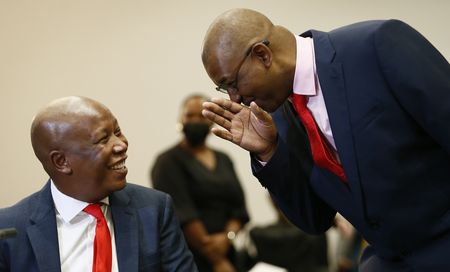
In 2023, Judges Matter also condemned Malema for attacking Olivier and accusing her of corruption and incompetence without any substantiation.
“This is an attack on the judiciary, a threat to judicial independence, and almost certainly a violation of the Constitution,” Judges Matter said in a statement.
In terms of Section 178 of the Constitution, Malema is one of six MPs, three from opposition parties, who serve on the JSC. They are mandated to represent Parliament, not a political party.
During the commission’s public interviews for judicial office, where candidates are questioned on their judgments, legal philosophy and constitutional views, Malema has often posed tough and critical questions.
But, at times, his line of questioning has been seen as confrontational and combative.
During the 2022 interviews for chief justice, he was among the commissioners who pressed Gauteng Judge President Dunstan Mlambo (now the deputy chief justice) on issues including transformation, perceptions of bias within the judiciary and allegations affecting the courts, as well as unsubstantiated sexual harassment claims, leading to tense exchanges that drew public criticism.
JSC Act deficient
Beyond Malema’s conduct and Parliament’s role, HSF is also challenging the constitutionality of the Judicial Service Commission Act itself.
It argues that the law in its current form fails to provide adequate mechanisms to regulate the behaviour of commissioners.
“The Foundation also brings a constitutional challenge to the Judicial Service Commission Act, contending that the Act is constitutionally deficient because it does not require the JSC to adopt a binding code of conduct for commissioners or provide sanctions for non-compliance,” read the papers.
The organisation is asking the court to declare the act constitutionally invalid, although it wants that declaration suspended temporarily to allow Parliament time to correct the defect.
In the interim, HSF wants the court to impose a temporary framework compelling the JSC to adopt a binding code of conduct for commissioners.
“The Foundation seeks a declaration of invalidity, suspended to allow Parliament to remedy the defect, with an interim regime requiring the JSC to adopt such a code.”
Ultimately, the case places the conduct of JSC commissioners and Parliament’s duties before the Western Cape High Court.
“The independence, dignity and effectiveness of the courts are central to South Africa’s constitutional democracy. Those entrusted with selecting judges must meet the standards required to protect that institution.”
At the time of writing, neither Malema nor the Speaker of Parliament had filed responding court papers. DM