




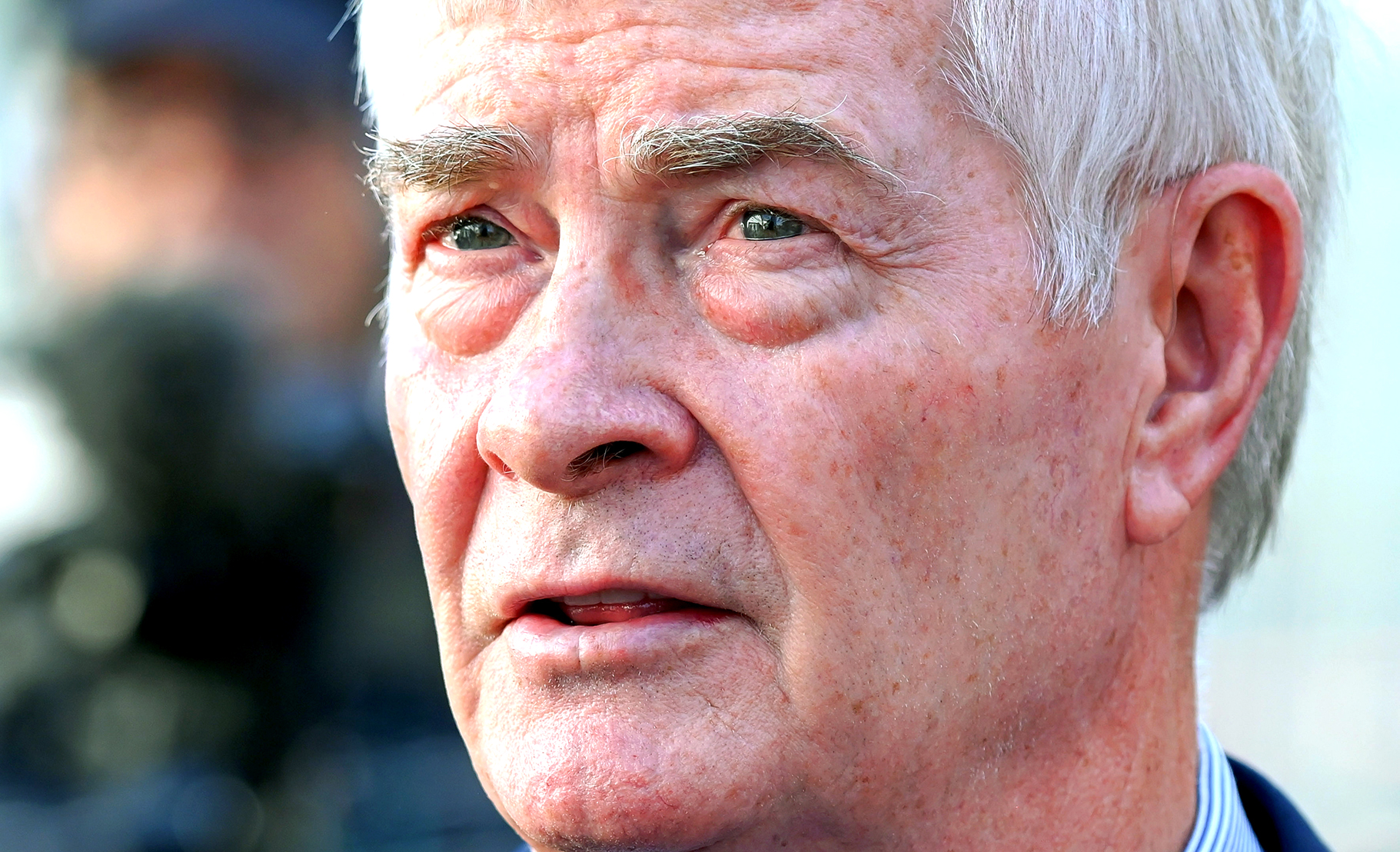
 Dr Pieter Groenewald, who serves minister of correctional services in the Government of National Unity, in Durban on 14 August 2025. (Photo: Darren Stewart / Gallo Images)
South Africa’s digital landscape has become a fierce and bewildering battlefield to capture voters’ attention, and the line between genuine political support and manufactured consent is growing blurrier.
Conservative politician Dr Pieter Groenewald, for instance, is an unlikely protagonist in this story of perplexing online behaviour, which shows little accountability or transparency. He is at the centre of an adoring young fan base, most suspiciously by accounts like the self-proclaimed “President of Black Twitter”, @ChrisExcel102.
This account, an anonymous paid mega-influencer with more than 3.5 million followers, blurs the lines between satire and political promotion. It began posting about “Lord Pieter Groenewald” in June 2025. The post was viewed by close to half a million users on X.
Groenewald has distanced himself from any involvement in these social media campaigns. Groenewald (70) is a founding member and former leader of the Freedom Front Plus (FF+), which represents minority interests and has roots in apartheid’s separatist Conservative Party. He now serves as minister of correctional services in the Government of National Unity (GNU).
The FF+ has doubled its support since 2019 by targeting all minority groups, which is a deviation from its separatist roots, with the party forming in the year of democracy to appeal to white Afrikaners who wanted their own Volkstaat.
Floor-crossing account
One might be inclined to call this online support a breakthrough in post-apartheid politics. However, analysing @ChrisExcel102 before this post reveals ideological inconsistencies. Just a month before, the same account also posted: “Lemme clarify this on my side. I’m an EFF member who loves Jacob Zuma… Who has a membership at [ActionSA] … also a former member of Patriotic Alliance. I hope you understand me…”
As recently as March 2024, the same account had posted that it was an EFF member who couldn’t be bought. This is unlikely to be the case, as @ChrisExcel102 has been shown to be one of several anonymous “mega-influencer” accounts that manipulate the national political discourse through paid campaigns and the use of an extensive network of nano-influencers.
A South African mega-influencer who was previously tracked down confirmed that he had several influencers working for him and that a social media campaign could cost anywhere from R80,000 to R250,000 in 2024, as previously reported in Daily Maverick.
/file/attachments/2991/06graph_179159.jpg "Mentions of Pieter Groenewald spiked across social media platforms in August 2025 after his interview with Sunday Times Politics Weekly. (Source: Supplied)")
Although there appears to be some authentic expression of interest in Groenewald (often referred to as “Oom Piet”) based on his tough stance on prison reform, the volume and frequency of posts that promote “Piet for president” are not sustained by individual spikes, such as the one shown above in August 2025.
The trend extends beyond X. On TikTok the account @somandla_institute has curated a “Dr Groenewald 4 President” playlist that features more than 30 videos. These clips use videos of black South Africans to market Groenewald as a saviour. The account also drives content that glorifies fierce apartheid-era figures such as BJ Vorster and PW Botha, while calling itself an “Institute for Separate Development”.
/file/attachments/2991/Screenshot2026-05-10at152301_448413.png "A screenshot of @somandla_institute’s TikTok videos supporting Pieter Groenewald. (Source: TikTok)")
Influence-for-hire content may be inauthentic but is paid for in advance, like a PR campaign. But inauthentic actors can also monitor trends on social media to create and drive content that the public finds interesting in order to monetise views and clicks independently of the people and ideas that they are ostensibly promoting.
These emerging trends follow concerns during the 2024 national elections, when researchers observed influential, often anonymous, accounts on X digitally crossing the floor after years of aggressively driving EFF hashtags, and then almost overnight shifting content to amplify the newly formed MK party.
This sudden shift raised questions about the authenticity of online political representation and the “influencer-for-hire” economy that dictates our discourse.
Legislative vacuum
Now, with fewer than six months to go until the 4 November elections, there appears to be little capacity to enforce accountability and transparency, with platforms operating outside existing legislative frameworks.
The Electoral Commission of South Africa (IEC) is working on amendments to the Electoral Code of Conduct to incorporate social media, but platform accountability and transparency fall outside its scope. “We are not a digital enforcement body,” said IEC deputy chief executive of outreach Victor Shale. “We are dealing with a moving target and a multiplicity of actors.”
IEC chairperson Mosotho Moepya has warned that young people are the primary targets in a “hurricane of disinformation”. He described countering disinformation ahead of the 2026 local elections like being a “meteorologist in the middle of a category 5 hurricane”.
Groenewald, responding via his media liaison Euné Oelofsen, explained that upon his appointment to the GNU Cabinet, “several posts with a negative tone, seemingly aimed at discrediting the minister” had been noted.
“There have been instances in which the minister had to seek legal assistance to remove content – disinformation – on social media. More recently (from December 2025 onwards) we have observed posts with more positive sentiment endorsing him as a presidential candidate. Neither the minister, his office, nor the FF+ are in any way involved in any of these social media campaigns. It is clear that, regardless of these campaigns, support for the minister and his work is organic.
“It is impossible to watch all the content. Although some of the content is clearly disinformation, some is repackaged from actual events the minister was involved in. We do not know the motives behind these types of profiles and pages that drive certain narratives, some of which can be harmful to society as a whole.”
Groenwald responds
Here are further responses, with Groenewald declining to respond to party-specific policy issues, since he was no longer FF+ leader.
What responsibility should parties have in ensuring accountability and transparency?
“Ideally, parties should be able to… regulate all content disseminated in their names. This is, however, not an easy task due to the anonymity of the actors behind certain pages and profiles. Unsanctioned content is more easily regulated when the persons behind it can be identified and compelled to remove it.
“Some of the content being circulated online is created for the financial gain that the pages and profiles seek to obtain by producing content that is ‘guaranteed’ to go viral. We believe some of these pages and profiles have noticed the minister’s organic support and popularity and are now deliberately creating content about him to earn money on social media. Regardless of these campaigns, support for the minister and his work is organic [in] nature.”
What loopholes undermine credibility and trust?
“Social media is still not covered by the same standards and regulatory frameworks as print and broadcast media, creating loopholes that allow inauthentic and possibly harmful content to be disseminated under the guise of real political sentiment.” DM
Yossabel Chetty is a researcher at the Centre for Information Integrity in Africa. Additional reporting by Janet Heard.
This story first appeared in our weekly DM168 newspaper, available countrywide for R35.
/file/attachments/2991/DM-080526_208362.jpg)
Comments
Scroll down to load comments...