




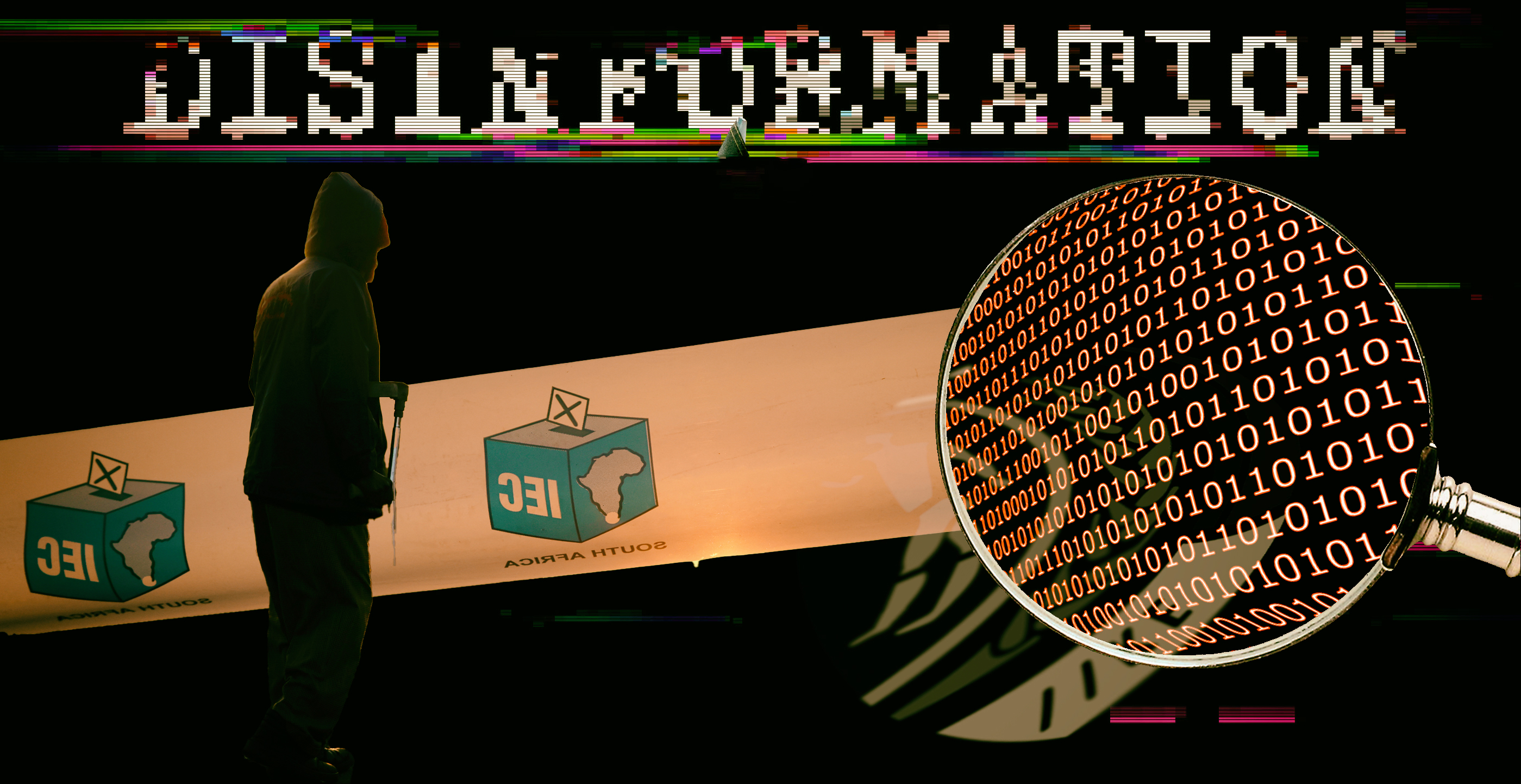
 An informal settlement resident walks to cast his vote on election day, 29 May 2024. (Photo: Felix Dlangamandla) | Disinformation. (Photo: iStock)
 Question: What keeps you up most about the upcoming elections?
Answer: The speed of disinformation unfolding. We simply can’t keep up. The measures from the 2024 general elections won’t be adequate because disinformation peddlers spend days and nights creating new crises – it’s financially beneficial for them. We’re always behind.
Q: How is the Electoral Commission (IEC) grappling with the informal media economy – online behaviour such as undisclosed influencer payments and monetisation via platforms?
A: We don’t have the means to monitor online spending purposefully. Our political funding regime relies on receivers and donors declaring what they’ve received/donated. When people circumvent the system – like undisclosed online influencer payments – it falls outside our scope. We’re concerned because it defeats the purpose of ensuring accountability and transparency.

Q: How much more sophisticated have paid influencer networks become?
A: We lack substantive monitoring mechanisms, but we’re aware of the trend. Networks are shifting from mega-influencers to nano-networks to evade detection. Known actors now work through proxies that can’t be easily detected, making it exponentially more complex.
Q: What do these opaque networks mean for free and fair elections?
A: Our constitutional obligation is to ensure the integrity of the vote. And we also have to ensure the integrity of information around the elections. So, any network that undermines our ability to achieve this is a concern, and we are dealing with a moving target and a multiplicity of actors.
So our outreach messaging to citizens has to be more purposeful. For instance, we are enhancing our institutional capacity in terms of social media, and recruiting expanded staff with the expertise and a skill set to analyse and detect online activity. We’re taking all these measures, but are aware that the magnitude of the problem will always be more than what we can afford to deal with, as a constitutional entity and a publicly funded organisation.

Q: What’s your message to voters navigating disinformation-saturated feeds and AI-generated “information”?
A: Get information from credible sources – our communication channels, television, and community radio and TV. Verify information. An (IEC-commissioned Voter Participation) survey showed that citizens trust TV most, so we’re targeting those channels, plus WhatsApp and local radio.
/file/attachments/2991/IEC-electionsinsert_172683.jpg "(Source: IEC Voter Participation Survey (VPS) 2025/26)")
Q: How do you tackle coordinated inauthentic behaviour?
A: We’re not a digital enforcement body. That’s for platform policies and regulations to define and address. We flag concerns through appropriate channels and work with partners who have technical capacity. We’ve met and will continue meeting with Google, Meta and TikTok. We hope to come up with a concrete plan of action.
Q: Can you enforce platform disclosure of influencer payments?
A: No. Influencer disclosures fall under advertising and consumer protection frameworks such as the Advertising Regulatory Board, Icasa (Independent Communications Authority of South Africa) and via the Department of Communications and Digital Technology. We have limitations. We can only enforce the Electoral Act and the Political Party Funding Act. We can’t force platforms to disclose.
Q: The Electoral Code of Conduct is being reviewed to incorporate social media. Will it be in place by the elections, and will it tackle influencer anonymity and funding disclosure?
A: We are banking on the code being ready by the local government elections, and there is good progress towards that goal. The legal framework doesn’t extend to monitoring online influencer disclosures – only political parties and candidates. That’s why parties can circumvent rules by working through undisclosed influencers.
Q: Are platforms becoming more accountable post-2024?
A: Those we’ve met remain committed to working with us. TikTok is doing background work too, but we’ve urged platforms to engage before the political marketplace heats up. For increased coordinated action, we’ve arranged joint meetings with platforms and via the Moxii Africa network.
/file/attachments/orphans/IEC-DCEO-Outreach-Dr-Victor-Shale-SUPPLIED_917787.jpg "The Electoral Commission’s outreach deputy CEO, Victor Shale. (Photo: Supplied)")
Q: How do disinformation networks impact information integrity and trust?
A: Globally, there’s a democratic recession with rising populism and disinformation. In our context with a violent past, this is especially dangerous. Disinformation floods the ecosystem with falsehoods, creating disgruntled citizens who either disengage from voting or act destructively. We’ve seen in 2024 how political leaders systematically discredited the IEC and targeted female officials. The result is declining voter turnout and erosion of institutional trust.
/file/attachments/orphans/YOuth-disinterest_832939.jpg "(Source: IEC Voter Participation Survey (VPS) 2025/26)")
/file/attachments/2991/IEC-electionsinsert2_145305.jpg "(Source: Afrobarometer 1999-2009 | HRSC South African School Attitudes Survey (SASAS) 2011-2025/26)")
/file/attachments/2991/IEC-electionsinsert3_166849.jpg "(Source: HRSC South African School Attitudes Survey (SASAS) 2003-2025 VPS 2025/26)")
Q: What role should political parties play?
A: The biggest tragedy is diminished political leadership. Parties treat politics as wealth accumulation, not development. Leaders ignore legal provisions and rules, then deflect blame. Until we have responsible political leadership promoting positive messaging, citizen participation and national cohesion, disinformation will thrive, and development will remain a distant mirage.
Q: What’s the IEC doing to rebuild trust in the democratic process?
A: The IEC leadership spent time in KwaZulu-Natal, the province with the lowest trust levels. The IEC met the premier, party political leaders (including MK party leader Jacob Zuma in Nkandla), civil society, religious and traditional leaders, including the Zulu king. We’ll continue this across the country based on research, identifying where attention is needed most. (In KZN, 33% are considering non-democratic alternatives compared with 26% nationally; trust in the IEC is 20% compared with 32% nationally, according to the Voter Participation survey.) DM
/file/attachments/2991/IEC-electionsinsert4_911104.jpg "(Source: HRSC South African School Attitudes Survey (SASAS) 2025/26)")
/file/attachments/2991/IEC-electionsinsert5_336107.jpg "(Source: HRSC South African School Attitudes Survey (SASAS) 2003-2025 VPS 2025/26)<br>")
/file/attachments/2991/IEC-electionsinsert6_338297.jpg "(Source: IEC Voter Participation Survey (VPS) 2025/2026)<br>")
This Q&A forms part of an Election Watch series by the Centre for Information Integrity in Africa (CINIA). CINIA has joined the Partnership on Information Integrity in Elections (PIIE) and the Local Elections Media Observatory network, which monitors, analyses risks and supports mitigation for the elections.
Follow CINIA’s work here.

Comments
Scroll down to load comments...