



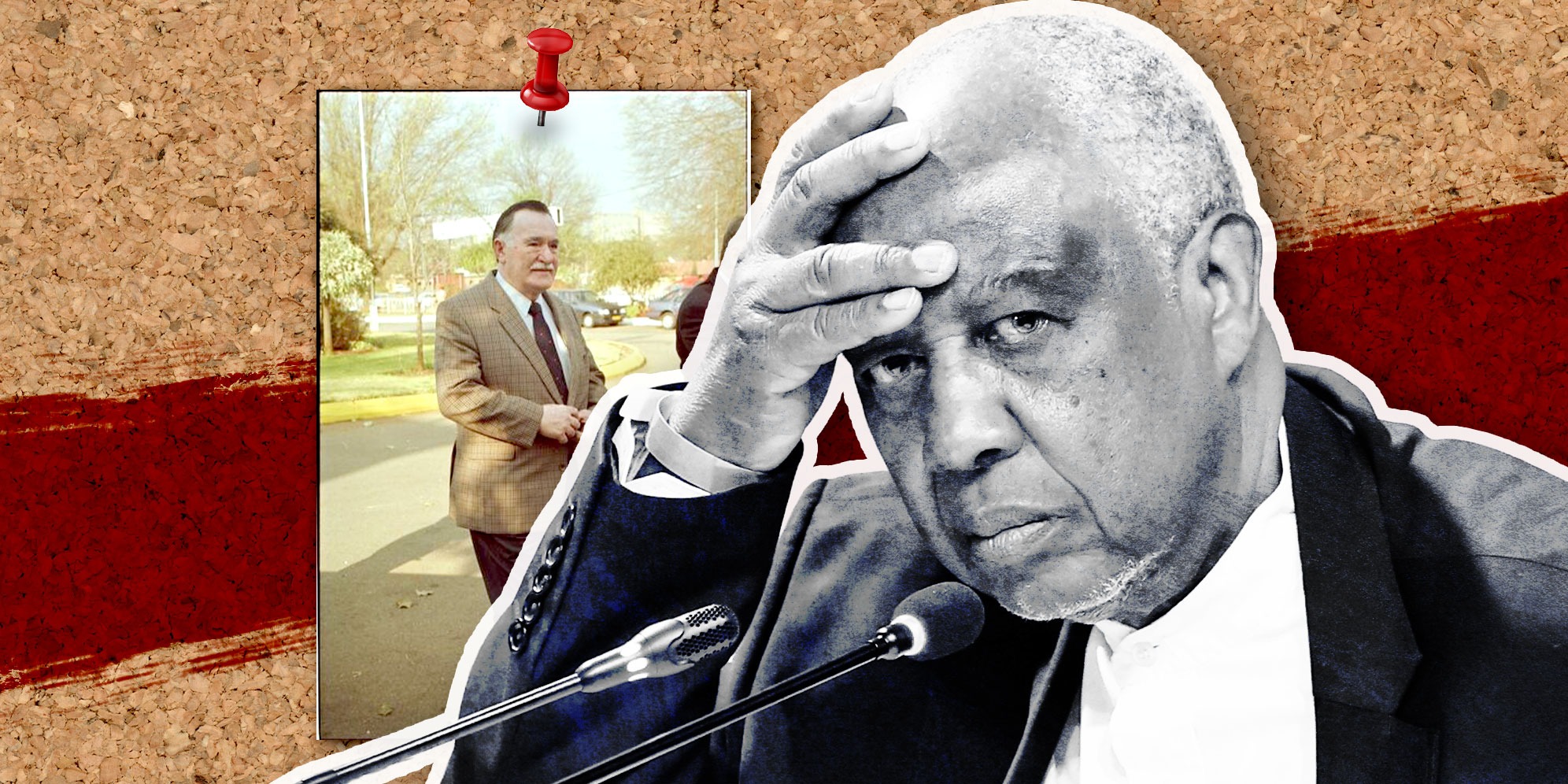
 Illustrative Image: Advocate Dumisa Ntsebeza, former Truth and Reconciliation Commission commissioner and Senior Counsel (right). (Photo: Gallo Images / Luba Lesolle) | Major General ‘Tienie’ Groenewald. (Photo: Wikicommons) | (By Daniella Lee Ming Yesca)
 At the Khampepe Commission sitting in Newtown, Johannesburg, an ailing but alert advocate Dumisa Ntsebeza, now 76, set out to the panel how apartheid generals had tried to stop him from “digging too deep” into past atrocities by security personnel.
Ntsebeza, who was appointed as a Truth and Reconciliation Commission (TRC) commissioner by President Nelson Mandela in 1994, had been summoned in 1996 or 1997, he said, to a meeting in one of the 672 hotel rooms in the “prestigious” 22-storey Johannesburg Sun and Towers in the CBD.
Ntsebeza had been accompanied by celebrated detective and head of the TRC’s investigating arm, the late Wilson Magadla, who died in 2011.
The meeting was with Major General Pieter Hendrik “Tienie” Groenewald, head of military intelligence in the South African Defence Force (SADF) and his “colleagues” who had threatened Ntsebeza and Magadla with the existence of “dossiers” that allegedly “seriously compromised” ANC leaders.
Destroyed files
Groenewald and his colleagues, said Ntsebeza, had urged him to halt investigations into former apartheid security forces “since they had an agreement in place with the ANC that apartheid-era crimes would not be pursued”.
Around this time, said Ntsebeza, the TRC had recovered a large number of SADF and Military Intelligence (MI) documents under a search-and-seizure warrant.
While Military Intelligence had embarked on an extensive destruction of files, the final report of the TRC, released in 2003, noted that “although subjected to close scrutiny during the 1993 destruction exercise, a large volume of military intelligence files survived”.
Ntsebeza told the commission that “he [Groenewald] also said that they were in possession of dossiers which seriously compromised senior ANC officials. I informed Groenewald that in respect of my investigations of the TRC, I take instructions only from the chair of the TRC, Archbishop Tutu, and no one else.”
/file/dailymaverick/wp-content/uploads/2024/05/AFP__19971201__SAPA971128022650__v1__HighRes__SafricaMandelaViljoenFarmers.jpg "South African President Nelson Mandela (left) addresses the media after his meeting with General Constand Viljoen (right), leader of the right-wing Afrikaner Freedom Front and members of the South African Afrikaner Agricultural Union at Mandela’s residence in Johannesburg on 28 November 1997. Mandela and farmers met to discuss a recent spate of criminal attacks in the farming community. (Photo: Walter Dhladhla / AFP)")
Key figure
Groenewald was a key figure in the “Committee of Generals”, set up in 1993 – the same year SACP leader Chris Hani was assassinated – who opposed a political transition to democracy and supported the creation of an independent Afrikaner homeland.
He was deeply involved in clandestine efforts to assist Unita and Renamo rebels in Angola and Mozambique, and spearheaded secret “offensive paramilitary” support for Inkatha leader Mangosuthu Buthelezi.
Prominent members of the committee included General Constand Viljoen, Lieutenant General Koos Bischoff, Lieutenant General Cobus Visser and Lothar Neethling, ex-Deputy Commissioner of Police. Groenewald died on 2 November 2015, aged 79.
Viljoen was part of the Afrikaner Volksfront (AVF), which included the extreme right-wing Afrikaner Weerstandsbeweging (AWB). Viljoen later resigned from the AVF and registered the Freedom Front for participation in the 1994 election.
/file/dailymaverick/wp-content/uploads/2025/03/Mango_thumb.jpg "President FW de Klerk (left) and Inkatha leader Mangosuthu Buthelezi in 1992. (Photo: Wessel Oosthuizen / Gallo Images")
‘Digging too deep’
“It was a strange request,” Ntsebeza recalled for the panel, noting that it was TRC chair Archbishop Desmond Tutu and vice chair Dr Alex Boraine who had called to inform him Groenewald was seeking to make contact.
The meeting with Groenewald, Ntsebeza said, had been “a matter of concern that has lived with me for quite some time as we were being confronted by, in particular, the late Tienie Groenewald, who said digging too deep in our investigations was against what had been agreed upon”.
Groenewald had expressed shock at the “rigour” of the TRC investigation, claiming that an agreement existed between the ANC, the National Party and high-ranking SADF officials “to ensure past conflicts were not investigated”.
In a supplementary affidavit, Ntsebeza set out in detail his recollection of that meeting as he believed it had “significant relevance for this commission”.
He recalled reporting it to Tutu and Boraine, and that they had advised him that “we had adopted the right approach in our encounter with the generals”.
FW de Klerk Foundation statement
Ntsebeza said he did not recall making a written record of this engagement at the time, although he had since referred to it on several occasions in public interviews over the years.
These remarks by Groenewald, said Ntsebeza, dovetailed with a statement released by the FW de Klerk Foundation months before the former president’s death in November 2021.
The July statement from the foundation noted “an informal agreement between the ANC leadership and former operatives of the pre-1994 government” which had ensured that “the NPA suspended its prosecutions of apartheid era crimes”.
The foundation’s admission was critical, Ntsebeza said, as it corroborated claims made by Groenewald. Ntsebeza said it also explained why there had been so little progress on TRC cases.
The De Klerk Foundation statement appeared to him, said Ntsebeza, “very clearly to be stating what the foundation and the ANC had agreed upon, no prosecution of apartheid-era crimes. And that is what triggered in me what Tienie Groenewald had said to me and Ntate Magadla when we met him at the Joburg Sun”.
This was, he said, “as explicit a statement as one could find of what a functionary of the De Klerk Foundation seems to confirm, namely of an agreement between it, I mean the ANC, and whoever was going to be speaking on behalf of the South African government of that time”.
Ntsebeza said the “Rodrigues case”, where the Gauteng high court instructed the National Director of Public Prosecutions (NDPP) to inquire whether improper influence had been brought to bear on the NPA with regard to these suspended cases.
‘Unforgivable’
Ntsebeza, who appeared at the commission on 30 April, has yet to be cross-examined. He told the commission that the alleged suppression of TRC cases had been an “unforgivable failure” of the post-apartheid government.
He said there had been a “shameful lack of political will to hold perpetrators of gross human rights violations accountable” and cited Tutu’s 2013 statement that a failure to prosecute those who spurned the amnesty process directly undermined the people who had participated in it in good faith.
He said South Africans had entered into a “constitutional compact” where perpetrators were offered immunity in exchange for the truth. The “solemn promise” was that those who did not receive or apply for amnesty would face legal consequences if evidence was available.
Instead of honouring this promise, the post-apartheid state had engaged in “various machinations” to ensure the bulk of TRC cases would never be heard in court.
Ntsebeza claimed the state had treated the victims’ families as “second-class citizens” who were not worthy of equal protection under the law. Most TRC cases could not be revived as witnesses and suspects had died in the intervening decades.
He told the commission the accounts as set out in Lukhanyo Calata’s founding affidavit, as well as the supporting affidavits, were “rooted in South Africa’s bitter and divided past. They make for difficult and painful reading”.
/file/attachments/orphans/thammtrc_865892.jpg "Illustrative image: Archbishop Desmond Tutu, Chairman of the Truth and Reconciliation Commission (TRC) and vice-chair Alex Boraine. (Photo: Gallo Images / Oryx Media Archive) | (Photo: Gallo Images / Oryx Media Archive) | Pin. (Image: Freepik | (By Daniella Lee Ming Yesca)")
‘No fairytale’
South Africans had entered into “a constitutional compact” to grant perpetrators an opportunity “to speak the truth and earn full immunity from criminal prosecution and civil litigation”.
“We made a solemn promise that those who were not amnestied, or who spurned the process, would face the consequences where their crimes were serious and evidence was available,” he said.
Ntsebeza described the suppression of TRC cases as a “terrible stain” on South Africa’s history and concluded that families were entitled to this independent commission of inquiry, not just as a matter of law, but as a “moral imperative”.
The fact that these issues had not been faced “has enabled the myth of a fairytale transition in South Africa to be widely disseminated across the world, yet how long will this last? If the past is not dealt with, it will return to haunt us.”
The Department of Justice, the National Prosecuting Authority, as well as former presidents Thabo Mbeki and Jacob Zuma have denied that any political interference took place. The commission continues. DM