



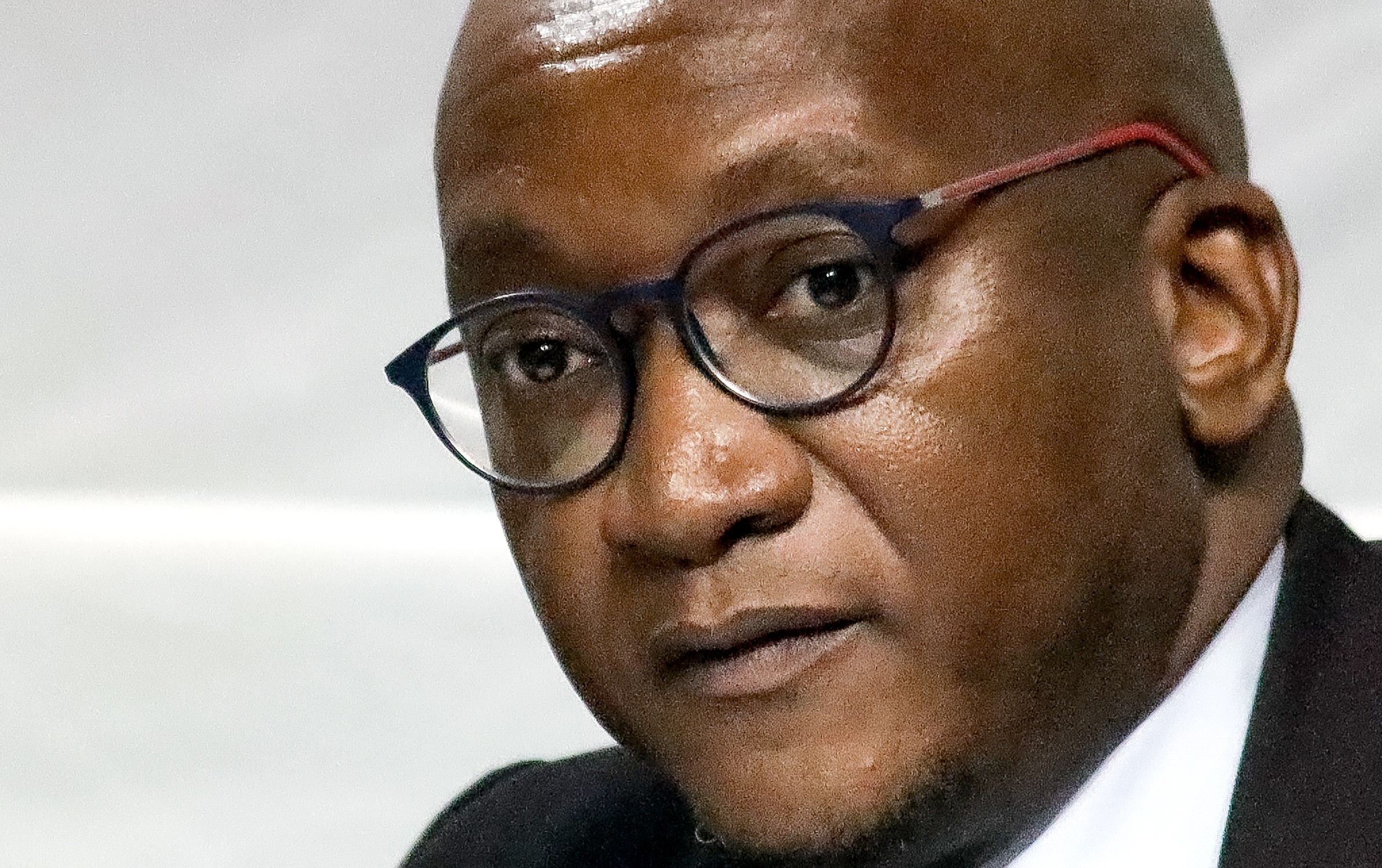
 Advocate Mthunzi Mhaga testifies at the Khampepe Commission in Johannesburg on 17 April 2026. (Photo: Fani Mahuntsi / Gallo Images)
 Editor’s note: Daily Maverick published an article on advocate Mthunzi Mhaga’s testimony at the Khampepe Commission on Tuesday, 21 April, which was subsequently removed following concerns raised over accuracy and fairness. It incorrectly stated that Mhaga sought clarity regarding whether ANC leaders would be arrested, whereas Mhaga sought clarity on differing versions of whether Reverend Frank Chikane wanted to proceed with the prosecution of those responsible for his attempted poisoning. The article also stated that Mhaga was a member of the Amnesty Task Team ‘established by former president Thabo Mbeki’. Mhaga was not a part of that team; instead, he served on an Interdepartmental Task Team on TRC matters. Daily Maverick apologises to Mhaga for the errors. This republished article includes a number of edits for clarity and accuracy.
The Khampepe Commission into political interference and delays in prosecuting apartheid-era crimes last week heard from National Prosecuting Authority (NPA) advocate Mthunzi Mhaga, a senior advocate formerly with the Priority Crimes Litigation Unit (PCLU), on how he sought clarity on differing versions on whether Reverend Frank Chikane wanted the suspects in his 1989 attempted poisoning prosecuted.
The commission was established by President Cyril Ramaphosa in May 2025 to determine whether there were attempts to influence the South African Police Service (SAPS) and the NPA not to investigate and prosecute the hundreds of apartheid-era cases recommended for investigation by the Truth and Reconciliation Commission (TRC).
In previous testimony, the Chikane matter has been cited as an example of possible political interference in the prosecution of TRC cases.
Testifying at the commission on 7 April 2026, former acting National Director of Public Prosecutions (NDPP) Mokotedi Mpshe recalled the division over the Chikane matter. Chikane, who was the director-general in the Presidency during Thabo Mbeki’s time in office, had criticised how the matter was handled by former PLCU leader Anton Ackermann.
In 2007, former law and order minister Adriaan Vlok and former police commissioner Johan van der Merwe pleaded guilty to attempting to murder Chikane and received suspended sentences.
Mhaga told the Khampepe Commission that he was appointed to the Interdepartmental Task Team (ITT), also known as the TRC Task Team, in 2006. This team was established from former NPA boss Vusi Pikoli’s office, according to Mhaga, and included other officials from the NPA, as well as SAPS, the National Intelligence Agency, the Department of Justice and the Directorate of Special Operations (DSO).
It was formed in the wake of the work of the Amnesty Task Team, established in 2004 following a framework set out by Mbeki, in part, to plan how to deal with alleged apartheid-era perpetrators who did not apply for amnesty.
In his affidavit, Mhaga described the ITT’s mandate: “to obtain dedicated investigative capacity from SAPS and the DSO; and second, to conduct an audit of the TRC cases with a view to determining which cases required further investigation and which were ripe for prosecution. Thereafter, a decision to prosecute or not would be made by the PCLU or the NPA.”
The commission has previously heard criticism, however, that such task teams subordinated the independent NPA and its PCLU to political oversight.
Minutes in question
On the ITT, Mhaga was responsible for taking minutes. He was called by the Khampepe Commission following the testimony of retired police Major General Philippus Christoffel Jacobs, also a member of the ITT.
The key issue was how the ITT recorded whether Chikane wanted his poisoners prosecuted or not – and what the late former national police commissioner Jackie Selebi was believed to have said on the matter.
While Selebi wasn’t on the task team, his colleague, Jacobs, testified that he conveyed Selebi’s view that Chikane didn’t want the prosecution to proceed. Jacobs supposedly said that another police official, Josias Lekhalakala, had told him what Selebi had heard on Chikane’s position.
/file/attachments/orphans/ED_604018_470267.jpg "Major General Philippus Jacobs appears at the Khampepe Commission on 14 April 2026. (Photo: Fani Mahuntsi / Gallo Images)")
Mhaga raised concerns because this third-party account from Jacobs directly contradicted information from his senior colleague, PCLU leader Ackermann, who had met Chikane and reported that Chikane did support a prosecution.
Mhaga questioned writing an official report when he knew there was a contrary view.
“So, as a lawyer, I sought, I think I was too cautious, I must say, I considered that it would be inappropriate of me to take that position in circumstances where this remains unverified. [Jacobs] says, ‘So-and-So told me that, So-and-So is against prosecution’, so that was, those were the reservations I had,” Mhaga testified at the commission (read his testimony here).
However, Jacobs was insistent that the report reflect that Chikane did not want the prosecution to proceed.
In correspondence to Mhaga at the time, he said: “I am waiting to brief the national commissioner [Selebi] on the draft report. […] Provisionally, I wish to indicate that from such side we are still not happy with how the Chikane matter is reflected. There was a definite decision that the Reverend Chikane must be consulted again, that his wishes need to be reflected, that the issue be reported to our principals, and they must make a recommendation to the NDPP on the matter. Kindly rectify this in your report.”
When Mhaga responded, saying the national commissioner, Selebi, needed to substantiate his views, Jacobs was adamant: “Whether you are in agreement with our view or not is irrelevant. Kindly reflect our recommendation in your report […].”
/file/attachments/orphans/DMJackie-Selebi-MAIN-PHOTO_934275.jpg "Jackie Selebi, the former national police commissioner. (Photo: Siphiwe Sibeko / Reuters)</p>
<p>")
In his affidavit to the commission, Mhaga stated: “When General Jacobs insisted that I include the information despite my reservations, I indicated that I noted his email and would await inputs from other members of the task team before finalising the minutes. I do not consider the position I adopted to be untoward in any respect. To the contrary, I believe it reflected a proper regard for accuracy and the integrity of the official record.”
Ackermann has previously testified to the commission that despite several attempts to clear up the matter, the insistence from Jacobs, and by proxy, Selebi, won the day, meaning the official record said Chikane didn’t want the prosecution to go ahead.
No political interference
Mhaga explained to the commission that he had never experienced political interference during his time at the NPA.
He said any suggestion resulting from Jacobs’ testimony that he had sought to impede work on TRC cases was “untenable” given his record of undertaking difficult investigations and prosecutions, including the murder of Batandwa Ndondo, the Highgate Hotel attack and the St James Church massacre.
He maintained that his refusal to immediately include Jacobs’ proposed amendments had been a “genuine attempt to seek clarity” on whether Chikane wanted to prosecute Vlok for his role in the plot and ensure the “accuracy of official records”.
During his testimony, Mhaga was asked by advocate Howard Varney if he could comment on the “roughly seven or eight convictions in the TRC cases” since 2003 out of the hundreds the TRC recommended.
“I can only account for 2005, when I started getting involved in TRC cases, until June 2009, when I ceased to have anything to do with the TRC cases. Anything beyond that or even preceding 2005, I am not in a position to comment,” Mhaga said.
Asked to comment further on the few convictions, Mhaga responded: “I choose not to. I leave that to the panel to determine the impact of that. That said, I would have hoped to continue working on the cases, but I have expressed the frustrations and the reasons behind the slow pace of movement in those matters. I cannot take it beyond that.” DM