



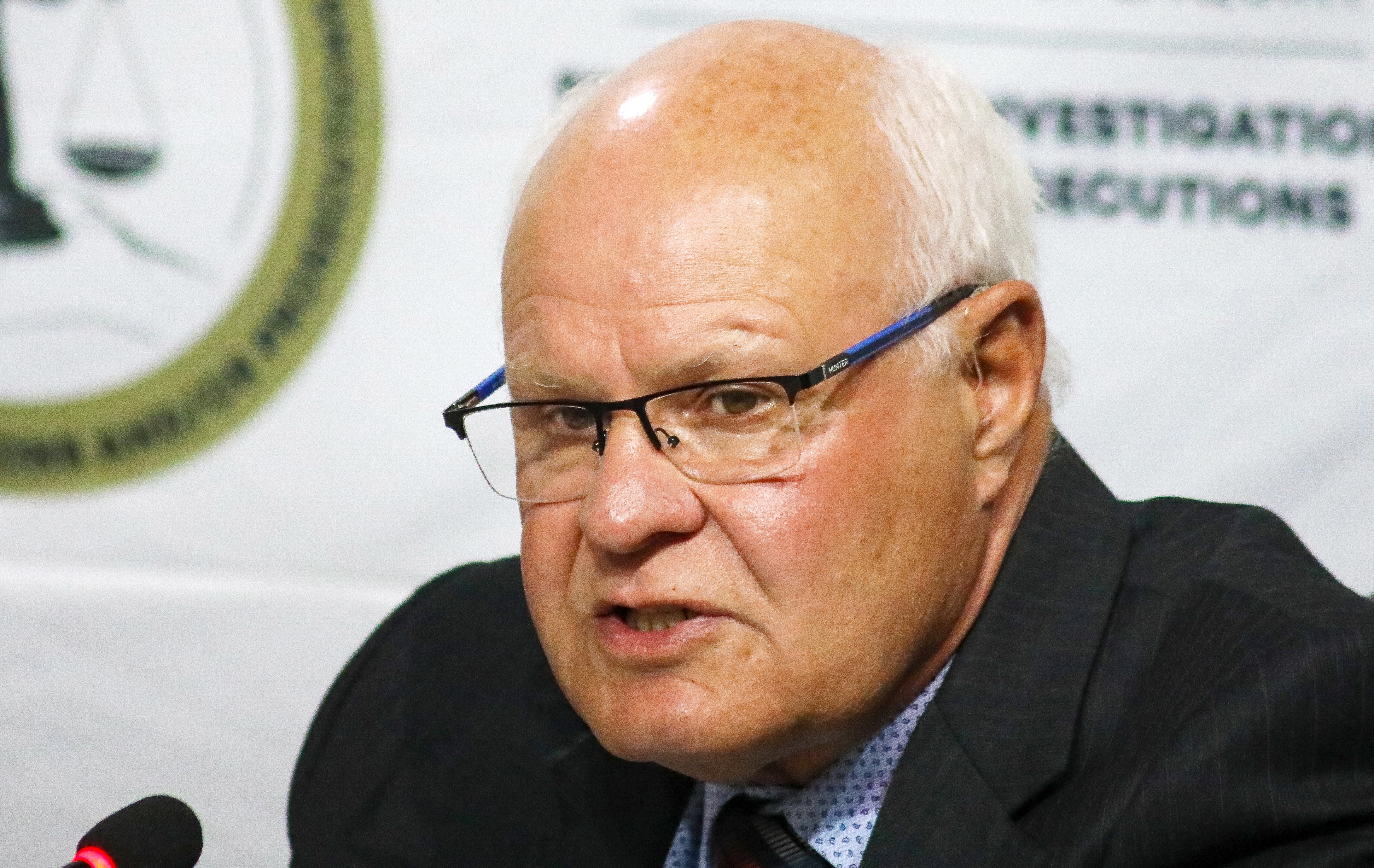
 Philippus Jacobs at the Khampepe Inquiry on 14 April. (Photo: Fani Mahuntsi / Gallo Images)
The role of former national police commissioner Jackie Selebi, appointed in October 1999 by President Thabo Mbeki, was one of procedural oversight and active intervention involving specific prosecutions.
Testifying on Monday at the Khampepe Inquiry into delayed Truth and Reconciliation Commission (TRC) prosecutions, retired Major General Philippus Christoffel Jacobs — now a doctor — noted that “at all material times during my tenure at SAPS, I had to perform my work subject to the national commissioner’s approval, who was the person responsible for decision-making on behalf of SAPS”.
In the early 2000s, Selebi, a close ally of Mbeki and a fellow returned exile, had seconded senior officials to represent the South African Police Service (SAPS) at the Amnesty Task Team (ATT), established by Mbeki to deal with high-profile individuals who had not applied for amnesty at the TRC.
“I wish to state from the onset,” said Jacobs, “that I have neither been present nor participated in any high-level discussions related to the meetings [referred to in court papers].”
Selebi’s eyes and ears
A career police officer and legal expert, Jacobs’ credentials spanned decades — from attending a 1996 conference on The Legal Aspects of Terrorism at George Washington University to a 2009 Interpol seminar in Lyon on investigating genocide and crimes against humanity. He saw himself as a pragmatic member of the “old guard” whose specialised skills remained indispensable.
In 2003, Selebi seconded Jacobs and Assistant Commissioner Josias Lekalakala to serve as his “eyes and ears” at the ATT. Their mandate was to brief Selebi on all draft reports and recommendations before they were finalised and submitted to the National Prosecuting Authority (NPA). This arrangement epitomised the executive creep that had taken root once the ATT was established as an entity separate from the NPA.
/file/attachments/orphans/0000109706_775612.jpg "Former National Police Commissioner Jackie Selebi. (Photo: Bongiwe Gumede / Gallo Images / Foto24)")
In his affidavit to the inquiry, Jacobs said, “What was communicated to the members of the PCLU (Priority Crimes Litigation Unit) and/or the ITT (Intergovernmental Task Team also known as the ATT) were the views of the national commissioner as my principal”.
Jacobs retired from the SAPS in 2017 with the rank of Honorary Lieutenant General.
The present in the past
By August 2025, the tide had turned for Lekalakala. Currently serving as the Gauteng provincial head of Crime Intelligence (CI), he now stands charged alongside the national head of the unit, Dumisani Khumalo, and several others. The group is accused of bypassing the essential vetting procedures required for the appointment of senior officials within both the SAPS and Crime Intelligence.
/file/dailymaverick/wp-content/uploads/2025/11/ED_585148.jpg "Crime Intelligence head Lieutenant General Dumisani Khumalo. (Photo: Frennie Shivambu / Gallo Images)")
A brutal turf war within the SAPS was laid bare by both the Madlanga Commission of Inquiry and a parliamentary ad-hoc committee. This exposure followed a watershed July 2025 press conference by KwaZulu-Natal Provincial Commissioner Lieutenant-General Nhlanhla Mkhwanazi, whose revelations effectively blew the whistle on systemic police criminality.

Khumalo and Lekalakala appeared in court in July 2025 alongside CI’s chief financial officer, Major General Philani Lushaba; component head of intelligence, analysis and coordination, Major General Nosipho Precious Madondo; technical management services officer, Major General Zwelithini Gabela; section head of personnel vetting, Brigadier Phindile Ncube; and senior technical support services member, Brigadier Dineo Mokwele.
It was alleged at the time that these arrests were part of a plot to derail CI investigations and to protect crime suspects, including leaders of the “Big Five” cartel, which has allegedly infiltrated all levels of the SAPS. It resulted in Khumalo being removed as head of Crime Intelligence, but he was reinstated late last year.
Back-door amnesty
Jacobs told the inquiry that his summons to appear before it stems from allegations by the families of victims that are contained in the founding affidavit of Lukhanyo Calata, son of Cradock Four member Fort Calata, who was murdered by Security Police on 27 June 1985. “I am implicated or potentially implicated in the political interference aimed at stopping the investigation or prosecution of TRC cases,” Jacobs explained to the panel.
/file/attachments/orphans/ED_561725_705285.jpg "Lukhanyo Calata testifies at the Cradock Four Inquest at the Eastern Cape High Court on 9 June 2025. (Photo: Lulama Zenzile / Gallo Images / Die Burger)")
The ATT comprised a volatile mix of former adversaries: apartheid-era security operatives still embedded in the state’s bloodstream and senior officials from a young, wary ANC-led government — many of whom were exiles shaped by a legitimate sense of paranoia. The inquiry is exploring allegations that Mbeki brought these opposing groups together in pursuit of a “secret” solution to avoid prosecutions of apartheid-era operatives.
Apartheid career
Jacobs joined the old Department of Justice in 1975, a year before the Soweto uprisings ripped through South Africa, and studied law full-time between 1976 and 1978.
After that, he was conscripted into the South African Defence Force for two years, serving as a legal officer at the Army Combat Training Centre at Lohatla in the Northern Cape.
In January 1980, while working for the Department of Justice, he was appointed as a public prosecutor in Springs. In 1983, he was transferred to the Directorate for Security Legislation, which, in the early 1990s, explored new legislation during the negotiation process with former liberation movements.
‘Suiker’ Britz
The Priority Crimes Litigation Unit (PCLU) — the body tasked with prosecuting TRC cases under advocate Anton Ackermann — sought to enlist legendary detective Hendrik Jacobus “Suiker” Britz to audit its 375 pending dockets.
Britz, the former head of the Serious Violent Crimes Unit (previously the Brixton Murder and Robbery Squad), was renowned for his exceptional track record in solving violent crimes. However, Ackermann fiercely opposed the appointment. His objection centred on Britz’s controversial history, specifically a previous and unsuccessful attempt by the detective to prosecute President Thabo Mbeki and 37 other ANC leaders.
/file/attachments/2990/Gemini_Generated_Image_dx2mz9dx2mz9dx2m1_483498.png "Advocate Anton Ackermann. (Image: Gemini AI)")
Advocate Chris Macadam, who worked alongside Ackermann in the PCLU, has charged that Britz was the “driving force” behind this effort despite a lack of sufficient evidence against Mbeki.
In the end, Britz was removed from handling TRC cases because of Ackermann’s objection.
The past vs the past
Ackermann, too, began his professional career as a prosecutor in apartheid South Africa and was viewed with deep suspicion by ANC members. He testified to the commission that while he had worked within the apartheid-era judiciary, he had “never applied an unjust law”, such as the Immorality Act.
He had received a Department of Justice bursary to study and did not have the resources to go into private practice, and so, like Jacobs, he became a state prosecutor.
Ackermann included in his submission to the Khampepe inquiry a letter by the late human rights lawyer, advocate George Bizos, setting out Ackermann’s fair-mindedness and decency as a prosecutor trapped in an indecent system, doing his best to be decent.
/file/attachments/2990/Screenshot2026-04-15085236_350084.png)
The newspaper article
In 2006, the conservative Afrikaans Sunday newspaper Rapport ran a story quoting former police commissioner Johan van der Merwe saying the SAPS had “done nothing” about obtaining evidence for the possible prosecution of 37 ANC leaders, including Mbeki, Jacob Zuma, Jackie Selebi, Linda Mti and Essop Pahad, who had not applied for amnesty.
Van der Merwe, alongside the former minister of law and order, Adriaan Vlok, were due to be charged by Ackermann for orchestrating the poisoning of the Rev Frank Chikane in 1981.
Chikane subsequently found himself caught between the rule of law and his new role in Mbeki’s office and had, according to Selebi, maintained that he did not wish his attempted poisoners to be charged.
/file/attachments/orphans/000063626_677282.jpg "General Johan van der Merwe. (Photo: Christiaan Kotze / Media 24 / Gallo Images)<br>")
Advocate Mokotedi Mpshe, former acting National Director of Public Prosecutions, testified on 7 April that the imminent arrest of Van der Merwe and Vlok had led to a deep rift between Ackermann and the ATT.
Chikane had written that “instead of just consulting me, as the victim, he [Ackermann] entered into an acrimonious argument with me about the approach of the government on post-TRC and the guidelines. It was clear that he was radically opposed to the guidelines as agreed on by Parliament and the Cabinet of South Africa.
“He seemed to be more interested in prosecution for the sake of it rather than the management of this difficult post-TRC process.”
Mpshe told the inquiry that in hindsight, Ackermann had been correct.
The removal of dockets
The dockets relating to TRC cases had been removed from the safekeeping of the DPP in Pretoria, advocate Paul Fick, then head of a team investigating cases, said Rapport.
Van der Merwe claimed there was evidence that ANC leaders were implicated in the murders of three people in a 1985 landmine explosion. Rapport also claimed that Ackermann had given “written instructions that police must ignore evidence into ANC leaders with a view to prosecution”.
Furious at what he termed a complete fabrication, Ackermann demanded the case files and all supporting documentation. Upon review, he discovered a 2003 memorandum he had authored that had been strategically altered to reflect a 2006 date. Ackermann maintained that this forgery was weaponised specifically to undermine his work.
At the time, these sensitive files were under the control of Louis Bester, a senior SAPS superintendent and section head of the Crimes Against the State unit. Bester became a central figure in the investigation into the allegedly forged memorandum — a document Selebi later utilised to claim that Ackermann was on the verge of arresting high-ranking ANC leaders.
Selebi had provided a copy of the disputed Ackermann note to Jacobs, who then faxed it to Ackermann. Jacobs later confirmed to Commissioner Jacobus de Beer that the original note had been kept in safe custody at Bester’s behest.
Who did it?
Following the NPA’s public allegations of forgery, De Beer instructed Bester to retrieve the original file for review. He was further tasked with taking a formal statement from the retired “Suiker” Britz to determine the exact process used to draft and file the document within the NPA.
What is crucial here is the provenance of the alleged forgery and who could have stood to benefit from it.
Bester was also the official who requested a forensic investigation into the document and who submitted the disputed note, along with 18 other specimen signatures, to the Forensic Science Laboratory on 22 August 2007. On 30 August 2007, he provided these exhibits to an independent forensic consultant, JF Hattingh, for a second opinion.
Bester acted as the commissioner of oaths for Britz’s affidavit regarding the document’s authenticity, signed on 22 August 2007.
In a handwritten note related to the case, Jacobs noted that the files received from Ackermann were under Bester’s custody.
The memorandum, sent from Ackermann to Silas Ramaite, addressed the amnesty status of several ANC members. In it, Ackermann concluded that “no further investigation is necessary” concerning the “foot soldiers” who had been involved in the landmine campaign.
The date discrepancy
While Ackermann’s memorandum bore the date 23 June 2006 (or 26 June 2006 in some references), forensic and archival evidence suggested it was actually drafted and received in 2003.
Britz confirmed in an affidavit that the note was drafted and filed with other documents in 2003, but mistakenly bore the 2006 date.
Jacobs concluded by stating that it was never within his capability or intention to instruct anyone to stop investigations or prosecutions. He asserted that he never engaged in any act of political interference and was simply following orders. DM
Second-hand truth better than no truth at all
Much of what is unravelling at the Madlanga Commission of Inquiry into police corruption and criminal collusion began long ago, at South Africa’s “dawn of democracy” when the stakes were high, blood flowed, and atrocities of unimaginable cruelty were committed by the apartheid state.
Many young South Africans may view this period of our lives through the hazy gauze of history, but the unfinished business of the TRC still lives.
The Khampepe Commission of Inquiry is a seminal moment in the country’s history. A kind of “second-hand” truth has emerged about secret backroom deals to preserve the peace and the mammoth task of “reconciliation” after years of prolonged civil war inside the country’s borders.
The families of victims have fought for almost three decades, claiming the means did not justify the end — the “national project” of a new “Rainbow Nation”.
Some myths and “miracles” were made real by the likes of Nelson Mandela and Bishop Desmond Tutu, but it was at great cost to those who never found justice and those who got off scot-free. Accountability, integrity and the rule of law were sacrificed at great cost to law enforcement in the coming years. DM
Comments
Scroll down to load comments...