



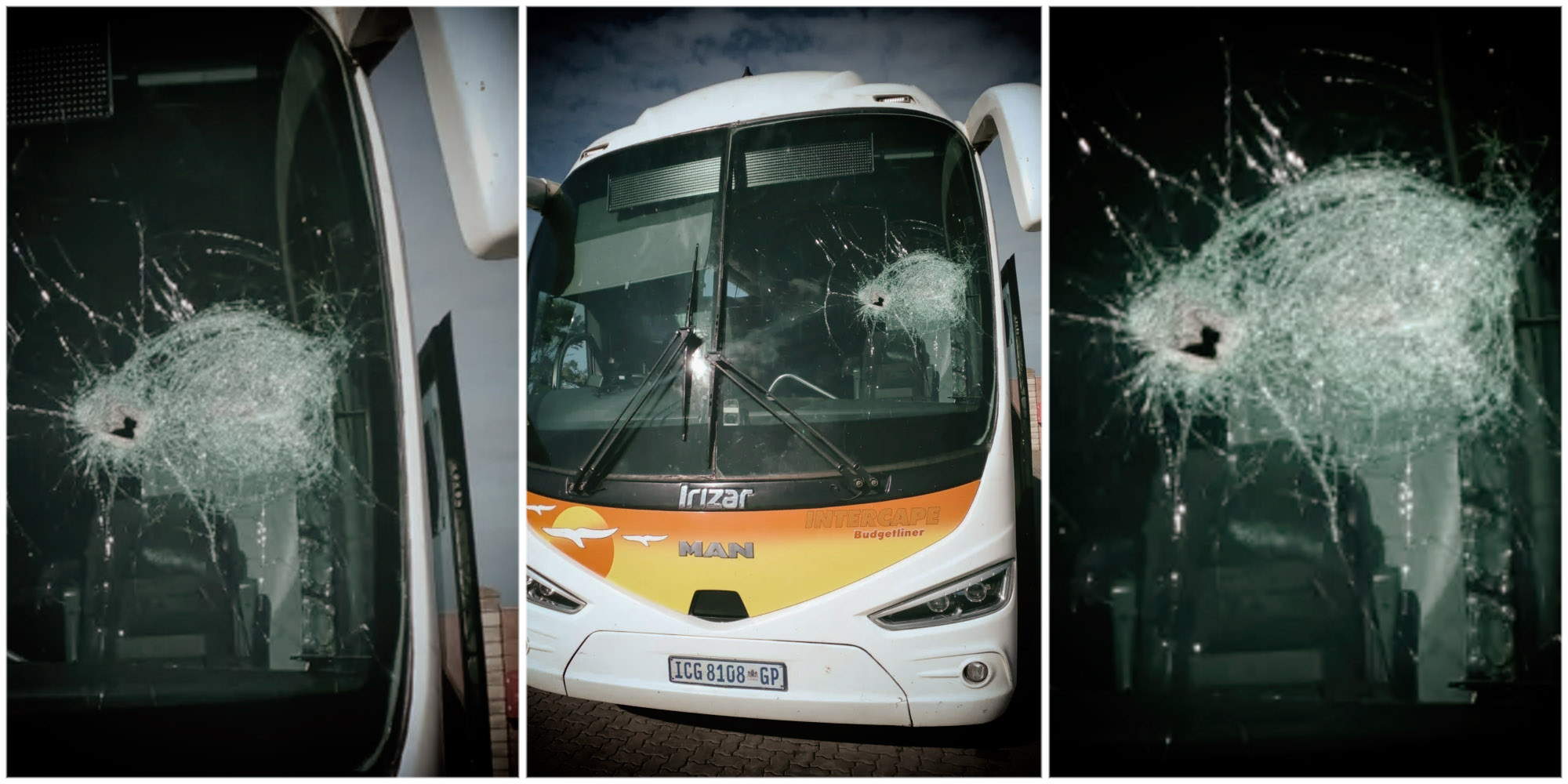
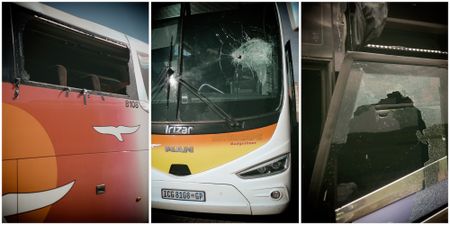
 Bus operators allege that minibus taxi associations were behind escalating extortion, violence and intimidation in the Western and Eastern Cape. These images depict the results of incidents in the Eastern Cape and Cape Town. (Photo: Supplied)
 Intercape CEO Johan Ferreira has welcomed the arrests of seven suspects accused of wreaking havoc and effectively barring buses from operating in parts of the Eastern Cape. He expressed hope that this breakthrough would lead to further arrests and the successful prosecution of the “perpetrators behind a series of violent attacks, including shootings and stone-throwing, as well as other acts of intimidation”.
Six accused were arrested on Sunday, 29 March, indicating what investigators believe to be a broader, possibly structured network rather than extortionists operating in silos. Their names are: Simphiwe Matshala, Mzuvukile Mbiyo, Siyanda Dyanti, Gwendoline Mazele, Siphelele Kwaza and Simphiwe Gxumayo.
Bonke Makalala, one of the alleged central figures in the attacks, has been in custody since 9 December 2023. Makalala’s name has now been added to the six others facing 125 charges ranging from racketeering under the Prevention of Organised Crime Act, multiple counts of extortion and attempted extortion, intimidation, kidnapping, interference with essential infrastructure and money laundering.
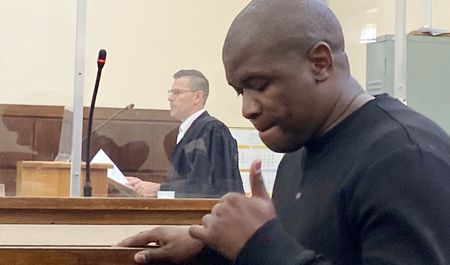
Additional charges under the Tax Administration Act are also expected, with prosecutors indicating that further counts may be added as the investigation unfolds. The accused’s first appearance in the Cape Town Magistrates’ Court was on Monday, 30 March.
Turning point
The breakthrough followed a four-year investigation, culminating in coordinated arrests across Cape Town, Matatiele and Nelspruit, involving multiple specialised law enforcement and prosecuting units, underscoring the scale and complexity of the case.
Parts of the Eastern Cape became no-go zones for Intercape after it refused to comply with extortion demands, including imposed schedules and fares. The company has faced sustained intimidation since 2019, including the stoning of buses and attacks on drivers, escalating sharply in 2022.
On 25 April 2022, one of its drivers, Bangikhaya Machana, was shot in the left arm and waist at an Intercape depot in Cape Town. The 35-year-old father of two young children died of his injuries three days later.
Machana’s killing marked a turning point, reigniting calls for government intervention and prompting Intercape to take legal action to compel authorities to act. What followed was a drawn-out process, punctuated by delays and stalled responses.
/file/dailymaverick/wp-content/uploads/2022/05/Bangikhaya-Machana-memorial-4769.jpg "Asange Mchana (centre), the widow of murdered long-distance bus driver Bangikhaya Machana, lights a candle during a memorial service at the Intercape Depot in Cape Town. Standing next to her on the right is Machana’s father, Nkululo Mchana. Mchana died after being shot outside his workplace. (Photo: Xabiso Mkhabela)")
‘Coordinated acts of intimidation’
Given the gravity of the allegations and the protracted period it took to bring the accused before court, prosecutors have indicated that they will oppose bail and intend to pursue the case in a manner that reflects the seriousness and organised nature of the offences.
The State alleges the accused were part of a structured criminal enterprise that used coordinated intimidation and violence to extort long-distance bus operators.
According to the State, between 2021 and 2023, the accused demanded substantial payments from bus operators in exchange for “protection” and the ability to operate without interference, which prosecutors argue points to an organised and systemic scheme rather than isolated incidents.
National Prosecuting Authority Western Cape spokesperson Eric Ntabazalila said: “These demands were enforced through coordinated acts of intimidation, including threats of violence, the disruption of operations and, in some instances, the unlawful detention of individuals.”
The investigation further uncovered what authorities describe as a pattern of payments made by several bus companies under duress, supported by financial records and corroborating statements. These funds were allegedly channelled and distributed among members of the group as part of a structured criminal enterprise.
The impact in some instances was severe: the financial demands proved so burdensome that affected businesses were forced to shut down or scale back operations, limiting services and undermining access to reliable long-distance transport for commuters.
The alleged illegal operations are also believed to have increased ticket prices, thereby placing additional strain on travellers. It further revealed how bus operators were allegedly subjected to imposed conditions, including restrictions on the number of trips and passengers, effectively allowing the group to dictate operational terms.
‘Meticulous’ police work
Underlining the significance of the arrests, police spokesperson Brigadier Novela Potelwa said they followed four years of “meticulous” investigative work targeting key figures in the transport sector.
“The extensive organised crime project investigation has, over time, laid bare the coordinated illicit activities as well as collusion of the alleged perpetrators, some who have a financial interest in the transport sector,” said Potelwa.

Intercape, however, had to go to court multiple times to force the police and government to act on the attacks. In 2022, an Eastern Cape court ordered the provincial government and then transport minister Fikile Mbalula to develop an action plan in consultation with SAPS.
Intercape went to court again to force SAPS to develop a safety plan. In 2023, the Eastern Cape police commissioner was summoned to the Eastern Cape Division of the High Court in Makhanda to explain why the SAPS had allegedly failed to develop a plan to ensure the safety of Intercape passengers and buses in the province.
In February 2024, the Makhanda high court issued a scathing judgment against the SA Police Service for failing to properly investigate attacks on Intercape buses and found that five provincial commissioners had failed to carry out their duties.
Dismantling one group doesn’t end the threat
The question now is whether these arrests mark a turning point or merely a temporary disruption. Extortion rackets of this nature are often sustained by loose but resilient networks, meaning the removal of key figures can create a vacuum quickly filled by new actors seeking to exploit the same routes and revenue streams.
Dr Siyabulela Christopher Fobosi, a senior researcher at the University of Fort Hare, emphasised that while the operation marked a visible breakthrough, it should be understood as part of a much broader and more complex challenge. These networks, he noted, were often adaptive — and dismantling one group did not necessarily eliminate the risk of others emerging.
He also emphasised that curbing extortion in the sector would require sustained law enforcement efforts alongside structural reforms within the industry to address underlying vulnerabilities. Syndicates might resurface in different forms or target other operators if underlying incentives remained unaddressed.

He identified several incentives behind the attacks, including high cash flows in the sector, limited regulatory oversight and gaps in security. Over time, organised crime had penetrated parts of the industry, leaving some operators particularly vulnerable. The impact extended beyond financial losses, affecting staff morale, passenger safety and public confidence in bus services.
Overall, he said, while the arrests were positive, the broader challenge of organised crime in the sector remained significant, and sustained intervention was required to prevent recurrence.
Overall, he said the arrests were a positive step, but the broader challenge of organised crime in the sector remained significant, and sustained intervention was required to prevent recurrence.
The case against the accused has been postponed to 7 April 2026 for the submission of bail information and the verification of the Eastern Cape addresses of three of the seven accused. DM