



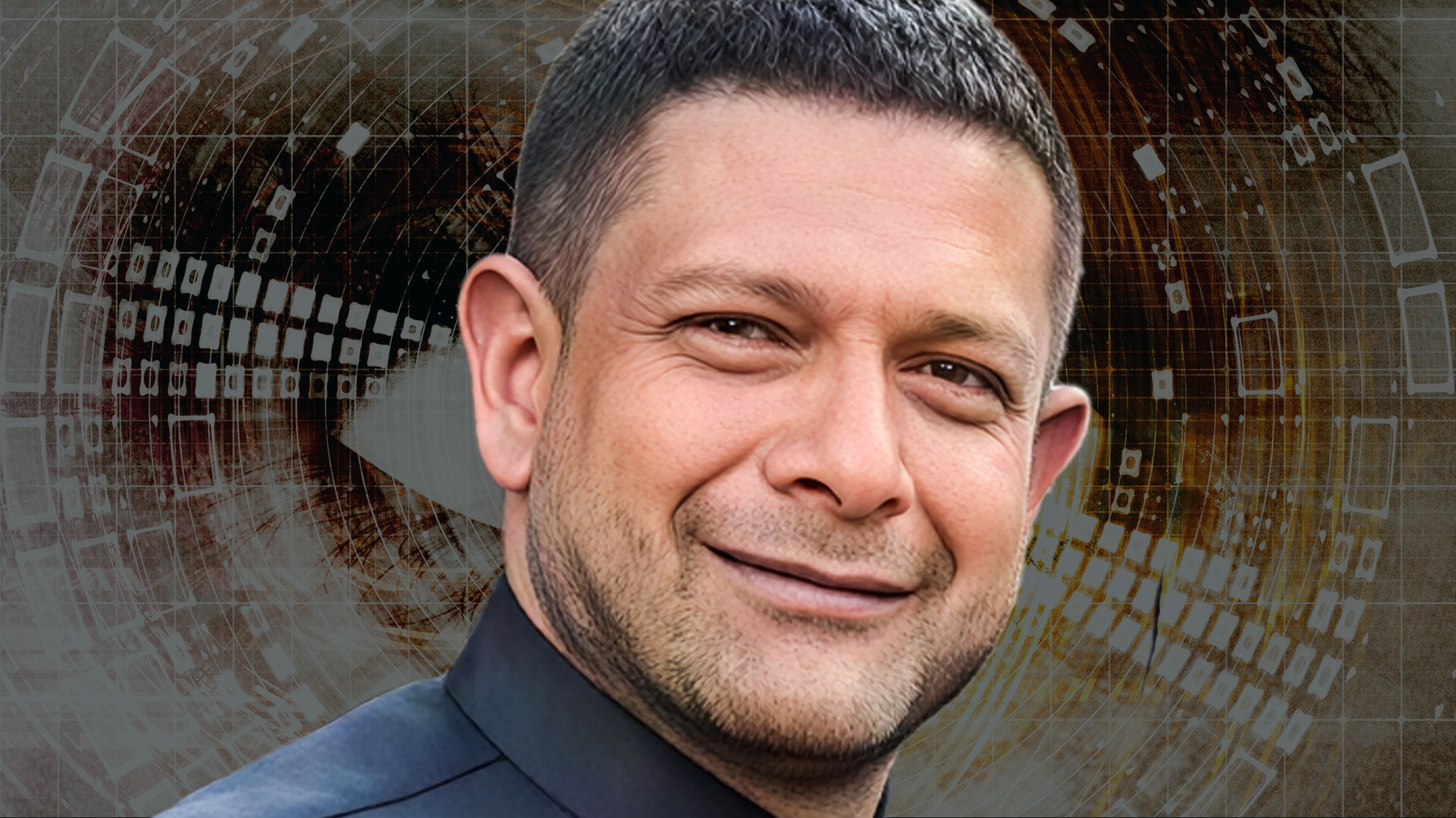
 Illustrative image | Security surveillance. (Photo: iStock) | Major General Feroz Khan, head of SAPS Counter and Security Intelligence. (Photo: X)
 /file/dailymaverick/wp-content/uploads/2025/10/label-analysis-2.jpg)
Major General Feroz Khan should have been called to testify at the multiparty ad-hoc committee investigation established to probe allegations of deep-rooted police corruption, KwaZulu-Natal Provincial Commissioner Nhlanhla Mkhwanazi said at the final session of the parliamentary committee last week.
Speaking long past midnight, the man who has arguably changed the political landscape of the country with his “bombshell” media conference on 6 July 2025, which prompted the committee investigation as well as the Madlanga Commission of Inquiry, claimed Khan’s office was “dirty”.
/file/attachments/orphans/WhatsAppImage2026-03-18at114749_546971.jpeg "KwaZulu-Natal Police Commissioner Nhlanhla Mkhwanazi returned to testify before Parliament’s ad hoc committee. (Photo: Zwelethemba Kostile / Parliament RSA)")
Fire them all
The country’s favourite Major General, dressed in a suit, calmly said that if he had the powers, he would fire the entire vetting unit, starting with its powerful head Khan, who also oversees the Anti-Kidnapping unit.
Mkhwanazi drew a line concerning one of the most visible, powerful and mysteriously wealthy members of SAPS. It is clear he views Khan as a threat to the country’s safety and security.
Khan has made no secret of the fact that he works closely with the private security company, Vision Tactical, concerning kidnappings and other crimes in Gauteng and surrounding areas.
In September 2020, a young Somalian, Abdi Nasir Yusoof, was shot in the back after fleeing the scene where Mayfair businessman Hamza Khan had been kept after being kidnapped.
The Mail & Guardian reported at the time that Hamza Khan’s family, after negotiations, agreed to pay a ransom of R200,000, but the businessman was still not released.
Later, a joint operation involving Vision Tactical, the Johannesburg Metropolitan Police Department (JMPD), Crime Intelligence and other SAPS units raided a lodge on Clifton Street and Hamza Khan (no relation to Feroz Khan) was retrieved. Controversy was sparked by the news that Major General Khan had run the operation from Vision Tactical’s head office in Houghton.
In October, “Witness C”, a member of the elite Political Killings Task Team (PKTT), told the Madlanga Commission that Khan had demanded R2.5-million from murder accused Vusumuzi “Cat” Matlala when he (Khan) had faced a disciplinary process instituted by Crime Intelligence head Dumisani Khumalo.
Evidence was also given to the commission that Khan would occasionally use Matlala’s penthouse in Menlyn, Pretoria.
/file/attachments/orphans/ED_597796_631802.jpg "Vusimuzi ‘Cat’ Matlala at the Gauteng Division of the High Court in Johannesburg on 26 February 2026, facing charges of attempted murder, conspiracy to commit murder and money laundering. (Photo: Gallo Images / Luba Lesolle)")
Mkhwanazi, during his swansong testimony, placed Pretoria centre stage, saying that many senior SAPS members (he did not specifically name Khan), including Major-General Shadrack Sibiya, often visited a farm belonging to late taxi boss Jotham Zanemvula “Mswazi” Msibi, outside Pretoria. This served as “a parallel Union Buildings”, he said.
That the committee did not call Khan is indeed puzzling. Perhaps the Madlanga Commission will still succeed in slicing the Gordian knot of crime, corruption and law enforcement and call Khan as a witness.
Questionable links
Mkhwanazi on Tuesday, 17 March also highlighted Khan’s alleged links to Matlala, as well as police agent/informant/fixer Brown Mogotsi. He said Khan’s reach and influence cut across intelligence operations into “external networks” and shaped the conduct of the police.
Khan reportedly has a close relationship with Mohammadh Sayed, co-founder of the tobacco company Carnilinx. In 2023, he was snapped at an Economic Freedom Fighters fundraiser where a more than R100,000 ticket bought him a place next to Sayed and alleged cigarette smuggler Adriano Mazotti. Sayed purchased the ticket for Khan. Mazotti has repeatedly denied being a cigarette smuggler.
In 2021, Daily Maverick reported that Khan was a “millionaire”, as according to CIPC records, he was an active director in several companies, at least one of which appeared to be worth R21-million at the time. Khan objected to being labelled a “millionaire”. At the time, Daily Maverick reported that, with his former wife, Khan owned several upmarket properties.
Mazotti is a well-known benefactor of EFF leader Julius Malema. Khan has always maintained that he was doing “intelligence” work while seen out and about with high-profile individuals.
Vetting the entire SAPS
Mkhwanazi told the committee that while his own contract had just been renewed, he still did not have security clearance. Khan was exposed in 2017 by City Press as having worked since 1997 without the required top-level security clearance. Khan received his clearance only on 10 May 2018.
Mkhwanazi said the State Security Agency had completed his own vetting but had held back on issuing clearance due to an Independent Police Investigative Directorate investigation (Ipid).
“I was told there was a case involving a so-called hit squad in 2013 in KwaZulu-Natal, in which I was implicated. At the time, I was working in Pretoria and had never worked in KwaZulu-Natal,” he said.
The highway patrol officer and the ton of cocaine
In 2021, a truck transporting almost a tonne of cocaine arrived at a warehouse in Aeroton, an industrial area South of Johannesburg.
Khan’s version of events that night is that he was called to the scene by a Gauteng Highway Patrol officer who found himself in a confrontation with members of the police, claiming to be from Crime Intelligence and the Directorate for Priority Crime Investigation (DPCI), who were attempting to remove the cocaine without following proper crime scene procedure.
Senior personnel, including Gauteng Provincial DPCI head Major General Ebrahim Kadwa, Major General Josias Lekalakala, and the provincial head of Crime Intelligence, were summoned by Khan, he claims, to resolve the matter. He then left the scene, he says.

In June of 2023 – two years after the incident – Ipid initiated proceedings against Khan, and a month later recommended that disciplinary proceedings be taken against him. A case was also opened against him along with Kadwa and other SAPS members, which the deputy director of public prosecutions declined to pursue.
In 2024, Khan, also Deputy Crime Intelligence head, fought the initiation of an expeditious disciplinary process by his boss, Dumisani Khumalo.
Khan alleged the disciplinary process – and its expeditious nature – was in retaliation for disclosures he had made of alleged misconduct by Khumalo and National Commissioner Fannie Masemola.
/file/dailymaverick/wp-content/uploads/2025/11/ED_576045-1.jpg "Former Crime Intelligence head Dumisani Khumalo. (Photo: Gallo Images / Frennie Shivambu)")
Arrest of top CI leadership
Shortly before Mkhwanazi’s press conference in July, Khumalo and other Crime Intelligence officials were arrested over an allegedly irregular staffing appointment, allegations which they denied. Khumalo was removed as Crime Intelligence head, but was later reinstated.
News24 later revealed that prior to his suspension in October 2025, the Inspector General of Intelligence, Imtiaz Fazel, had recommended disciplinary and criminal charges against National Commissioner Fannie Masemola and Khumalo over five properties bought by Crime Intelligence for more than R120-million in 2023 and 2024.
Testifying previously at the ad hoc committee, Khumalo claimed that there was a coordinated misinformation campaign against him due to his efforts to clean up the notorious unit.
Khan, in turn, accused his boss of unfairly targeting him. Khan said Khumalo used the 2021 cocaine bust to try to get rid of him because he had investigated the abuse of secret service funds. Police bosses, via court processes, denied that Khan was being dubiously targeted.
Ironically, in March 2025, Khan was found not guilty of a charge of defeating the ends of justice in a hearing chaired by Mkwanazi.
Internal war
Khan’s controversial appointment as acting head of Crime Intelligence after the suspension in December 2020 of Divisional Commissioner Peter Jacobs by then National Commissioner Khehla Sitole, was when the spanner was jammed in the works.
This was one of the reasons the then Minister of Police, Bheki Cele, refused to sign off on a “continuation of Secret Services Account application” by Khan in December 2020.
In May that year, Cele had written to Sitole stating the illegality of Khan’s appointment from December 2020 to February 2021 by the late Lieutenant General Sindile Mfazi, then Deputy National Police Commissioner of Crime Detection.
A later inquiry by Lieutenant General Thembi Hadebe, with findings handed down in August that year, noted that Khan had signed off on several procurements that “do have a direct and or indirect impact on the finances of any division and therefore deserve strict monitoring by all officials in terms of Section 45 of the PFMA [Public Finance Management Act]”.
Hadebe’s finding was clear: Khan exceeded his authority, violating the PFMA and the SAPS Act, but his actions were rather through “ignorance” than “intentional”, she said. Hadebe also recommended that all administrative action taken during that time by Kahn, “which were delegated above the Divisional Commissioner, be reviewed”.
Mfazi was unable to shed any light on the matter as he had died in July 2021, initially of suspected Covid-19 complications.
Colleague Pilasande Dotyeni, a former CI analyst, claimed to the ad-hoc committee in February that Mfazi had been “covertly assassinated” by poisoning after uncovering corruption among senior officers.
Cele’s bombastic predecessor, Fikile Mbalula, had also attempted to seize control of Crime Intelligence, issuing an unsuccessful “ministerial directive”, which included the rescinding of the promotion of Khan as well as the high-ranking CI member Colonel Smanga Simelane. Khan lived to face another day after Mbalula was shuffled out.
Khan the VIP protector
In a 2021 Western Cape Division of the High Court in Cape Town defamation action between Khan and then Western Cape Head of Detectives, Major General Jeremy Vearey, relating to a Facebook comment Veary had posted, the veteran detective noted one of Khan’s claims that he had provided VIP protection for Nelson Mandela, Thabo Mbeki and other senior ANC members could not be true.
/file/dailymaverick/wp-content/uploads/2023/05/veary-890.jpg "Axed head of Western Cape detectives Major General Jeremy Vearey. (Photo: Brenton Geach)")
Veary, an Umkhonto weSizwe (MK) member who was part of Mandela’s security detail, said Khan would not have been appointed at the age of 2o in 1990 when ANC senior leaders were first released.
At that age, he would not have had the top-level security clearance as “prevailing political circumstances at the time required sophisticated and experienced protection. The plaintiff [Khan] had no such experience”, said Veary at the time.
Veary said Khan had not protected Mbeki from 1994, “nor was he appointed such when Thabo Mbeki became president in 1999”. The defamation matter against Veary by Khan appears yet to have been decided on by the court.
The rise and rise of Khan
Feroz Khan joined the SAPS as a constable on 1 September 1991 before being promoted to lance sergeant in 1992, warrant officer in 1995, inspector in 1996, captain in 2001, superintendent in 2004, colonel in 2010 and major general in 2017.
He joined what was then known as the Crime Intelligence Service and moved to Protection and Security Services from 1995 until 1999, when he joined Gauteng Crime Intelligence.
From 2003 to 2009, he was part of “technical workshops” before moving to Alex Crime Intelligence. Between 2010 and 2017, he was the principal agent commander of the Undercover Agent Programme before becoming the section commander of Counter and Security Intelligence. These were the years he skipped a rank from colonel to major general, bypassing brigadier.
His future in the SAPS now hangs in the balance. DM