




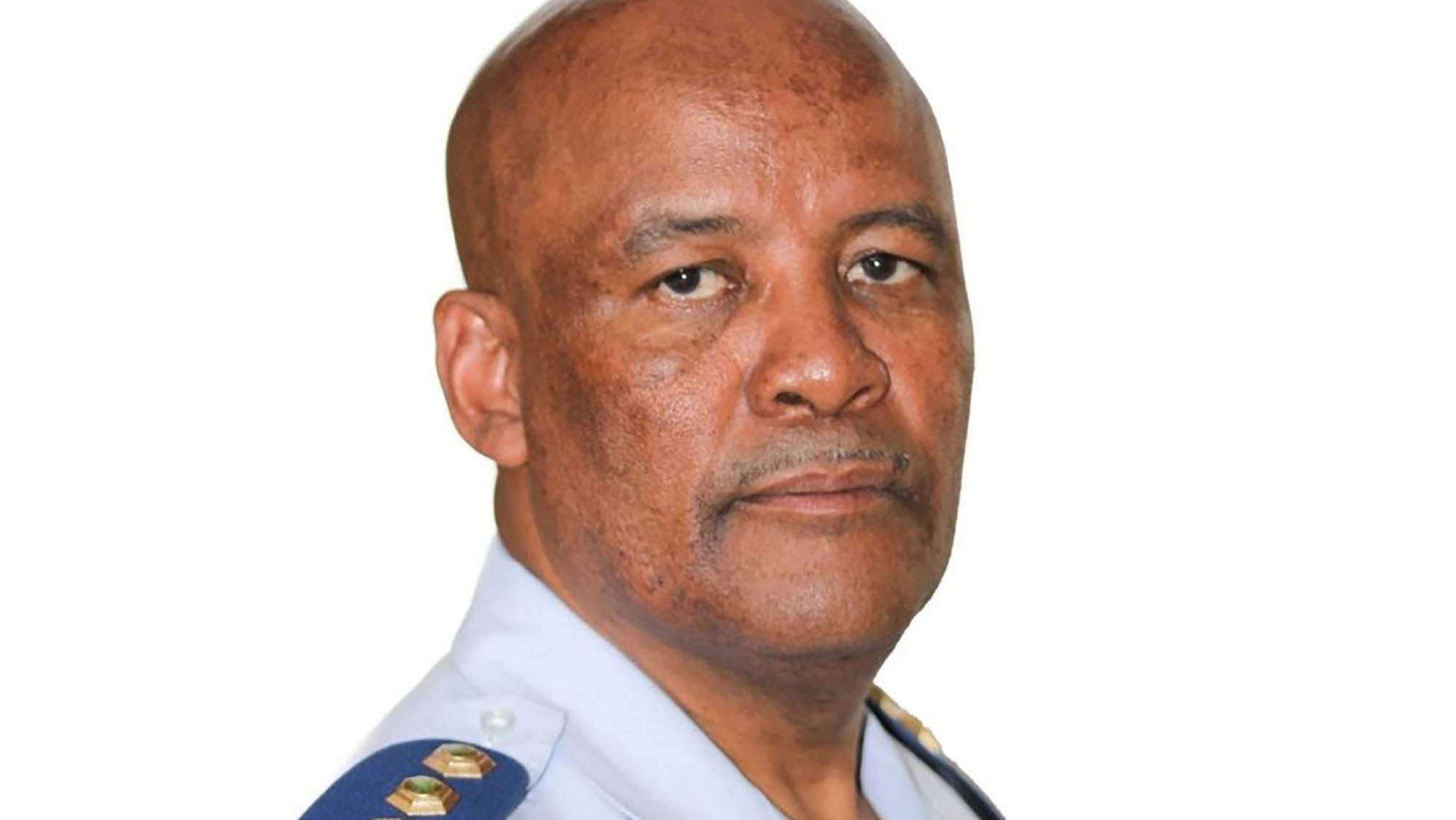
 The late Lieutenant-General Sindile Mfazi, former deputy national commissioner of crime detection. (Photo: SAPS)
 A former colleague of Deputy National Police Commissioner of Crime Detection Sindile Mfazi has alleged that he was covertly assassinated in 2021 after he uncovered corruption among senior officers, with the murder made to look like Mfazi had died due to Covid-19.
This is according to Pilasande Dotyeni, a former Crime Intelligence analyst with the South African Police Service (SAPS), who addressed Parliament’s ad hoc committee on Tuesday, 3 February 2026.
He told the ad hoc committee he was making a “May Day” call for it to “do something” in relation to what happened to Mfazi, whom he said was “buried under a lie of Covid-19” and died choking on his own blood.
Asked what the status of the investigation into Mfazi’s death was, Dotyeni said: “Nothing is happening, it’s dying a slow death.”
He was in the police service between 2004 and 2011 and was based in the Eastern Cape. Dotyeni remained in contact with Mfazi after that.
Mfazi died in July 2021 at the age of 59.
On 9 July 2021, a government press statement, headed “SAPS Deputy Commissioner succumbs to COVID-19”, described him as “a highly decorated senior officer, who served... for 39 years”.
‘R1.6bn and irregular mechanisms’
Dotyeni spoke at length about his background on Tuesday before the committee. His typed submission, one of two documents he presented to the committee, added allegations about his last communication with Mfazi.
“In our final encrypted conversation just days before his death, General Mfazi confided in me that he had unearthed a complex web of corruption centred on emergency procurement tenders – specifically, PPE (personal protective equipment) contracts valued at over R1.6-billion – being channelled through irregular mechanisms, including the Crime Intelligence secret fund,” Dotyeni’s submission read.
“His findings reportedly pointed to a coordinated siphoning operation involving actors inside SAPS Headquarters.”
Daily Maverick previously reported that a confidential police risk-based and compliance draft internal audit report uncovered that R1.6-billion in irregular procurements by the SAPS had occurred over six months in 2020.
The National Prosecuting Authority’s Investigating Directorate subsequently, in 2022, announced that 15 people had been arrested “in connection with alleged corruption” in awarding R1.9-million in police PPE contracts.
In a statement, it said: “The arrests follow an investigation into the capture of the SAPS procurement and supply chain to aid front companies to score lucrative contracts and facilitate kickbacks to SAPS senior officials.”
Ad Hoc Committee Investigating Allegations made by Lt Gen Mkhwanazi - Our 2nd witness today is Mr Pilasande Dotyeni, a former crime intelligence officer, explains his job description. #pkttt @ParliamentofRSA @SAPoliceService @NPA_Prosecutes pic.twitter.com/YHzlmbgBZp
— Justice-and-security-Cluster (@JustSecuCluster) February 3, 2026
It was not clear whether that was part of what Mfazi was said to have exposed.
According to Dotyeni’s submission, in their final exchange Mfazi had warned that “people very high up”, including in the SAPS, were involved in the R1.6-billion PPE contracts that had been channelled via “irregular mechanisms”.
“There was an urgency in his tone, but also resignation. He said he would follow up in person soon. He never did,” his submission said.
Another section added more chilling allegations: “This was murder by professionals – a method chosen specifically to imitate a Covid-19 medical emergency and deflect suspicion.
“It was a covert assassination, carried out in peacetime, against one of the most senior police officers in the Republic.”
Immediate suspicions
Parliament’s ad hoc committee is investigating accusations that a drug cartel has infiltrated SA’s criminal justice system, politics and private security. So far, it has been hearing from witnesses, including senior state officials and policing figures.
Last week, it commenced its public hearings, and Dotyeni’s submission, containing allegations about Mfazi, fits into those.
Daily Maverick previously reported that Mfazi died in July 2021, and in reaction, the national police commissioner at the time, Khehla Sitole, announced that his death was apparently Covid-related.
“The SAPS has lost one of its reliable, dedicated and greatly respected leaders in the organisation. Lieutenant-General Mfazi led by example and served this country with distinction until his death,” Sitole said.
But suspicions started surfacing that Mfazi had actually been poisoned. Daily Maverick reported that his body was therefore exhumed. Dotyeni’s allegations now align with this perspective.
His submission to the ad hoc committee said he had operated with top secret clearance and was adept at data analysis and interception, digital technology and accessing financial systems.
‘Extensive corruption’
Each morning between 2008 and 2010, Dotyeni had in-person intelligence briefings with Mfazi, who headed Crime Intelligence in the Eastern Cape at the time.
Dotyeni remained in contact with Mfazi after leaving the police service, and said that in 2020 Mfazi contacted him discreetly with a request.
“He asked for my technical assistance in covertly monitoring SAPS internal systems –specifically, to track procurement fraud and tender manipulation,” Dotyeni’s submission to the ad hoc committee read. “He suspected a criminal network operating inside the SAPS.
“Because General Mfazi no longer trusted some of his subordinates or formal channels, he turned to someone he knew could handle such a task with discretion and skill.”
The Last Radio Call
— ANC SECRETARY GENERAL | Fikile Mbalula (@MbalulaFikile) July 10, 2021
A Tribute To A Good Man, An Officer And Gentleman, A Standard Bearer For Non-Statutory Forces Lieutenant General Sindile “Pitso” Mfazi.
The South African Police Services has lost one of its most effective senior police officers… pic.twitter.com/TEgwNiirzy
Mfazi apparently asked Dotyeni to “deploy digital surveillance and behavioural monitoring methods, including keystroke tracking within SAPS’ procurement systems and secure communications monitoring – tools I had used previously in high-level intelligence operations”.
Dotyeni said he could do this, but it never got to the point that he put this plan into action.
“Then, in July 2021, just days before his death, General Mfazi contacted me for what would be the final time,” his submission read.
He reported that he had reached a disturbing threshold in his investigation: the corruption he had uncovered was “extensive”, reaching into the uppermost levels of SAPS national management.
A few days later, he heard Mfazi had died due to Covid-19.
Poison and ‘political retribution’
“To many, this explanation was plausible; to me, it was impossible,” he said.
Dotyeni said Mfazi’s family had not believed the official stance that he died due to Covid-19, and they obtained a court order to have his body exhumed.
An independent toxicology analysis was conducted on it.
“The results were conclusive: General Mfazi had been poisoned with liquid casting resin, a synthetic chemical commonly used in plastics and industrial materials, but utterly foreign to human consumption,” Dyantyi’s submission to the committee read.
Read more: The SAPS is a national emergency — eyes cannot be wide shut any more
Mfazi’s fate, he said, “signalled to all within SAPS that even those in the upper echelons of command are not immune from political retribution when they investigate the wrong truths”.
A few months after Mfazi died, Daily Maverick asked the police whether his body had been exhumed, whether tests had been conducted on it, and if so whether the toxicology results had been received.
The national police spokesperson at the time, Brigadier Vish Naidoo, said: “I can confirm that in respect of the death of Lieutenant-General [Mfazi], the SAPS is investigating a case of inquest to determine the cause and circumstances of his death.
“As part of the investigation there has been some analysis done for which we are still awaiting the results.”
Based on Dotyeni’s submission, it appears the independent results show he was poisoned. DM