



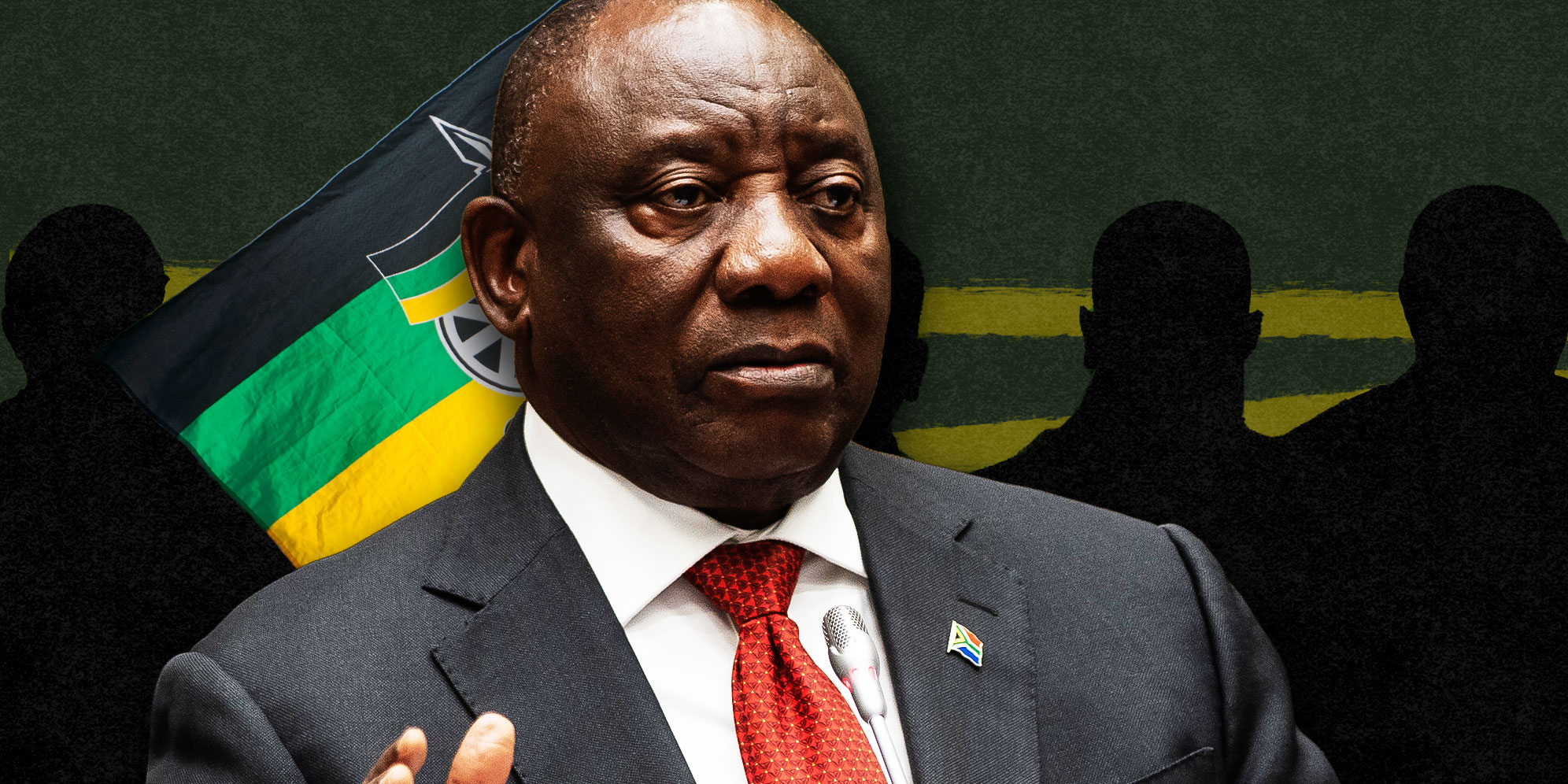
 Illustrative Image: President Cyril Ramaphosa. (Photo: Brenton Geach / Gallo Images) | ANC flag. (Photo: Thapelo Maphakela / Gallo Images) | (By Daniella Lee Ming Yesca)
 While President Cyril Ramaphosa projected confidence at this week’s ANC National General Council (NGC) and consolidated support, the meeting is the beginning of the end of his tenure in office.
This is because the ANC holds an elective conference in 2027, so he is winding down his term as party president.
To prevent two centres of power, in both party and state, or for other reasons, ANC presidents have not completed two terms. Nelson Mandela, famously, chose to quit after one.
So, talk turns to who comes after Ramaphosa: pollsters have taken the national pulse on the likely candidates named so far — two women have come into play, one name is too late for the first polls.
Soccer boss and business baron Patrice Motsepe has said he will not stand, but was included in the polls after suggestions that he could be persuaded.
/file/dailymaverick/wp-content/uploads/Becs-concert-patrice-option-01.jpg "Patrice Motsepe is the outlier candidate. (Photo Nic Bothma /EPA )")
The billionaire, who leads CAF (Confederation of African Football) and owns Mamelodi Sundowns, as well as a successful suite of businesses from mining to banking, is the outlier candidate, scoring five percentage points more than the deputy president, Paul Mashatile. Motsepe leads in a poll of general voters by the Social Research Foundation (SRF).
/file/attachments/orphans/who-should-replace-cyril_122795.jpg)
Among ANC voters, Mbalula got 15 percentage points more than Mashatile in the SRF poll.
Mbalula is also regarded a smidgeon more positively than Mashatile in an Ipsos poll from July/August, with Motsepe far more highly regarded than either Mashatile or Mbalula.
/file/dailymaverick/wp-content/uploads/2025/08/ED_567576.jpg "Fikile Mbalula is regarded slightly more positively than Mashatile in an Ipsos poll from July/August. (Photo: Luba Lesolle / Gallo Images)")
The Ipsos poll retained Cyril Ramaphosa to test positive regard, and he scored high among those who gave eight, nine or 10 points out of 10 to the named leaders.
/file/attachments/orphans/Public-Ratings-of-Political-Leaders_538227.jpg)
The ANC primary race has opened up, with Mashatile in, Mbalula in, and the electricity minister, Kgosientsho Ramokgopa, reportedly putting his hand up too. Because the ANC Women’s League wants a woman president, two veterans, the ANC deputy secretary-general, Nomvula Mokonyane, and the Speaker of Parliament, Thoko Didiza, are now being publicly mooted.
Ramokgopa is a popular choice among Daily Maverick readers because he led the campaign (with ample business support) to end load shedding. He has brought clarity and purpose to his role and is an excellent communicator. However, his approval numbers in the party and the public are low.
/file/dailymaverick/wp-content/uploads/2023/11/koeberg-2.jpg "Dr Kgosientsho Ramokgopa is a popular choice among Daily Maverick readers. (Photo: Darren Stewart / Gallo Images)")
Mashatile, an ANC lifer, has a mountain to climb from the numbers — especially if Mbalula throws his hat in the ring. The party’s secretary-general is an excellent campaign manager.
At 64, Mashatile is no longer a spring chicken and has planned for the top job throughout his political career. A master tactician with experience at provincial and national government, what counts against him is that he is an exemplar of the patronage politician, his lifestyle supported by a circle that has grown extremely rich from state tenders. That’s a high mountain to climb.
/file/dailymaverick/wp-content/uploads/2025/10/WhatsApp-Image-2025-10-30-at-15.37.42.jpeg "What counts against Deputy President Paul Mashatile is that he is an exemplar of the patronage politician. (Photo: Fikile Marakalla / GCIS)")
The ANC Integrity Commission (IC), the guardian of the party’s ethics, had Mashatile appear before it in 2025, and it has presented its findings to the National Executive Committee. These have not been publicly released.
In the organisational report to the NGC this week, the IC makes the point that: “While many leaders view their lifestyle choices as private, they remain public role models. Extravagant living contradicts ANC values and undermines moral authority. The IC recommends lifestyle audits from the President down to all office-bearers at national and provincial levels. The IC should process the results to avoid conflicts of interest.”
South Africa has among the world’s highest levels of women’s political participation, but the ANC (Africa’s oldest liberation movement) has never had a woman president. Didiza and Mokonyane are both emerging as candidates. In the party’s culture, nobody can publicly say they would like to give it a shot.
Read more: Nomvula Mokonyane champions women’s leadership in ANC ahead of presidential race
Ipsos only polled Mokonyane, and she has a long marathon ahead to build a profile — she received an aggregate score of 3.7 out of 10 for political leadership. Charismatic and hard-working, she has a constituency in Gauteng and the ANC Women’s League. But she is also seriously implicated by the Commission of Inquiry into State Capture in the Bosasa scandal.
/file/attachments/orphans/6I1A5328_664526.jpg "Nomvula Mokonyane was seriously implicated in the Bosasa scandal by the Zondo Commission. (Photo: Felix Dlangamandla)")
Didiza does not have an obvious constituency, and when the party tried to parachute her in as Tshwane mayor in 2016, it was a disaster. She is a reform candidate and a well-respected Speaker, so the party’s substantial renewal wing could support her.
/file/dailymaverick/wp-content/uploads/2022/12/MC-Agroecology_2.jpg "Thoko Didiza is a reform candidate and a well-respected Speaker. (Photo: Felix Dlangamandla / Gallo Images)")
The on-ice police minister, Senzo Mchunu, was in the ANC presidency race. But his alleged fund-raising with alleged crime kingpin Vusimuzi “Cat” Matlala and his implication as a major domo of a post-Zondo police capture network in the proceedings of the Madlanga Commission make his chances stillborn.
A smaller, sober-minded ANC
The NGC this week shows a sober-minded and much smaller ANC. The party now has just over 540,000 paid-up members in good standing — down from 1.4 million in December 2020, when former secretary-general Ace Magashule inflated membership numbers.
The party is finally following former president Thabo Mbeki’s dictum that a smaller ANC would be more powerful — born of the Leninist doctrine of Better Fewer, But Better — a call for higher quality party membership.
The party wants to win back its majority, but this is unlikely to happen.
More than 120,000 of the ANC’s members have undergone political education; the populism at conferences that was rife under former president Jacob Zuma is gone. The party has been chastened by its loss of a majority in 2024.
The NGC’s documents were replete with self-criticism like this: “The era of state capture (approximately from 2009 to 2018) saw an unprecedented erosion of state capacity and public trust [in the ANC].”
And this: “New corruption scandals still come to light regularly … procurement fraud … construction mafias … this ongoing corruption undermines services, cripples government capacity … and shatters social cohesion.”
And this: “[Our] core values and ethos — humility, selflessness, service to the people — were undermined by scandals of corruption and ill-discipline.”
It went on like this for hundreds of pages as the ANC warned the 1,650 delegates that the lights could go out if the party did not change its ways. This is the context in which the ANC heads into 2026, when it will fight another tough local election battle.
Data show that local elections tend to accelerate the party’s downward trend. A leading political analyst in the financial sector said the ANC is in decline but not in a death spiral. It has reached the end of its claim to be a representative of the people; many liberation movements that have turned into parties assume the mantle of being the people.
But gains in reforms of the energy market, green shoots in logistics (the reform of Transnet) and some by-election wins (the party fights each one like a battle), as well as the ability to keep paying a grant or providing a public work opportunity to well over half of all poor black households, could stem its spiral, said the analyst.
If a local election were held tomorrow, this is what an Ipsos in-house winter 2025 poll suggests may happen:
/file/attachments/orphans/who-would-you-vote-for_914892.jpg)
The DA’s internal polls show higher numbers, but the Ipsos poll is larger (3,600 individuals) and in-house. The DA and SRF polls are smaller, phone-based polls. Both are likely to change substantially by the time the local elections roll around, says Ipsos director Mari Harris.
The SRF’s Gabriel Makin says the meta-trend he sees is that the ANC is moving down to 40% while the DA is moving up to that level. Whoever becomes ANC president will need to be a deft coalition manager, as that form of government is South Africa’s near-term future. DM