




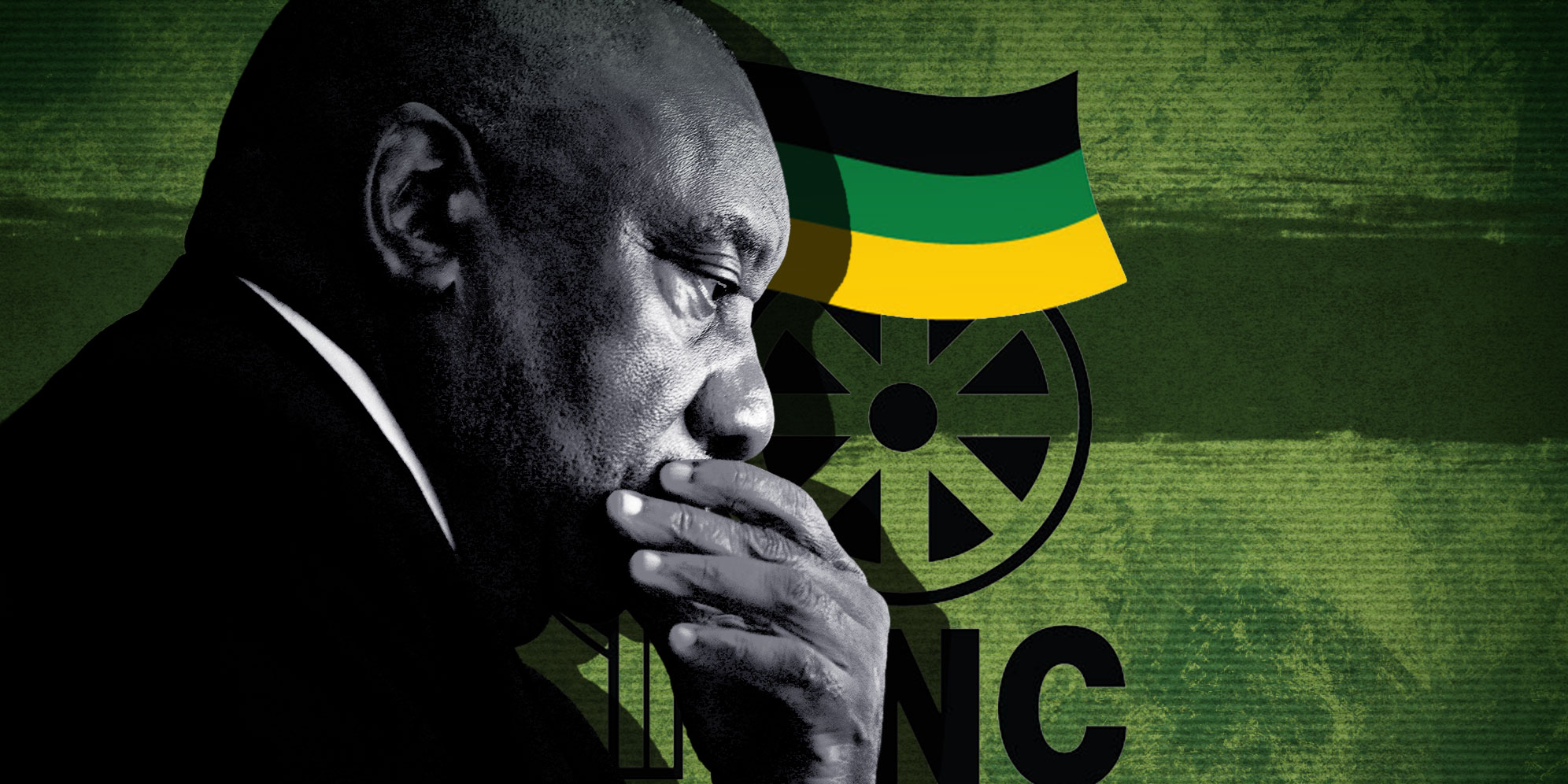
 Illustrative image: President Cyril Ramaphosa. (Photo: Gallo Images / ER Lombard) | ANC Logo. (Image: Wikicommons) | (By Daniella Lee Ming Yesca)
 President Cyril Ramaphosa has made no secret that the motif of his Presidency of the ANC has been to “renew” the party. He took office in 2017, promising to remove corruption and to change the way the ANC and its members behave.
The aim heading into the 2019 elections was to give voters the prospect of hope. He was saying to them that if they voted for the ANC, the ANC would change.
Now, nearly seven years later, voters want to see proof that the party is in fact changing.
This is what makes this National General Council (NGC) of the ANC so important. It is the party’s last chance before the local government elections to demonstrate that, in fact, it has changed.
The backdrop is not encouraging.
What renewal?
The past month has been dominated by the revelations of the Madlanga Commission and the Parliamentary ad hoc committee inquiry into corruption in the police (strangely, there has been complete radio silence from the other inquiry, by Parliament’s Intelligence Committee, which normally meets in secret).
In a twist that was probably unforeseen, this has ended up focusing on Ekurhuleni.
Imogen Mashazi, the former city manager there, has almost personified the problems in local government. She gave the strong impression that she was completely out of touch with reality and, in particular, the law.
Read more: Madlanga hearing told Ekurhuleni failed to act on metro police rape and corruption claims
The fact that someone could behave in such a manner is, in the end, only because of the ANC. It created the situation that allowed a person to behave like this, first in office, and then on the stand.
That she has displayed huge amounts of bling in the past is also an indication of how the ANC has run many municipalities. This presents itself as evidence of simple corruption.
Paul Mashatile
But perhaps the most important indicator that senior leaders in the ANC have not grasped how the world has changed comes from its deputy president, Paul Mashatile.
As News 24 reported this week, he has refused to give direct answers to a parliamentary question about why he received a diamond from Louis Liebenberg, who is accused of being at the centre of a Ponzi scheme.
Read more: Deputy President Paul Mashatile caught between luxury property, a shiny diamond and a hard place
When asked directly about his relationship with Liebenberg, Mashatile referred only to Parliament’s ethics committee (which found him guilty of not declaring the diamond as a gift) and then said, “Any further inquiries on this matter must be referred to the Acting Registrar of Members’ Interests”.
As is clear, this is not an answer at all. Instead, it is a deliberate attempt to duck the question.
It also follows Mashatile’s sudden declaration to Parliament that he does own a property in Constantia, Cape Town, worth R28.9-million.
While this has received some attention in the past few years, it will be nothing like what will happen if he is elected leader of the ANC.
To have a leader who has refused to answer a simple question about his relationship with an obvious criminal might well signal to voters that the ANC is not at all serious about renewal.
Ramaphosa’s options
Of course, there are ways for the ANC to come away from this NGC and immediately begin to send certain signals.
Leaders could line up behind Ramaphosa’s latest promise – and the party’s disciplinary machinery could suddenly start up. The Integrity Commission could even, finally, do something that results in the removal of some of its leaders from certain positions.
The liar Malusi Gigaba, for example, could be told to resign as an MP and from his position as Chair of Parliament’s Defence Committee.
David Mahlobo could be fired as Deputy Minister of Water Affairs and Sanitation.
But, sadly, none of this will happen. If it could, it would have by now.
And despite so many promises over the years, the Integrity Commission has done nothing of consequence in the past 20 years.
It is not going to change now.
That leaves it all up to Ramaphosa.
There are some things he could do.
The Madlanga Commission is due to give him an interim report next week. The fact that Ramaphosa has made it clear he wants regular interim reports suggests he wants ammunition on which to act before the final report is issued.
Depending on the contents of the interim report, Ramaphosa might well show that he is reclaiming the initiative and make major changes.
The ANC would claim this is proof that it is changing.
Enter the MK party
While it appears true that the ANC has not yet learnt the lessons of last year’s elections, the political field on which it plays might be about to change radically.
As so often happens in our politics, that change might come from KwaZulu-Natal.
Next week, the provincial legislature is due to vote on the uMkhonto Wesizwe party’s (MK party’s) no-confidence motion against the Premier, the IFP’s Thami Ntuli.
As Greg Ardé reports in Daily Maverick, the MK party may take over the provincial government there.
While that would be bad for the ANC in the short term, in the longer term, it could have the impact of re-energising our politics.
The debate would move from “has the ANC changed?” to “Is the ANC better than the MK party?”
The MK party is currently in turmoil (a brief and by no means exhaustive recap: its leader Jacob Zuma has fired his daughter for allegedly selling mercenaries to Russia and replaced her with another daughter; John Hlophe is on suspension; Colleen Makhubele has been reinstated as chief whip; and the party has had nine (that’s 9!) chief whips in KZN since July last year).
That chaos would almost certainly be replicated in the provincial government.
Considering how so many of the ANC’s problems come from that province, it might well suggest to voters that they should go back to the party.
In the longer run, though, on the evidence so far presented, the answer is clear.
The ANC has not learnt the lessons of last year’s election. It is likely to pay a heavy price as a result. DM