




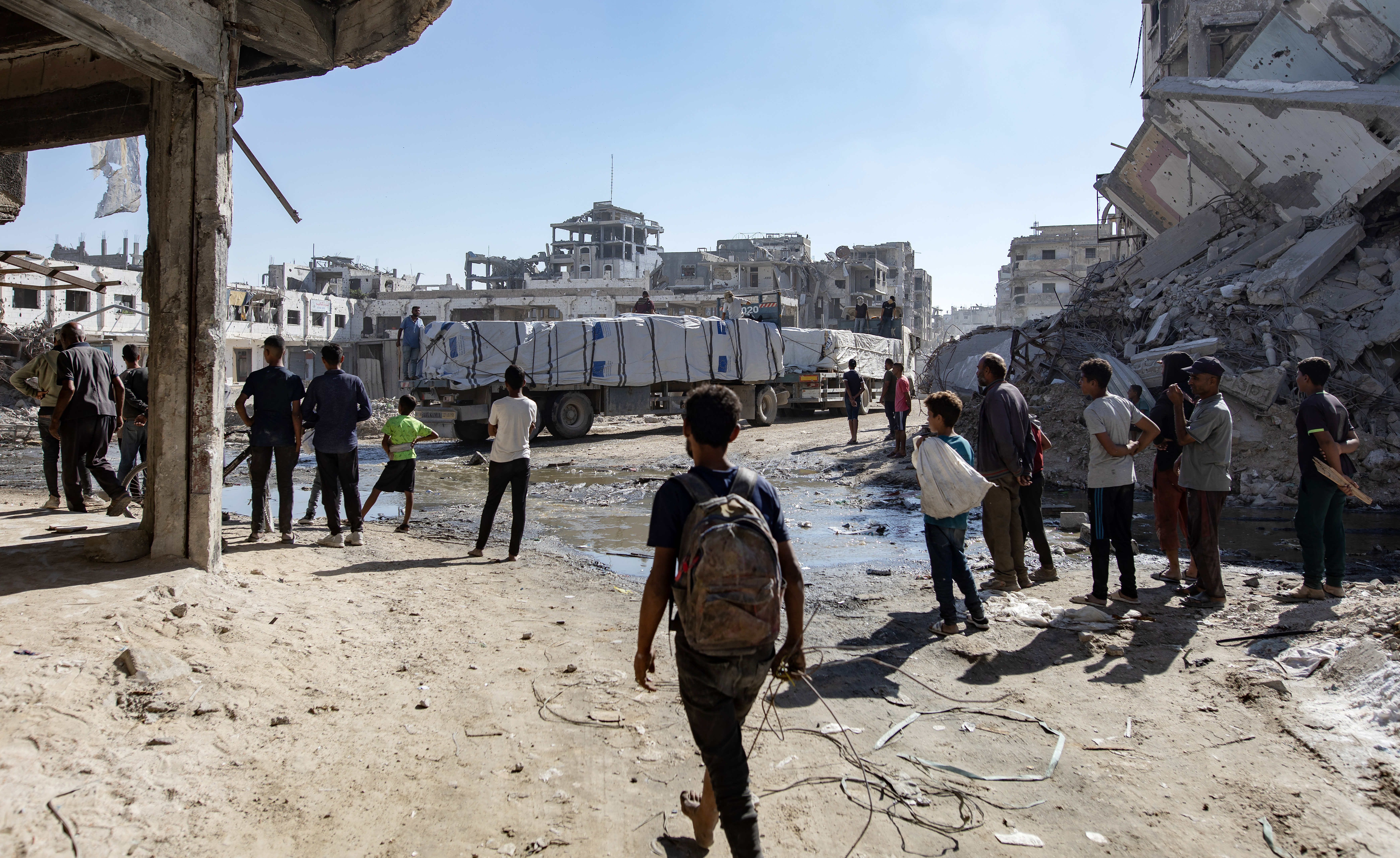
 Trucks carrying aid provided by the World Food Programme in Khan Younis, southern Gaza Strip, on 15 October 2025. (Photo: EPA / Haitham Imad)
 The United Nations’ (UN) top court said on Wednesday, 22 October that Israel is obliged, as an occupying power, to facilitate humanitarian aid to Palestinians in Gaza and ensure that the “basic needs” of the population are met.
“As an occupying power, Israel has obligations under international human rights law to respect, protect and fulfil the human rights of the population of the Occupied Palestinian Territory,” said International Court of Justice (ICJ) president Yuji Iwasawa, who read out the ruling on Wednesday afternoon.
“Restrictions on the provision of humanitarian aid that is indispensable for the wellbeing and dignity of the Palestinian population directly implicate these obligations,” he said.
The ICJ also found that Israel has an obligation to support the relief measures provided by the UN and its entities, including the UN Relief and Works Agency for Palestine (UNRWA), the main UN agency that aids millions of Palestinians.
Read more: World Court: Israel must allow UN aid to Gaza to ensure basic needs of Palestinians
READ HERE: The full text of the #ICJ Advisory Opinion on the Obligations of Israel in relation to the Presence and Activities of the United Nations, Other International Organizations and Third States in and in relation to the Occupied Palestinian Territory https://t.co/T5Ml4vSsuM pic.twitter.com/8ocEG13jq7
— CIJ_ICJ (@CIJ_ICJ) October 22, 2025
The order comes after the UN General Assembly requested an advisory opinion from the World Court in December 2024, on Israel’s obligations to allow the UN and other international agencies to provide humanitarian assistance in the Gaza Strip.
The request was in response to Israel’s decision to ban UNRWA from operating in its territories from January this year, as well as other obstacles faced by other UN agencies in their work in Gaza.
/file/dailymaverick/wp-content/uploads/2025/10/13450719.jpg "Yuji Iwasawa (left), president of the International Court of Justice, arrives during a non-binding ruling on the Israeli occupation of Palestinian territories in a courtroom in The Hague, Netherlands, on 22 October 2025. (Photo: EPA / Koen van Weel)")
The ban, passed by Israel’s parliament in October 2024, followed months of attacks on the agency by Israeli Prime Minister Benjamin Netanyahu and his allies, who claim UNRWA has been infiltrated by Hamas – an allegation the agency refutes.
The legislation forced UNRWA to suspend operations in Gaza and the West Bank.
On Wednesday, Iwasawa said the ICJ had found that Israel had “not substantiated its allegations that a significant part of UNRWA employees” were members of Hamas.
Read more: Legal opinion expected after ICJ concludes hearings on Israel’s aid obligations in Gaza
The ICJ said in its opinion that Israel should not “impede” UNRWA’s work or the work of other international organisations and third states in Gaza and the West Bank. It added that Israel “has an obligation to cooperate in good faith” with the UN, including UNRWA, “by providing every assistance in any action” it takes in accordance with the UN Charter.
South Africa was among the countries that argued before the ICJ in the case in April this year, with Department of International Relations and Cooperation (Dirco) director-general Zane Dangor telling the court that the collapse of the humanitarian aid system in Gaza was “by design”.
Reacting to the advisory opinion on Wednesday, Dirco spokesperson Chrispin Phiri told Daily Maverick: “The advisory opinion spells out the obligations in clear terms, and reiterates South Africa’s position that a real guarantor for regional stability is that, ultimately, the realisation of the right of the Palestinian people to self-determination, including [their] right to an independent and sovereign state.”
/file/dailymaverick/wp-content/uploads/2025/10/13444663.jpg "A humanitarian aid truck moves through the Rafah border crossing, between Egypt and the Gaza Strip, in North Sinai, Egypt, on 20 October 2025. Aid deliveries to Gaza have resumed since the ceasefire agreement between Israel and Hamas went into effect on 10 October 2025. (Photo: EPA / Stringer)")
Farhan Haq, the deputy spokesperson for UN secretary-general António Guterres, said at a press conference on Wednesday that Guterres welcomed the issuance of the ICJ opinion.
“The court emphasised the obligation of Israel to allow and facilitate humanitarian relief schemes by the United Nations, including by UNRWA, and other impartial actors, for so long as the population in Gaza remains inadequately supplied… That is the cooperation that we expect to have [with Israel],” said Haq.
‘Inadequately supplied’
The ICJ, in its opinion, noted that during the course of its military campaign in the Gaza Strip, Israel had “substantially restricted” – and between 2 March and 18 May 2025 “completely prevented” – the entry of aid into Gaza, with “catastrophic consequences” for Palestinians.
Read more: Many of my staff can’t work because they are starving, says Gaza City hospital director
In August, the Integrated Food Security Phase Classification declared that an “entirely man-made” famine was unfolding in Gaza City. More than 360 people, including 130 children, have died from starvation in the region, according to a report from Al Jazeera.
The ICJ found that Palestinians in Gaza were “inadequately supplied”, and reiterated that Israel cannot use “starvation of the civilian population as a method of warfare”. Additionally, it concluded that Israel’s use of the Gaza Humanitarian Foundation since May 2025, which was widely criticised by the UN and its agencies, did not significantly alleviate the dire situation in Gaza.
The 20-point ceasefire plan mediated by the US this month allows for 600 trucks of aid a day into Gaza, according to Al Jazeera.
Read more: There ‘must be no backsliding’ on Gaza ceasefire agreement — UN relief chief
On Wednesday, Haq said the UN and its partners have made progress “in scaling up our response efforts, especially in central and southern areas” of the Gaza Strip. However, he added that the continued closure of the Zikim and Erez crossings, “which provide direct access to the north, makes it extremely challenging for the UN and partners to reach people there”.
/file/dailymaverick/wp-content/uploads/2024/02/tori-ICJ-rafah-4-inset-1.jpg "Foreign Minister Naledi Pandor speaks to Zane Dangor, director-general of the Department of International Relations and Cooperation, before the International Court of Justice in The Hague, Netherlands, delivers an order on South Africa’s genocide case against Israel on 26 January 2024. (Photo: Michel Porro / Getty Images)")
Responding to questions from reporters, Haq said: “There is more aid going in… We need to have more crossing points open; we need to get more aid in… The cooperation [with Israel] has improved in recent days since the ceasefire, but much more needs to be done.”
Israel has dismissed the ICJ’s findings. Reuters reported that, in a post on X, Israel’s foreign ministry said it categorically rejected the court’s findings, saying: “Israel fully upholds its obligations under international law.” DM
Victoria O’Regan is a 2025 Dag Hammarskjöld Journalism Fellow whose reporting on the 80th UN General Assembly and its activities in New York has been sponsored by the Dag Hammarskjöld Fund for Journalists.