



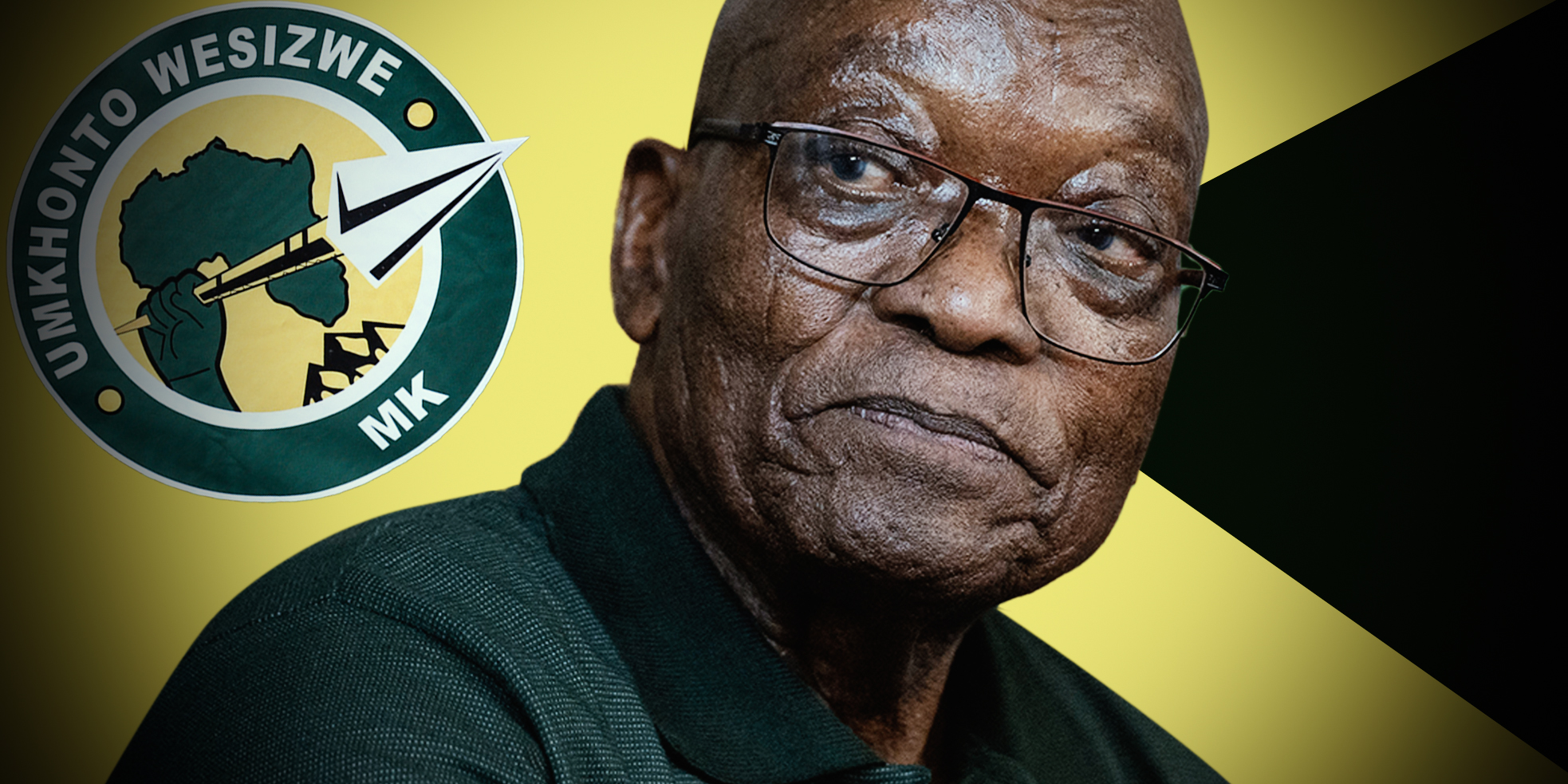
 Illustrative image | Former South African president Jacob Zuma. (Photos: Ihsaan Haffejee / AFP | Gallo Images / Fani Mahuntsi)
 Jacob Zuma’s announcement just before the holiday season that he would campaign and vote for the new uMkhonto Wesizwe (MK) party caught most by surprise. It was astonishing that a former leader of a governing party, one who still receives a state pension, VIP security and other benefits, would do this.
Also, it seemed inconceivable that a person who has divided our country for so long, and has so tarnished South Africa’s name (especially during the Zondo Commission hearings) could continue to play a political role — and be free to do so. Given that Zuma’s political generation is now well past pensionable age, it also seemed unlikely that he could still have a big influence with an entirely new formation.
However, it’s now emerged that the party was registered with the Electoral Commission back in September.
The fact that some of its events have been relatively well attended also suggests that there was an organisational effort already in place.
The date of the announcement, just before the holiday season, and its hosting at least one event in Mkhondo, Mpumalanga, soon before the ANC’s January 8th Statement in the province, helped the party grab a fair percentage of headlines during the past few weeks.
This is all evidence of effective strategic thought but still leaves unanswered the question of how much influence the party will have come election time.
Siyabonga Hadebe has argued in Business Day that Zuma may well address the aspirations of those for whom very little has changed since the end of formal apartheid. He suggests that even if uMkhonto Wesizwe does not win much support now, there will be more parties basing their programmes on addressing inequality.
In the Sunday Times, Sipho Singiswa predicted that Zuma will win strong support and suggested that the ANC under President Cyril Ramaphosa is now very weak.
While praising Zuma, Singiswa made no mention whatsoever of the corruption claims against him and the strong evidence that Zuma is guilty of corruption involving Schabir Shaik and the Guptas.
https://www.dailymaverick.co.za/article/2022-08-01-jacob-zuma-corruption-trial-predictably-postponed-again-with-concourt-appeal-decision-pending/
Consequences of Zuma’s rule
Life in South Africa has become harder in the past five years. Inflation is higher than it was, load shedding is more intense and violent crime has risen.
Zuma is likely to argue that this is all the fault of Ramaphosa, that despite all the available evidence, Ramaphosa bears responsibility for all the consequences of Zuma’s rule.
But in reality, it was while Zuma was president that corruption increased, the Guptas were able to steal billions, Eskom power stations were overused and Transnet was neglected. In short, the evidence shows it was during and often because of Zuma’s rule that the state was hollowed out to this extent.
Not for nothing did Ramaphosa refer to this time as “nine wasted years”.
And yet, just as many Americans believe President Joe Biden is responsible for the rising cost of living, so many voters here may believe their quality of life has declined because of Ramaphosa.
Also, the failure of the justice system and the National Prosecuting Authority to charge those responsible (including Zuma) for State Capture despite Chief Justice Raymond Zondo’s findings means that Zuma can argue he and his allies are innocent of wrongdoing.
There is a reason he and others always argue that the justice system is biased against them. They have been making the argument for so long that some voters may now believe it.
Ramaphosa has scored several own goals here, making him extremely vulnerable to attack.
First, despite the public evidence of how bad things are for so many people, he has done virtually nothing. He has refused to be assertive in dealing with government failures.
So weak is his government that he could not even use the ANC’s January 8th Statement event to promise better. Instead, he focused on the ANC’s track record over the past 30 years.
https://www.dailymaverick.co.za/article/2024-01-14-crushed-by-the-present-the-anc-will-rely-on-the-past-to-help-it-win-the-future/
And of course, the Phala Phala saga and the way the ANC used its parliamentary majority to defend Ramaphosa is an open door for attacks on the President. Zuma and his allies can argue that it is Ramaphosa who is corrupt and that he has been using US dollars to buy votes in the ANC.
Also, the ANC is organisationally weak at the moment, making it easier to organise against it.
However, there are still reasons to believe uMkhonto Wesizwe will not win many votes, at least outside of Zuma’s political heartland of KZN.
Even if it can organise against the ANC, it is unlikely that any new party would be able to compete nationally. The best-case scenario for Zuma would probably amount to a few pockets of strong support.
A well-informed electorate
At the same time, while life may have deteriorated for most people in SA over the past five years, the electorate has more access to political information than at any time in our history. Many voters will be aware of what happened, why and who was responsible.
The SABC and other broadcasters carried live testimony from the Zondo Commission, making sure that many people know what happened during the Zuma years.
This will make it difficult for Zuma to claim that he is not guilty of corruption and played no role in enabling it.
While he may argue that millions of people are still living a life defined by apartheid, it is obvious that he had the power to change much of this and did not. While he publicly proclaimed his support for land expropriation without compensation, he did not institute such a policy while President.
If he believes in radical change now, why did he do nothing during the nine years while he was President?
But perhaps the most important reason Zuma is unlikely to win much support is that he only ever became President because of the strength and organisation of the ANC while he was its leader. He took over a massive organisation that was controlling the resources of the entire government. For all of the time he was its leader, the ANC was more popular than he was.
Now, uMkhonto Wesizwe may be defined solely by Zuma’s image, which places a ceiling on its possible support, even in KZN.
However, that does not mean the party may not play a significant role at some point.
In an era where parties with one or two seats in a council can end up holding the mayoralty of a major metro, it is entirely possible that a party with just one or two seats in the National Assembly or a provincial legislature (such as in KZN) could hold the balance of power.
This presents a danger to the ANC — it might have to negotiate with a party controlled by someone who hates its current leader.
While this would complicate matters for the ANC, it is not evidence of a major shift in our politics.
Of course, much can still happen — more smallanyana skeletons could emerge about Zuma and the ANC could make more missteps — but it seems unlikely that uMkhonto Wesizwe can make a major change in our politics, whatever the party’s name will be by the time voters queue to cast their votes. DM