



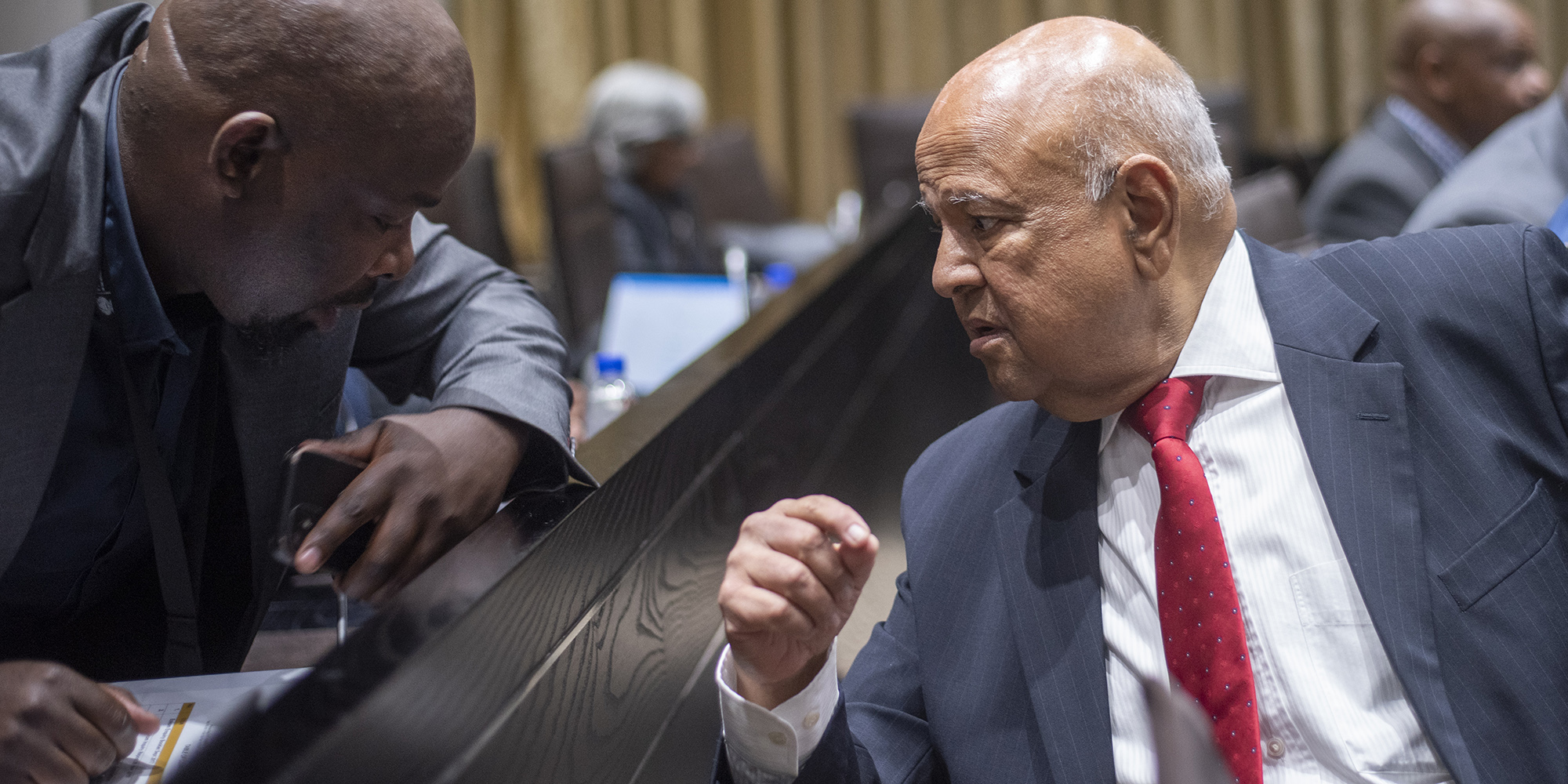
 Public Enterprises Minister Pravin Gordhan during the meeting of Parliament’s public spending watchdog, the Standing Committee on Public Accounts on Wednesday, 17 May 2023. (Photo: Gallo Images / Brenton Geach)
 Public Enterprises Minister Pravin Gordhan deftly sidestepped questions about:
- What he’d done when told the names of the “high-ranking politicians” involved in Eskom corruption – nothing, as “no evidence” was proffered;
- A privately funded intelligence investigation into corruption at Eskom – nothing, because he was only “told in passing” about it; and
- Pinpointing the whereabouts of that investigation’s report(s) – nothing, as much “other work” had to be done.
“Without tangible evidence that will withstand judicial scrutiny, there is no point speculating who these politicians may be... I am not going to smear the reputation of others without credible evidence and verifiable facts provided,” Gordhan told Parliament’s public spending watchdog, the Standing Committee on Public Accounts (Scopa), on Wednesday.
That included not approaching President Cyril Ramaphosa, who has told Parliament in person and in a written reply he had not been informed about the “high-ranking politicians” involved in Eskom corruption.
Read more in Daily Maverick: Gordhan must shed light on allegations of corruption at Eskom when he appears before Scopa
Instead, De Ruyter became the focus.
“That he [De Ruyter] signed [the CEO contract] as self-proclaimed champion of corporate governance and the only person in town who understands the role of various institutions and people,” only to contravene the confidentiality clause was noteworthy, said Gordhan.
“In no big institution like Eskom, or the private sector, would you have a CEO, who has left for whatever reason… writing chapter and verse about events that have been taking place in the company itself.
“[He’s] taken the country back to swart gevaar tactics by labelling all of us as communists, as people who are mindless, as people for whom the hammer and sickle must be drawn in our parking bays, which is the worst insult that anyone can cast on South Africans, who want this country to work, who want Eskom to work, who want load shedding to end and who want to mobilise capacity within Eskom, within government and within society in order to make sure the right things are done.”
Swart gevaar tactics were used by the apartheid regime in the 1980s as propaganda to stir white fears against black majority rule and to increase the repression of activists.
2024 on their minds
The often terse ministerial commentary about De Ruyter underscored how the ex-CEO’s statements, amid what’s now dubbed State Capture 2.0, hit a political nerve of the governing ANC.
The rolling blackouts that have left South Africans without power for up to 11½ hours a day come as the 2024 elections loom against the waning electoral fortunes of the party that has controlled national government since 1994. Ending the intensity and frequency of these scheduled power cuts is a top government priority for 2023.
And while Gordhan called for the depoliticisation of the public debate, the fact that a landmark election is at most 15 months away is sharpening the politicking on both sides of the House. Exchanging political barbs has been on full display during budget vote debates.
Essentially, the De Ruyter/Eskom saga is about politics – the politics of a governing ANC at odds with itself amid proclamations of unity, the politics of vested interests and factional jockeying paralysing the government, policy implementation and the governance of South Africa, which despite being the most industrialised country in Africa is the most unequal in the world.
On Wednesday, Gordhan told MPs he was shocked by the e.tv interview De Ruyter gave on My Guest Tonight in late February that sparked the pushback from the ANC, including litigation currently under way for the ex-Eskom boss to withdraw his remarks about the ANC benefiting from corruption at the state power utility.
De Ruyter has followed up with a book, Truth to Power: My Three Years Inside Eskom in which he elaborates on corruption and sabotage at the power utility, criticises key ANC policies like black economic empowerment, and writes about meetings and incidents at work.
Gordhan, who described De Ruyter as a “know-all” and as making out he’s the “only hero in town”, didn’t mince his words to MPs.
“This egotistical trip that he is on at the moment is not serving him or the country in any positive way. Any notion that he has that he is this messianic or heroic figure that is going to, on the one hand, condemn all of us, but on the other hand be the saviour, but also take rather old-fashioned ideological positions in relation to both my organisation [the ANC], but others as well, is a misplaced area of focus on his part.”
For its part, Eskom was to the point on De Ruyter’s book.
“Eskom will review the contents of the book and comprehensively respond at an appropriate time. We continue to focus on the task at hand to recover generation performance, reduce load shedding and turn the organisation around,” the power utility said in a statement on Monday.
‘Nothing new’
Throughout Wednesday’s Scopa meeting Gordhan held the line that De Ruyter’s claims about corruption were nothing new. It’s a political response right from the start of this saga that still struggles to sidestep questions about why more was not done sooner.
Over the past few years, Eskom has regularly issued reports about the arrests of contractors, employees and others, and the Special Investigating Unit has regularly reported to MPs about its Eskom-related cases, from conflicts of interest to coal contracts and more.
Read more in Daily Maverick: Much of De Ruyter’s corruption claims not new and response to them is political posturing
This “nothing new” line did not quite cover the lackadaisical attitude of the police, Hawks and prosecution services. Not after earlier Scopa engagements over De Ruyter’s claims showed the SAPS knew of the privately funded, intelligence-driven investigation by mid-2022, as did the State Security Agency and, according to the SAPS, the Hawks too, although they denied this.
Read more in Daily Maverick: SAPS knew of private Eskom corruption probe while significant portions of De Ruyter statements corroborated
That “nothing new” line was held when DA MP Benedicta van Minnen asked whether the minister wasn’t shooting the messenger.
“This is not this poor little guy that’s being attacked... He goes into personal descriptions of all sorts, I hear. I haven’t read the book. Is that necessary?” said Gordhan who, nevertheless, seemed to know quite a bit about it.
“If you are in charge, you are in charge... The buck stops with you. If you are in charge you must show some sense of responsibility. If you have not achieved your mission, show some sense of remorse. ‘I’m sorry South Africa. I tried my best. I couldn’t do better. That’s what was required.”
“You don’t go around making allegations against people. That’s character assassination to defend yourself and some would say that’s narcissistic behaviour at the end of the day.”
Like discrediting a purveyor of uncomfortable truths, humbling oneself is one of those ANC traditions that continue to define it. It’s the ground zero for rehabilitation back into the governing party’s ranks.
On Wednesday, Gordhan was steadfastly dismissive of what he called the De Ruyter project and told MPs he’d done all that was necessary for the state power utility.
“I stand totally opposed to corruption. Where it was within my scope or ability to assist Eskom to combat corruption, I have done so,” proclaimed Gordhan. DM