



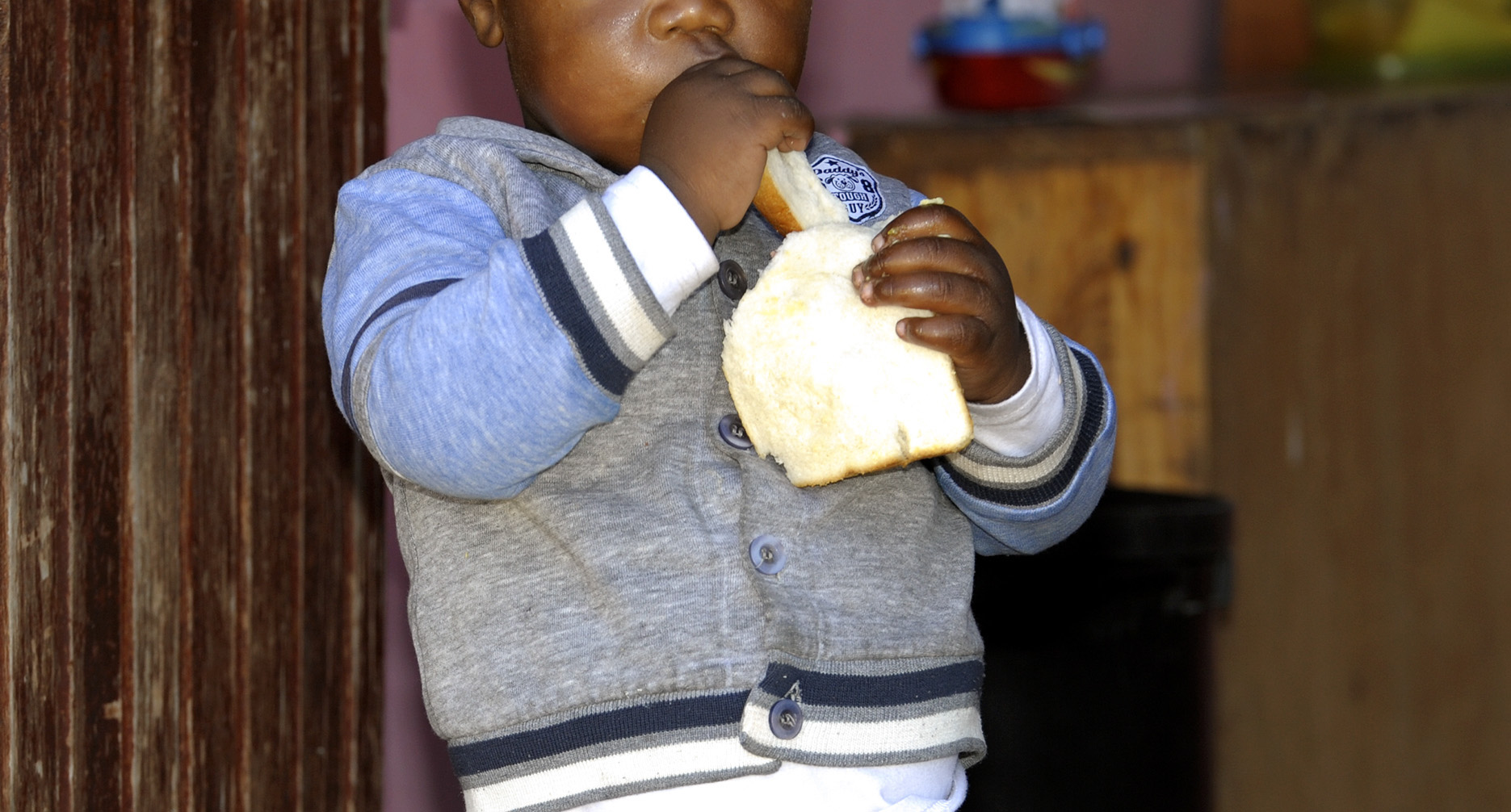
 A child has a dry slice of bread to mitigate hunger. (Photo: Joyrene Kramer)
Friday, 28 May is World Hunger day. This is part of a series of articles Maverick Citizen is publishing this week looking at the scale, impact and responses to hunger in South Africa: read others here, here and here. The articles will also be published in a special newsletter on Friday.
Food scientists and researchers explain how eating enough food, containing proteins, carbohydrates, fat, vitamins, minerals, fibre and water is essential for a normal, healthy, functional being. But the sad reality is that not everyone can afford food with the basic nutrition that their bodies need. This increases the risk of diet-related illnesses and restricts people, children especially, from reaching their full potential.
As revealed by the World Bank in a May 2021 update, in the past year the need for food grew more intense because of disruptions caused by the climate crisis coupled with the Covid-19 pandemic and high food price inflation.
In South Africa, media reports have revealed the shocking reality of what people are capable of consuming just to have something in their stomachs: sometimes stuff that is not normally considered food, or food that has no nutritional value.
A report by Groundup on the hunger situation in Peddie in the Eastern Cape tells of children eating wild plants to survive, as the pandemic and the lockdown took their toll. In another story, TimesLIVE revealed the plight of hungry children in the Richtersveld in the Northern Cape who eat river sand over weekends when they can’t benefit from school feeding.
In urban areas, people have other coping strategies.
/file/dailymaverick/wp-content/uploads/2021/05/Unconventional-Meal_3.jpg "Skopas are Johannesburg staple snack that helps keep the hunger at bay, at only one or two rands a pack. (Photo: Michelle Banda)")
In Johannesburg skopas are a staple snack keeping the hunger at bay at only one or two rands a pack. Di skopas or skopas, also known as di kip kip, are the sugary and colourful popcorn snacks that many consume as a substitute for a nutritious meal that they cannot afford. It’s sold at taxi ranks, spaza shops and vendor stalls.
Cynthia Makua, a resident from Alexandra, said skopas are a lifeline for her as sometimes it’s all she can afford to eat.
“I am old and frail and these,” she said, pointing at her pack of skopas, “don’t even keep me full, but at least I can afford them daily. When I still could afford food they were a snack, but now I consider them a meal — yet I would like to think my situation is better than others in the area where some have only water and nothing else.”
The five members of the Madlati family, living in Meadowlands Zone 5, Soweto, told Maverick Citizen about their diet. Ligea Madlati is a Mozambican citizen and mother of three. She said life is much better when they have a bag of maize meal, even without gravy to go with the pap.
/file/dailymaverick/wp-content/uploads/2021/05/Unconventional-Meal_1.jpg "A noodle meal and piece of bread Liego Madlati and her three sons shared on Saturday 22 May 2021. (Photo: Michelle Banda)")
Without any IDs it’s hard for Madlati and her sons to benefit from food parcels or social grants. Madlati said she, her husband and her son live with HIV, but without any access to nutritious food to accompany the medication, they are at risk of defaulting on it.
“My husband, I and our one son are on HIV medication and to take our ARVs we should have eaten a proper meal, which is often not at our disposal. Sometimes a handful of pap and salt is all we have once a day to boost our daily energy intake. On other occasions we have tea and uphuthu [a coarse-textured grainlike meal typically enjoyed with an accompaniment of vegetables and meat in KwaZulu-Natal and Eastern Cape, or as the star of the dish with amasi (sour milk) in Gauteng],” said Madlati.
“I take up any kind of job and on good days I can make R50 to buy a 5kg bag of mealie meal, which is a basic need in our household.”
The Covid-19 pandemic has exposed enormous food inequalities and injustices that have long existed, but are getting worse. The year before Covid, for example, research among primary school children and their mothers at a rural site in Limpopo (published by BMC Public Health) drew attention to the “double burden of malnutrition, with thinness among children and overweight/obesity among mothers”. It concluded that “the need to address the dual problems of undernutrition and rapidly rising trends of overweight/obesity cannot be over-emphasised”.
There’s a similar story in many other parts of South Africa as poor people wait for effective strategies to fulfil their right to “sufficient food” and basic nutrition for children, and coping strategies such as the ones described in this article are becoming increasingly common. DM/MC
Comments
Scroll down to load comments...