



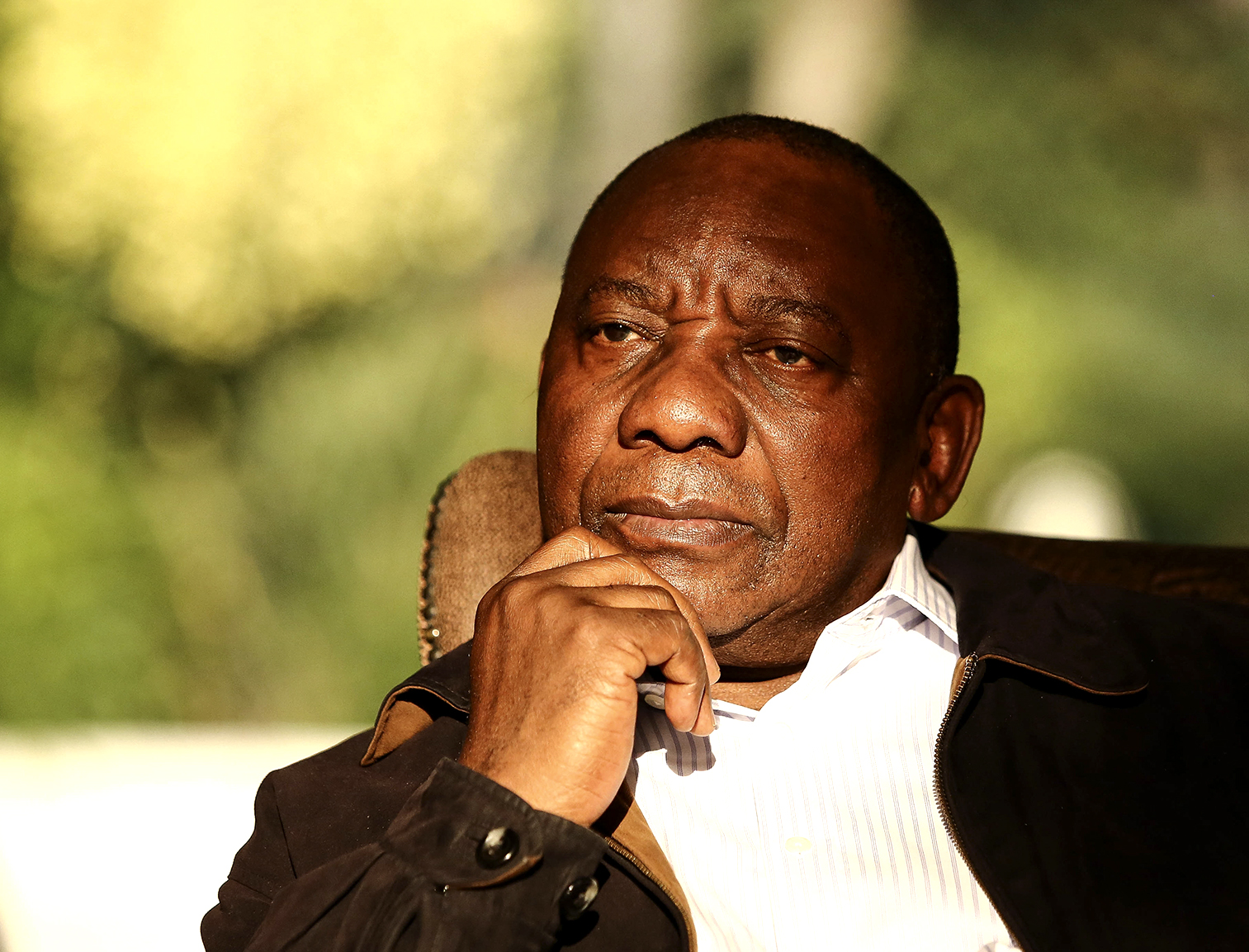
 South African Deputy President Cyril Ramaphosa poses for a portrait during an interview in Hyde Park on June 23, 2017 in Johannesburg, South Africa. Ramaphosa said the country needs sensitive and competent leaders to deliver to the needs of the people of South Africa. (Photo: Moeletsi Mabe/Sunday Times/Gallo Images/Getty Images)
 While the country awaits further details on the easing of restrictions to prevent the spread of Covid-19, President Cyril Ramaphosa visited the Nasrec Expo Centre in Johannesburg on Friday, which has been transformed into a temporary isolation site for people who cannot self-isolate at home.
The president inspected the beds installed in cubicles at the venue where he was elected ANC leader in 2017, a sobering reminder that while restrictions may be easing and more people will be allowed to go to work, the fight continues.
The virus will spread; there will be more fatalities. It’s now a balancing game.

Ramaphosa has announced that the country’s response to Covid-19 will move from Level 5 to Level 4, from “drastic measures” to “extreme precautions”, according to a government infographic.
It might be a welcome relief for those suffering from the lockdown's economic and social effects but many of the details are yet to be explained as the government continues to search for the balance between doing the most to prevent the spread of the virus and the least to harm the economy.
“Level 5 means that drastic measures are required to contain the spread of the virus to save lives,” said Ramaphosa on Thursday evening.
“Level 4 means that some activity can be allowed to resume subject to extreme precautions required to limit community transmission and outbreaks.”
Certain sectors of the economy can reopen come 1 May, with one third of employees at qualifying companies allowed to go back to work, but Ramaphosa, apart from saying cigarettes can be sold and people can exercise under strict conditions, deferred almost all details of the plan to his ministers.
Cooperative Governance and Traditional Affairs Minister Nkosazana Dlamini Zuma and Trade, Industry and Competition Minister Ebrahim Patel are due to brief the media on Saturday.

“The briefing will serve as the official launch of the Risk-Adjusted Strategy for public comment and consultation,” tweeted Government Communication Information Services on Friday.
Some of the lockdown regulations appeared to have been implemented on the fly (there’s hardly a textbook to follow). It appears the government now wants to capitalise on collaborations during the lockdown with political parties, the business sector and civil society to build buy-in and reduce potential legal challenges to the regulations.
“We will give all industry bodies an opportunity to consider these details and, should they wish, to make submissions before new regulations are gazetted,” said Ramaphosa.
There has been some indication of what will be permitted.
A draft risk-adjusted strategy presented to decision-makers this week said that under Level 4, food retailers would be able to sell a full line of products within existing stock. It’s unclear whether that might include alcohol.
Sectors permitted to operate, in addition to those already considered essential services, would include all financial and professional services, global business services for professional markets, postal, telecoms, fibre optic sectors, and formal waste recycling businesses.
The draft plan said open-cast mines could operate at 100% and other mines at 50%. These are, of course, subject to change.
There has been no indication of when schools might reopen. “The relevant ministers will provide details on the process for the phased reopening of schools and other educational institutions,” said Ramaphosa.
Basic Education Minister Angie Motshekga and Higher Education, Science & Innovation Minister Blade Nzimande are set to hold a media briefing on Monday.
Regulations could be applied differently in different parts of the country. Metros like Johannesburg, Cape Town and eThekwini have seen a high number of infections and are high-risk due to their population densities while some areas are, for now, low-risk.

“To ensure that our response to the pandemic can be as precise and targeted as possible, there will be a national level and separate levels for each province, district and metro in the country,” said Ramaphosa.
“The National Coronavirus Command Council will determine the alert level based on an assessment of the infection rate and the capacity of our health system to provide care to those who need it,” he added.
Assessments of infection rates will be determined by the proportion of the population tested and the proportion of positive results. Health system capacities depend on the number of hospital beds added and the usage of available beds.
DA leader John Steenhuisen welcomed the phased reduction of regulations but said more details are needed around the plan before he comments further.
“It is important to establish absolute certainty around this new phased approach, and so the details must be clear and unambiguous. We cannot have the issue muddied by conflicting statements from various ministers,” he said.
EFF spokesperson Vuyani Pambo also said the party’s response was limited while ministers were expected to explain further details before Level 4 is implemented. He warned against reopening sectors of the economy if it wasn’t supported by scientific data.
“The government should not bend at the altar of capitalist greed because the measures put in place thus far will be reversed in a short period of time,” said Pambo, also calling for a clear plan on education. DM