



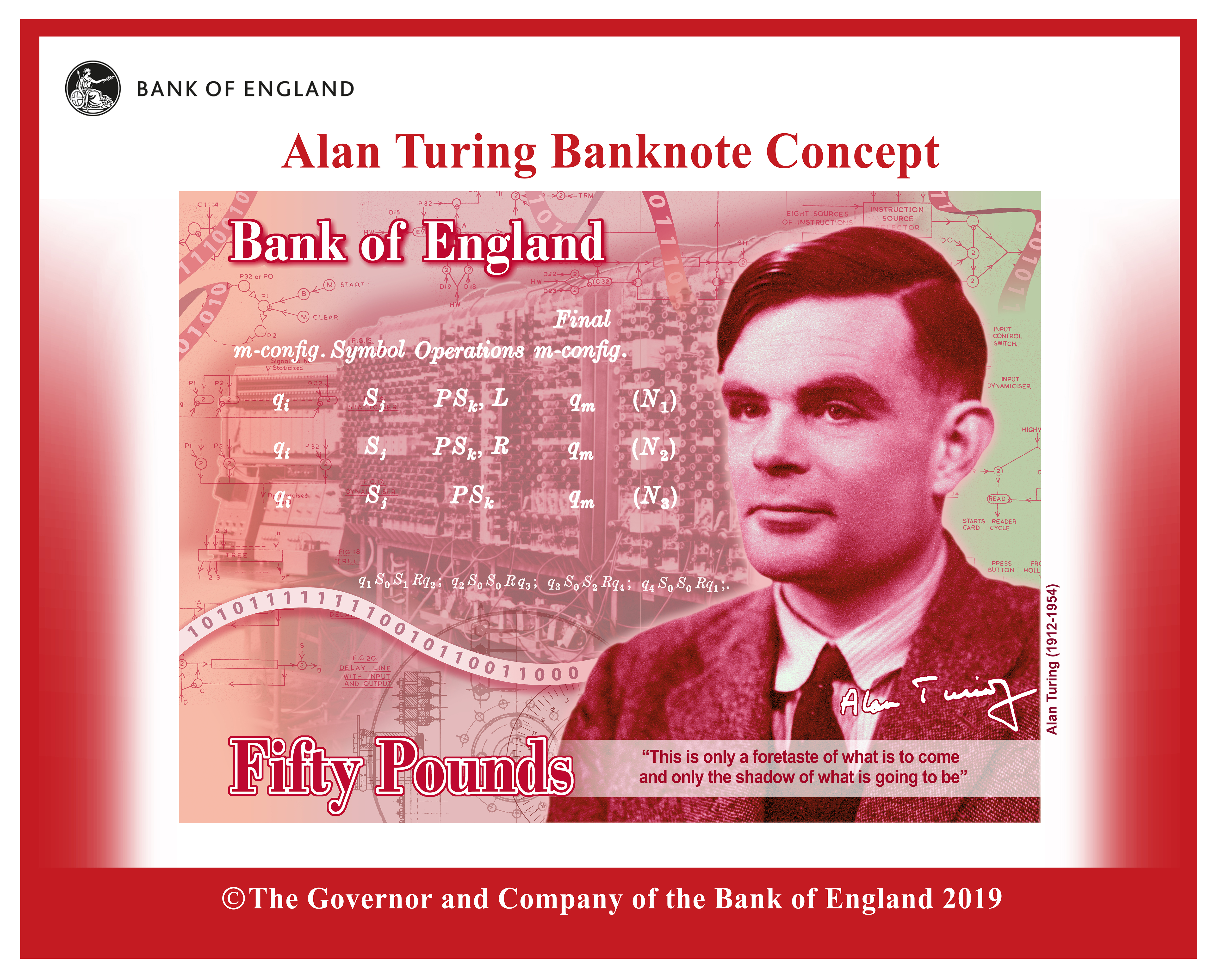
 epa07718246 An undated handout photo made available by the British Bank of England on 15 July 2019 showing the new concept image design of the Bank of England's 50 GBP note featuring British computer pioneer and codebreaker Alan Turing. Bank of England Governor, Mark Carney, announced that Alan Turing will appear on the new polymer note. Alan Turing was an outstanding mathematician whose work has had an enormous impact on how we live today. As the father of computer
science and artificial intelligence, as well as war hero, Alan Turing?s contributions were far ranging and path breaking. Turing is a giant on whose shoulders so many now stand.?
Alan Turing provided the theoretical underpinnings for the modern computer. While best known for his work devising code-breaking machines during WWII, Turing played a pivotal role in the development of early computers first at the National Physical Laboratory and later at the University of Manchester. EPA-EFE/BANK OF ENGLAND / HANDOUT MANDATORY CREDIT HANDOUT EDITORIAL USE ONLY/NO SALES
epa07718246 An undated handout photo made available by the British Bank of England on 15 July 2019 showing the new concept image design of the Bank of England's 50 GBP note featuring British computer pioneer and codebreaker Alan Turing. Bank of England Governor, Mark Carney, announced that Alan Turing will appear on the new polymer note. Alan Turing was an outstanding mathematician whose work has had an enormous impact on how we live today. As the father of computer
science and artificial intelligence, as well as war hero, Alan Turing?s contributions were far ranging and path breaking. Turing is a giant on whose shoulders so many now stand.?
Alan Turing provided the theoretical underpinnings for the modern computer. While best known for his work devising code-breaking machines during WWII, Turing played a pivotal role in the development of early computers first at the National Physical Laboratory and later at the University of Manchester. EPA-EFE/BANK OF ENGLAND / HANDOUT MANDATORY CREDIT HANDOUT EDITORIAL USE ONLY/NO SALES The mathematician was chosen from almost 1,000 eligible nominations from the field of science suggested by the public, Bank of England Governor Mark Carney said at an event in Manchester, U.K. on Monday.
“Alan Turing was an outstanding mathematician whose work has had an enormous impact on how we live today,” Carney said. “Turing is a giant on whose shoulders so many now stand.”
Other names on the shortlist for the note included Stephen Hawking, Ada Lovelace and Charles Babbage, and Mary Anning.
Turing -- played by Benedict Cumberbatch in a 2014 movie about his life -- was best known for his work devising code breaking machines during World War II and later helped develop the first computers. His work on the question of whether computers can think laid the foundations for AI.
The decision follows a campaign for more diversity on the U.K. currency. Turing, who was convicted for gross indecency for his relationship with a man, was chosen from a shortlist of nine men and four women. He was pardoned posthumously in 2013.
The new polymer note, Britain’s highest denomination in circulation, is set for release by the end of 2021 and the concept design unveiled by Carney featured a photograph of Turing taken in 1951. A table and mathematical formula from his academic work, a picture of an early digital computer, binary code, and a quote from Turing are also included. DM