




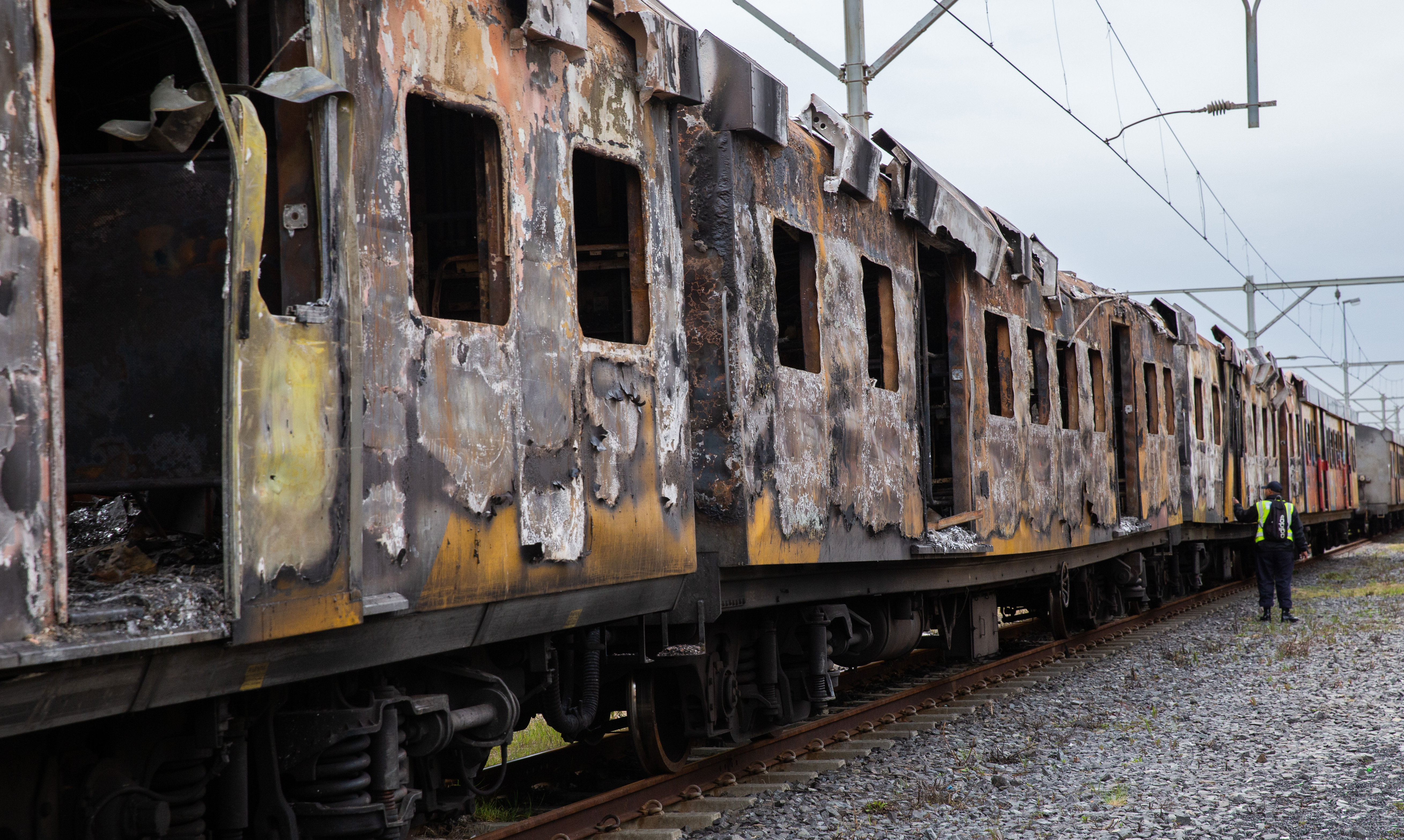
 Burnt out trains at the Paarden Eilend Depot in Cape Town, 27 July 2018, Ashraf Hendricks/GroundUp
/file/dailymaverick/wp-content/uploads/SUNE-Felicity-Purchase-1.jpg "Felicity Purchase, Cape Town Mayco Member for Transport and Urban Development. Photograph taken on 23 November 2018 in Cape Town by Hlumela Dyantyi.")
“I grew up using the train. We used the train to go to school,” said Felicity Purchase, new City of Cape Town mayco member responsible for Transport and Urban Development.
Speaking with a sense of urgency, Purchase said she and her team had already begun “significant amount of work daily to orientate ourselves with various issues”.
When Daily Maverick visited her just days into her job, her office in the city centre was still bare as she moved boxes into the Cape Town Civic Centre.
Before being appointed as a mayco member in November, she was a ward councillor in Cape Town’s “deep South” region — Ward 69 — which includes Noordhoek, Masiphumelele and Kommetjie. But this isn’t the veteran councillor’s first stint as part of a mayoral committee — under Dan Plato’s previous mayorship between 2009 and 2011 she was responsible for the Tourism and Economic Development portfolio.
Purchase was named into Plato’s mayco after the resignation of former mayor Patricia de Lille. She takes over the portfolio of transport and urban development after predecessor Brett Herron resigned from the DA a day after De Lille resigned.
The conversation quickly shifted to the biggest transportation problem in the city: The rail crisis. Talking about the train service, Purchase said:
“I want to see it safe, clean and reliable — that is my biggest desire.”
Drawing on her childhood experience — Purchase said she relied on public transport while growing up in the “deep south” of Glencairn and later in St James — areas in Cape Town’s southern peninsula often only accessible by trains or cars.
As teenagers, she and her friends would “take the train to the bioscope [cinema] in Muizenberg and come back at 12:03 on the last train — and it was safe. She said her parents were not worried about her safety on the train. That’s what she hoped parents could feel about their children commuting by train in Cape Town today.
“I would want every parent to feel their child is safe, and the elderly,” says Purchase. She would like to see a train system where people could feel safe enough to take out their laptops and cellphones while commuting — something which is presently risky.
In her adulthood, she continued to commute by train until a recent incident that deterred her.
“I stopped using the train when the train broke down and [the trip] took three hours.”
But would she take a train on the notorious Central Line at peak hour soon, like her predecessor Herron did in November 2017?
Cape Town’s Central Line serves Khayelitsha, Mitchells Plain and through to areas such as Nyanga and Bonteheuwel, which had seen the most reports of train delays. Presently, because of a limited service, there is only one train operating every 60-90 minutes during peak hour between the Cape Town station and Khayelitsha.
Train services on that route have been grappling with vandalism, arson and a general neglect of stations that have left commuters vulnerable to criminal attacks. Richard Walker, Metrorail Western Cape Regional Head said in October that the line was only at 25% capacity. This places an additional burden on the city’s taxi and bus system from commuters finding alternative transport.
Purchase told Daily Maverick she was not in a position to test the Central line now, citing bronchitis. She would, however, be prepared to board a train in the new year.
One of the biggest problems for the city’s rail network is arson attacks — there were 13 incidents in September. A major attack occurred during a meeting between Passenger Rail Agency of South Africa (Prasa) officials and Parliament’s portfolio committee on transport in October.
There had been 167 arson attacks on rail infrastructure in the city since 2015, said Metrorail spokesperson Riana Scott at the time. Additionally,there were 745 reported incidents of fires nationally, according to the Railway Safety Regulator State of Safety Report 2017/2018.
The question: Is Purchase up for the challenge of leading a team in a city facing severe problems on a notorious rail network that has been labelled as “atrocious” and is crippled by arson attacks, vandalism and cable theft?
“I feel excited because there’s a lot of positive things I can do,” said Purchase. She would continue where Herron left off, meeting players in the public transport industry, especially the rail industry, such as Prasa — which is ultimately responsible for Metrorail train services — and the Western Cape provincial government.
“I have a good working relationship with the province,” said Purchase, who told Daily Maverick that she was due for her first meeting with Prasa provincial officials within days of the interview.
A new rail unit was launched in October — a joint venture between Prasa, the City and the provincial transport department to combat not only rail crime, but protect Prasa rail infrastructure and assets.
Speaking about the tendency of politicians — from both her party, the DA, and also the ANC —to use the rail service to score cheap points, Purchase told Daily Maverick: “Party politics is not really useful at this time — I want to get the job done.”
For instance, when the unit was formed there were allegations that the breakdown of Cape Town’s rail industry was trapped in a blame game between the City and the provincial and national governments.
Declaring her passion for trains as a concluding statement during the interview, Purchase said she looked forward to forging relationships with “like-minded people” for the benefit of service delivery. DM
Felicity Purchase quick quotes
Train vandalism: “There has to be zero tolerance. People must understand this is their infrastructure.”
During a presentation to Parliament’s portfolio committee on Transport in October, it was revealed that 1,519 coaches had been lost nationally to vandalism during 2017/2018. The Western Cape accounted for 44% of this figure.
Working class commuter costs: “People are paying... 43% of their income on public transport — it is not sustainable… If people were closer to their work — if they could jump into one bus or train — it would be far more economical for them.”
The state of the City: “The City is doing well. The City is in a good space. There have been challenges in the past 18 months.”
The taxi industry: “We need to get back to a law-abiding space with the taxis.”
Sentiments that the DA is anti-black, anti-poor: “[This accusation is] used by political opponents to make themselves look better… I don’t buy into that and give it energy.” DM
Comments
Scroll down to load comments...