



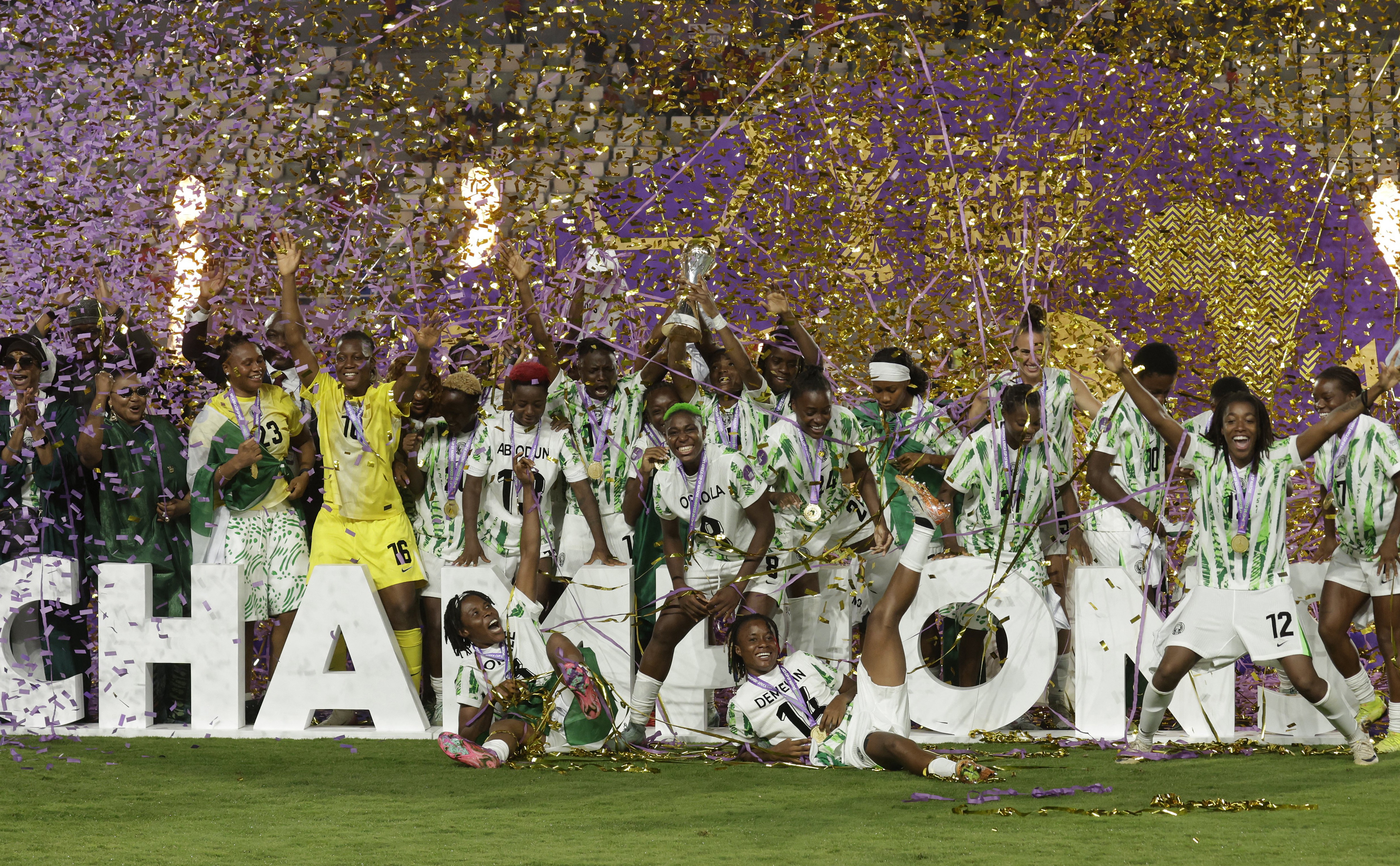
 Nigeria must now wait until July 2026 to begin their Women's Africa Cup of Nations defence after the tournament was postponed two weeks before its scheduled start in Morocco. (Photo: Abdel Majid Bziouat / AFP)
Well, the worst-kept secret in soccer is finally out. The 2026 Women’s Africa Cup of Nations (Wafcon) has been postponed. The official confirmation came less than two weeks before the scheduled start of Africa’s premier women’s soccer competition.
On Thursday, 5 March, the Confederation of African Football (Caf) released a vague statement announcing that instead of the originally stated dates of 17 March to 3 April, Wafcon will now be held from 25 July to 16 August.
“In October 2024, Caf granted the hosting rights for the Women’s Africa Cup of Nations 2026 to Morocco and this tournament was scheduled for 17 March – 3 April 2026,” Caf said.
“After discussions between Caf and its partners, Fifa and other stakeholders, Caf decided to reschedule the dates of Wafcon 2026 to 25 July – 16 August 2026; to ensure the success of this important women’s competition, in the light of certain unforeseen circumstances,” the custodian of African soccer stated.
“Preparations for Wafcon 2026 are under way and all the parties are confident that it will be very successful.”
/file/attachments/orphans/TL_2499393_843633.jpg "The Confederation of African Football, headed by Patrice Motsepe, issued a vague statement explaining the postponement of the 2026 Women’s Africa Cup of Nations. (Photo: Mahugnon Leopold Soglo/Gallo Images)")
Caf’s disrespect
Considering that a number of teams that qualified for the tournament were already in camp preparing for participation in the biennial soccer spectacle, to say that the Caf announcement is vague is a gross understatement.
If anything, the way Caf has conducted itself has been highly disrespectful towards all those involved in women’s soccer. Its modus operandi has been silence.
Speaking on Radio2000’s Game On two days before Caf’s official announcement, Banyana Banyana coach Desiree Ellis expressed her frustration at the lack of communication with teams in light of rumours that the event would be postponed.
/file/attachments/orphans/B26BXPL0726_740965.jpg "Banyana Banyana coach Desiree Ellis and her team have been in camp preparing for the 2026 Women’s Africa Cup of Nations. (Photo: Phakamisa Lensman / BackpagePix )")
“We are all in the dark. We only know what we see on social media and what we hear in the news. If someone is listening, if they can just give us a yes or no,” Ellis said.
“It’s not really fair. I’m just going to raise one question. Would this happen in the men’s game? How do you prepare? How do you get everything sorted out in two weeks?”
Unprecedented postponement
As to Ellis’s question about whether the Africa Cup of Nations (Afcon) and Wafcon get the same treatment, the answer is no. Granted, Wafcon is not the first Caf-sanctioned tournament to not proceed as scheduled.
But in the case of Afcon, there’s always been sufficient notice, months not weeks, when it comes to changes such as this.
That was the case when the world virtually came to a standstill during Covid, with the 2021 edition in Cameroon moving to 2022. The announcement of this postponement was made in June 2020, and the reasoning was there for all to see, with movement in the world restricted because of the pandemic.
/file/attachments/orphans/B26ARNZ1597_497301.jpg "The Confederation of African Football has previously moved around tournaments, whether the host country or dates. But that has never happened two weeks before a major tournament. (Photo: Nokwanda Zondi / BackpagePix)")
Other delayed editions of Afcon had a sufficient heads-up for participating teams.
The only short-term notice came ahead of the 2015 Afcon, when Morocco landed Caf in a similar predicament to the 2026 Wafcon. Even then, the teams were given a two-month working room.
In October 2014, three months before before Afcon was scheduled to start, Morocco requested a postponement after an Ebola outbreak in West Africa.
Caf moved swiftly and heavy-handedly, stripping Morocco of the hosting rights and handing the tournament to Equatorial Guinea instead. The timelines remained intact, and the tournament kicked off in January 2015 as scheduled, unlike the 2026 Wafcon postponement.
McKenzie’s Morocco criticism
In February, the South African sports ministry confirmed that it had been approached by Caf as a possible replacement for Morocco, which had hosted the last two Wafcons. But Morocco will remain hosts of the 2026 edition, and only the date is being postponed.
Speaking to journalists at a press conference on Wednesday, 4 March, South Africa’s sports minister, Gayton McKenzie, expressed his frustration at Caf’s silence and the lack of clarity surrounding the tournament.
“We must not be scared to ask difficult questions that many people are thinking, but are not willing to say out loud. Are we now all going to suffer because Senegal won the men’s Afcon? If Senegal lost that Afcon final, would we still be sitting with this uncertainty?”
He also accused Morocco of holding Caf hostage because of the events surrounding the emotionally charged 2025 Afcon final between Morocco and Senegal, which the latter won 1-0.
/file/attachments/orphans/B26A4SS0220_146618.jpg "Gayton McKenzie, the South African Minister of Sport, Arts and Culture, has accused Morocco of trying to make Confederation of African Football boss Patrice Motsepe look bad. (Photo: Samuel Shivambu / BackpagePix)")
“At the moment, there remains significant uncertainty about the tournament schedule, with very little time remaining before it is expected to take place,” McKenzie said. “We have more clarity about games being planned in villages in Limpopo than about the premier women’s football tournament on our continent.”
“This is unfair to the teams preparing to compete, to the federations trying to plan, and most importantly to the women who have dedicated their lives to the sport,” the minister added.
“We must not be scared to ask difficult questions that many people are thinking, but are not willing to say out loud. Are we now all going to suffer because Senegal won the men’s Afcon? If Senegal lost that Afcon final, would we still be sitting with this uncertainty?” McKenzie asked.
“Let me be clear, it was a great match. But Morocco must accept that a game of football is just a game at the end. Sometimes you win, sometimes you lose.”
A source close to the matter previously told Daily Maverick that the tournament was unlikely to be moved from Morocco, adding that the drama appeared to have been caused by the flexing of muscles in the Caf boardroom. DM
Comments
Scroll down to load comments...